
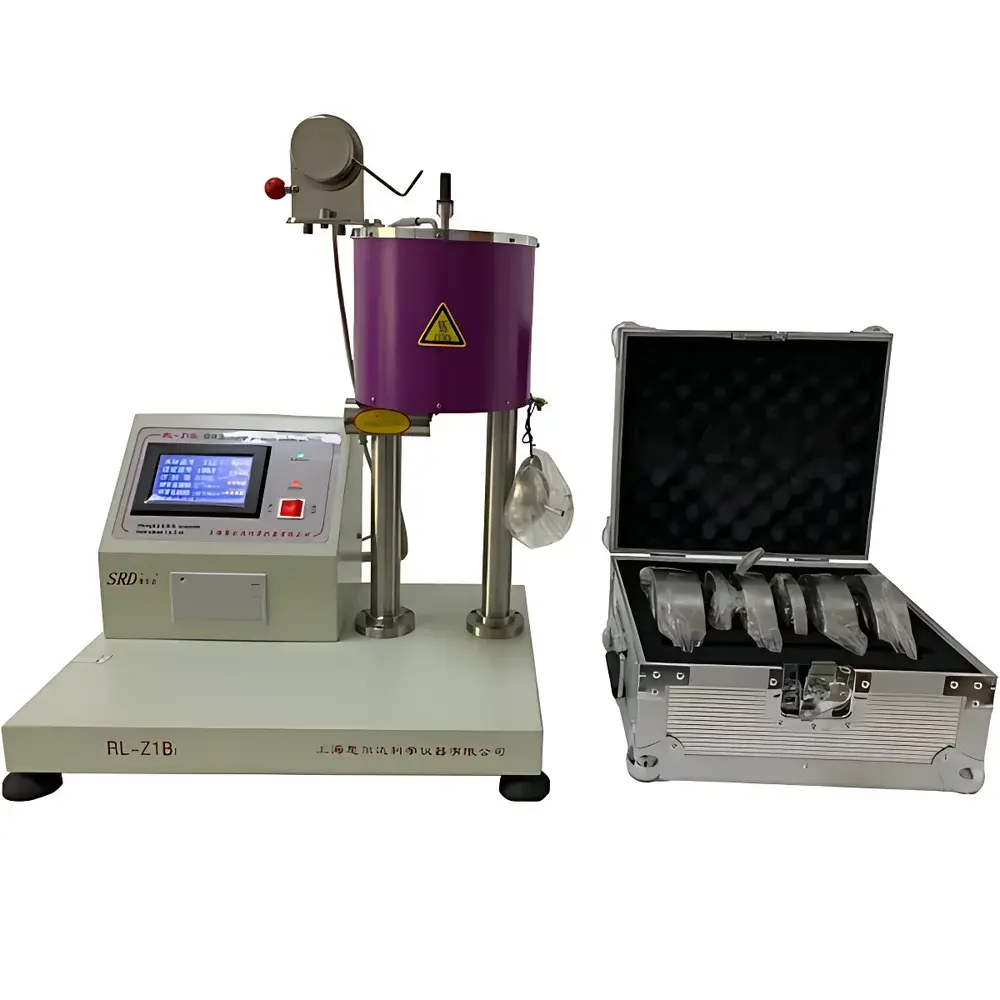
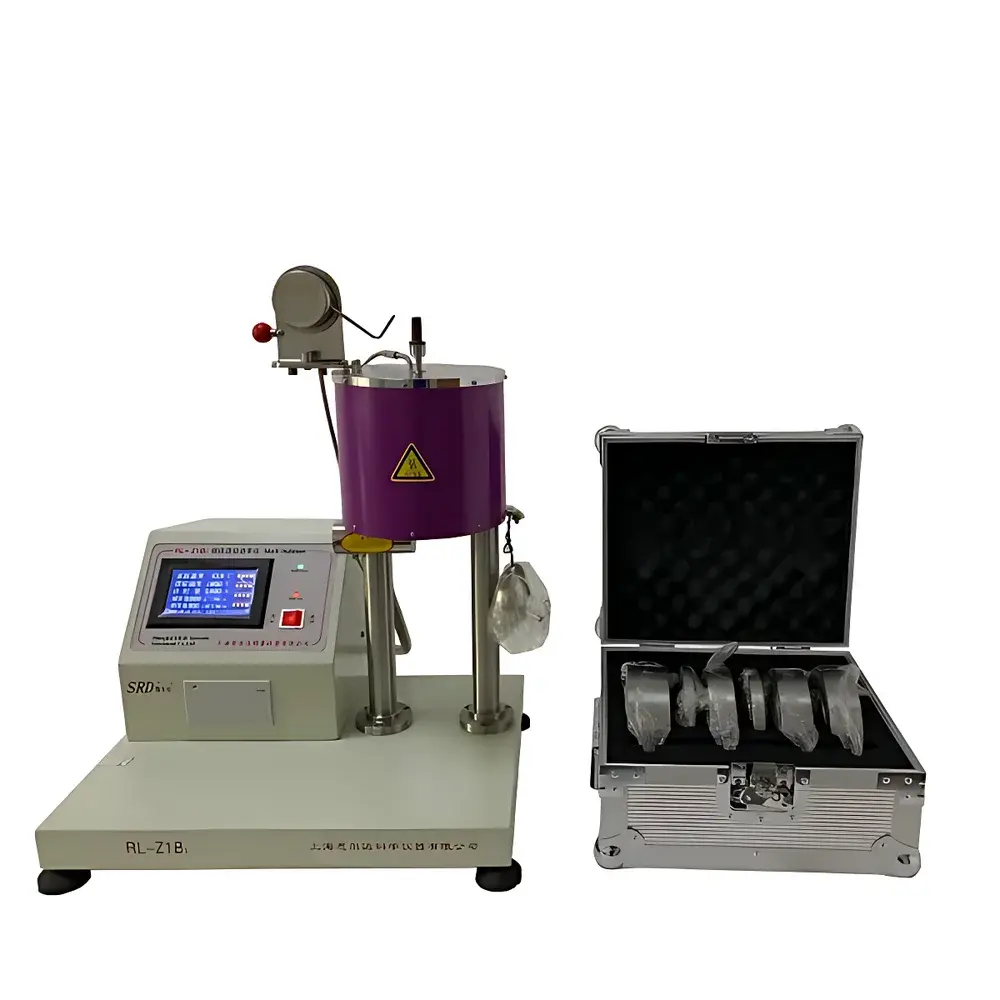
SRD RL-Z1B1- Corrosion-Resistant Melt Flow Indexer
| Brand | SRD |
|---|---|
| Origin | Shanghai, China |
| Model | RL-Z1B1- |
| Temperature Control Range | 100–400 °C |
| Temperature Display Accuracy | < 0.1 °C |
| 8-Hour Temperature Stability | < 0.10 °C |
| Temperature Recovery Time | ≤ 4 min |
| Standard Die Orifice Diameters | Φ2.095 ± 0.005 mm and Φ1.18 ± 0.01 mm |
| Available Test Loads | 325, 1200, 2160, 3800, 5000, 10000, 12500, 21600 g |
| MFR Measurement Range | 0.01–9999 g/10 min (automatic mode) |
| Power Supply | 198–242 V AC, 50 Hz, 3 A |
| Dimensions (W×D×H) | 520 × 380 × 730 mm |
| Net Weight | Main Unit 40 kg, Weight Set 22 kg |
| Compliance | ASTM D1238, ISO 1133, GB/T 3682 |
Overview
The SRD RL-Z1B1- Corrosion-Resistant Melt Flow Indexer is a precision-engineered instrument designed for the quantitative determination of melt mass-flow rate (MFR) and melt volume-flow rate (MVR) of thermoplastic polymers under standardized thermal and mechanical conditions. Based on the fundamental principle of extrusion plastometry—where molten polymer is forced through a calibrated capillary die under controlled temperature and applied load—the RL-Z1B1- delivers high reproducibility in compliance with international test standards including ASTM D1238, ISO 1133, and GB/T 3682. Its distinguishing feature lies in its corrosion-resistant construction: critical wetted components—including the barrel, piston, and die—are fabricated from high-performance alloys originally developed for aerospace turbine applications, enabling reliable testing of highly aggressive fluoropolymers such as FEP (F46), PFA, ETFE, and other fluorinated resins that generate hydrofluoric acid at elevated processing temperatures.
Key Features
- Corrosion-resistant barrel and die assembly using aerospace-grade alloy materials, certified for extended service life in fluoropolymer testing environments
- Microprocessor-based control system with real-time PID temperature regulation, achieving ±0.1 °C display accuracy and <0.10 °C drift over 8 hours
- Integrated electronic automatic cutting mechanism with user-selectable time intervals (e.g., 10–120 s), ensuring consistent specimen collection even under low-MFR or viscous flow conditions
- Large backlit LCD interface supporting bilingual (English/Chinese) menu navigation and direct parameter entry for temperature, load, cut interval, and dwell time
- Onboard calculation engine for MFR (g/10 min), MVR (cm³/10 min), and melt density (ρm) derivation from dual-measurement protocols
- Rapid thermal recovery (<4 min to re-stabilize after load change or sample insertion), minimizing cycle time between consecutive tests
- Modular weight set covering full ISO/ASTM standard loads (325–21600 g) with traceable calibration documentation
- Thermal compensation algorithm mitigates drift caused by ambient fluctuations or line voltage variation (198–242 V AC, 50 Hz)
Sample Compatibility & Compliance
The RL-Z1B1- accommodates a broad spectrum of thermoplastics used in wire & cable insulation, chemical processing linings, semiconductor component molding, and high-purity fluid handling systems. Validated materials include polyethylene (PE), polypropylene (PP), polycarbonate (PC), nylon (PA6, PA66), polyoxymethylene (POM), polyphenylene sulfide (PPS), polyetherimide (PEI), and acrylic esters. Crucially, its corrosion-hardened architecture permits routine testing of fluoropolymers without degradation of dimensional tolerances in the die or barrel—preserving long-term measurement integrity. All operational parameters align with ISO 1133-1 (mass-flow method) and ISO 1133-2 (volume-flow method), and support GLP-compliant audit trails when paired with optional external data logging software. The instrument meets electromagnetic compatibility (EMC) requirements per IEC 61326-1 and safety standards per IEC 61010-1.
Software & Data Management
While the RL-Z1B1- operates autonomously via embedded firmware, it supports RS232 serial output for integration into laboratory information management systems (LIMS). Exported data includes timestamped test ID, setpoint temperature, applied load, cut timestamps, individual specimen masses/volumes, calculated MFR/MVR values, and operator-entered batch identifiers. When connected to validated PC-based software (sold separately), the system enables FDA 21 CFR Part 11–compliant electronic signatures, audit trail generation, user access level assignment, and automated report formatting aligned with ISO/IEC 17025 documentation requirements. Raw data files are stored in CSV format for third-party statistical process control (SPC) analysis.
Applications
- Quality control of incoming fluoropolymer resin batches in chemical processing equipment manufacturers
- Process validation for extrusion and injection molding of FEP-lined tubing and valves
- R&D screening of polymer blends containing PTFE or modified fluororesins
- Regulatory submission support for medical device polymer certifications (ISO 10993, USP Class VI)
- Comparative assessment of thermal degradation effects on MFR stability during multiple extrusion passes
- Calibration verification using NIST-traceable reference materials (e.g., certified PE standards with stated uncertainty ≤±1.5%)
FAQ
Does the RL-Z1B1- comply with ASTM D1238 Condition E (2.16 kg @ 190 °C) and Condition G (5.0 kg @ 230 °C)?
Yes—its full load configuration (325–21600 g) and 100–400 °C temperature range fully cover all standard ASTM and ISO test conditions for common thermoplastics and engineering resins.
Can the instrument measure MVR directly without manual density input?
Yes—the system calculates MVR automatically when configured for volumetric measurement using the integrated piston displacement sensor and calibrated die geometry; melt density ρm is derived in real time from concurrent mass and volume readings.
Is the corrosion-resistant material certified per ASTM G152 or ISO 9223 for fluoropolymer service?
The barrel and die alloys are qualified per internal SRD Specification S-MAT-FLUORO-01, which references ASTM G152 accelerated corrosion testing protocols under HF-saturated nitrogen atmospheres at 380 °C for ≥500 hours with <0.5 µm/year erosion rate.
What maintenance intervals are recommended for sustained accuracy?
Capillary die inspection and dimensional verification every 200 tests or quarterly (whichever occurs first); barrel bore polishing annually or after 1000 fluoropolymer runs; temperature sensor recalibration biannually using a NIST-traceable reference thermometer.






