
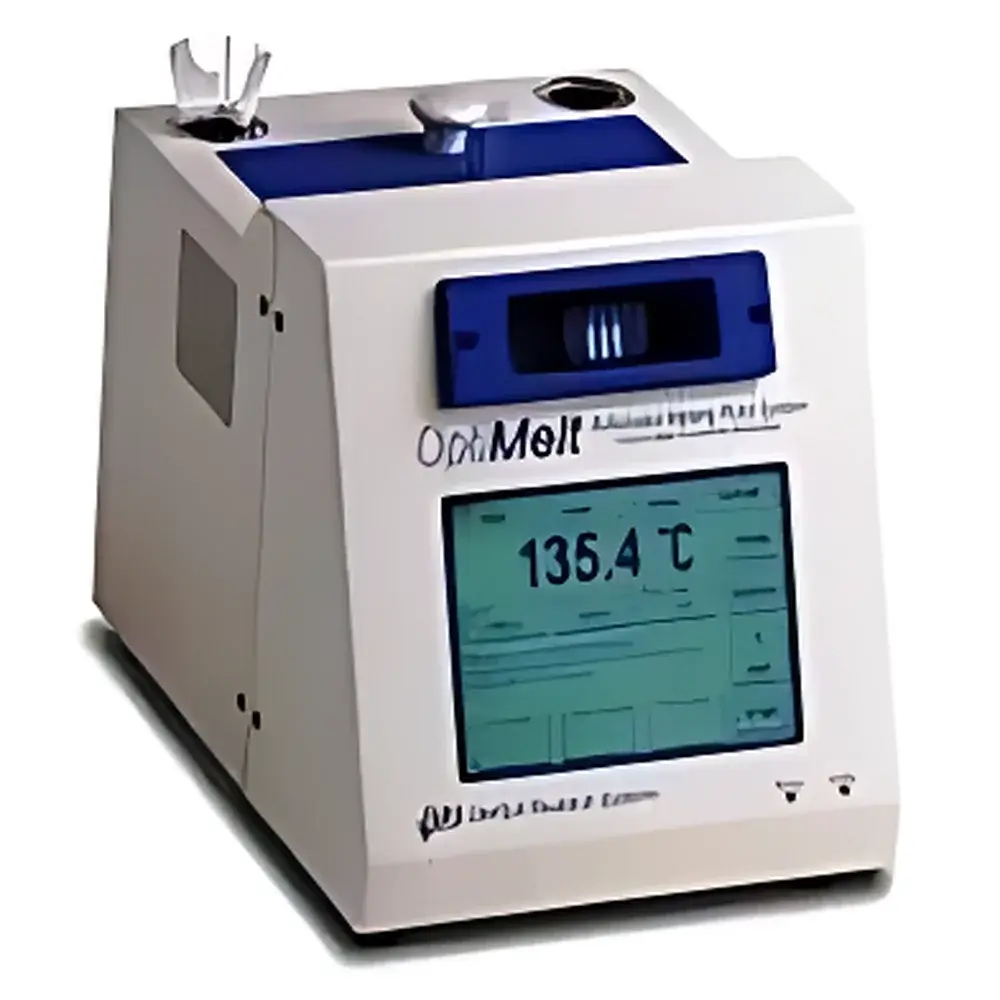
SRS Opti-Melt100 Melting Point Apparatus
| Origin | USA |
|---|---|
| Manufacturer Type | Authorized Distributor |
| Origin Category | Imported |
| Model | Opti-Melt100 |
| Price | ¥56,500 (CNY) |
| Temperature Range | −10 °C to 400 °C |
| Heating Rate | 0.1–20 °C/min (adjustable in 0.1 °C/min increments) |
| Temperature Repeatability | ±0.3 °C |
| Temperature Accuracy | ±0.3 °C (≤100 °C), ±0.5 °C (≤250 °C), ±0.8 °C (≤400 °C) |
| Capillary Outer Diameter | 1.4–2.0 mm |
| Sample Capacity | 2 capillaries simultaneously |
| Temperature Resolution | 0.1 °C |
| Heating Time | 10 min (50 °C → 350 °C) |
| Cooling Time | 10 min (350 °C → 50 °C) |
| Display | Touchscreen LCD |
| Interface | USB, RS-232 |
| Software | Melt-View™ (Windows-compatible) |
| Power Supply | AC 90–264 V |
| Operating Temperature | 0–40 °C |
| Weight | 4.1 kg |
| Dimensions | 20 × 25 × 21 cm |
Overview
The SRS Opti-Melt100 Melting Point Apparatus is a precision thermal analysis instrument engineered for reliable, automated determination of solid-phase transition temperatures in pharmaceutical, chemical, and materials science laboratories. Based on optical detection principles—specifically real-time monitoring of light absorption and reflection changes during phase transition—the Opti-Melt100 delivers objective, observer-independent melt point identification. Unlike traditional visual melt point instruments reliant on subjective endpoint judgment, this system employs a high-resolution digital imaging detector synchronized with a calibrated platinum RTD (Resistance Temperature Detector) sensor to capture dynamic optical behavior as crystalline structure collapses. The aluminum heating block is microprocessor-controlled to ensure linear, programmable temperature ramps across the full range of −10 °C to 400 °C, enabling reproducible thermal profiles critical for method validation and regulatory compliance.
Key Features
- Triple-channel optical detection architecture: Simultaneous real-time imaging of two sample capillaries plus reference channel for enhanced baseline stability and noise rejection.
- Integrated 1.3-megapixel digital camera with LED-illuminated viewing chamber and 10× optical magnification lens—enabling clear visualization of meniscus formation, sintering, and collapse events without operator interpretation bias.
- High-fidelity temperature control: Platinum RTD sensor with 0.1 °C resolution and traceable NIST-calibratable accuracy (±0.3 °C at ≤100 °C); aluminum heating block ensures uniform thermal distribution and minimal axial gradient.
- Autonomous operation mode: Standalone touchscreen interface supports full method definition, execution, annotation (up to six temperature markers per run), and result display—no PC required for routine measurements.
- Rapid thermal cycling: Achieves 50 °C → 350 °C in ≤10 minutes and cools 350 °C → 50 °C in ≤10 minutes via passive convection-assisted design—reducing turnaround time between analyses without forced-air or Peltier complexity.
- GLP-compliant data handling: Built-in audit trail, electronic signatures (via optional Windows login integration), and secure storage of up to 24 user-defined methods and 8 complete analytical reports—including timestamped images, temperature logs, and annotated melt intervals.
Sample Compatibility & Compliance
The Opti-Melt100 accommodates standard cylindrical glass capillaries (OD: 1.4–2.0 mm, length: 100 mm), compatible with USP <741>, EP 2.2.17, and JP 2.60 monographs. Its dual-capillary configuration supports parallel testing for statistical validation or comparative analysis (e.g., polymorph screening). All temperature calibrations are performed using certified reference standards (e.g., indium, caffeine, potassium diphenylphosphate), and calibration history—including date, operator ID, and deviation values—is retained in non-volatile memory. The system meets core requirements of FDA 21 CFR Part 11 for electronic records and signatures when used with validated Melt-View™ software under controlled IT environment protocols. Instrument qualification documentation (IQ/OQ/PQ templates) and traceable calibration certificates are available upon request.
Software & Data Management
Melt-View™ software (Windows 10/11 compatible, USB-connected) provides real-time video overlay of temperature vs. time curves synchronized with frame-by-frame image capture. Users may replay sequences at variable speed, export annotated TIFF/PNG stills, generate PDF reports with embedded metadata (operator, method ID, environmental conditions), and export CSV-formatted thermal logs for statistical process control (SPC) analysis. Data integrity safeguards include write-protected archive folders, automatic backup to external drives, and configurable auto-delete policies aligned with organizational retention schedules. Raw image files retain EXIF metadata including shutter speed, gain settings, and sensor temperature—supporting forensic review during regulatory inspections.
Applications
- Pharmaceutical quality control: Identity verification and purity assessment of active pharmaceutical ingredients (APIs) per ICH Q5 and USP general chapter <741>.
- Polymorph characterization: Detection of subtle melting endotherms associated with solid-state transitions in crystalline hydrates or solvates.
- Chemical synthesis validation: Confirmation of product identity and batch-to-batch consistency in fine chemical manufacturing.
- Academic research: Teaching labs benefit from intuitive interface and visual feedback; research labs leverage image-based endpoint detection for novel compound screening.
- Regulatory submission support: Fully auditable data packages compliant with EMA CHMP/ICH guidelines for physicochemical characterization dossiers.
FAQ
Does the Opti-Melt100 require external cooling accessories to achieve specified cooling rates?
No. The instrument achieves ≤10-minute cooling from 350 °C to 50 °C using optimized passive heat dissipation through its aluminum chassis and ambient convection—no compressed air, water chillers, or thermoelectric modules are needed.
Can Melt-View™ software be deployed in a networked lab environment with centralized data archiving?
Yes. When installed on a domain-joined Windows workstation, Melt-View™ supports UNC path configuration for direct saving to network-attached storage (NAS) or LIMS-integrated repositories with role-based access controls.
Is the platinum RTD sensor field-replaceable, and what is its recalibration interval recommendation?
The integrated PT100 sensor is not user-serviceable but is covered under SRS’s 2-year extended warranty. Annual recalibration against NIST-traceable standards is recommended for GLP/GMP environments; calibration certificates include as-found/as-left data and uncertainty budgets.
How does the optical detection algorithm differentiate between sintering and true melting?
The algorithm analyzes temporal gradients in pixel intensity variance across the capillary column—not just bulk transmission loss. Sintering produces gradual, spatially heterogeneous opacity; true melting manifests as sharp, synchronous reduction in edge contrast and meniscus definition, triggering the primary endpoint flag.
What documentation is provided to support 21 CFR Part 11 compliance?
SRS supplies a comprehensive Validation Support Package including Risk Assessment Report, URS (User Requirements Specification), FRS (Functional Requirements Specification), IQ/OQ/PQ test protocols with pass/fail criteria, and a System Configuration Record detailing firmware versions, cryptographic hash values, and audit log retention settings.



