
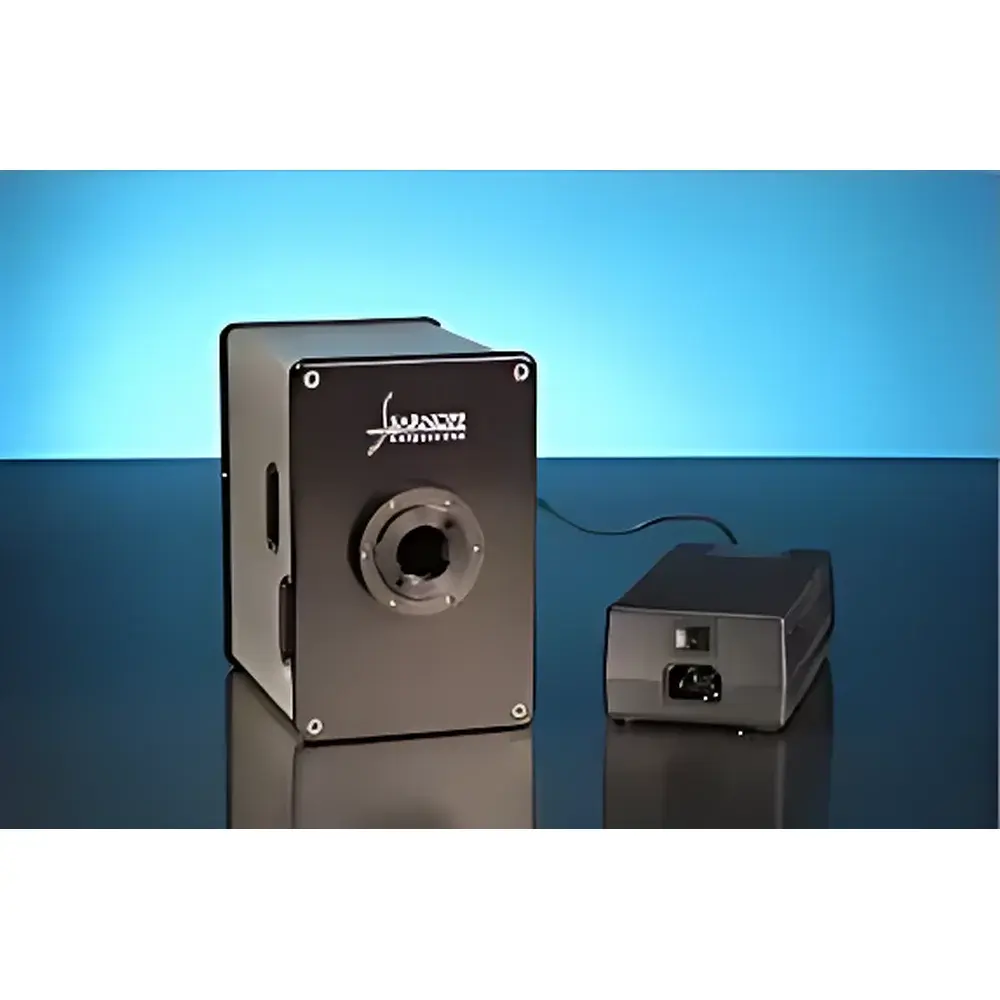
SRS/Stanford Research Systems UV-Enhanced High-Speed CCD Camera
| Brand | SRS/Stanford Research Systems |
|---|---|
| Origin | USA |
| Product Type | Scientific CCD Imaging Camera |
| Models | 8K-7U-32, CCD180-512-SFT, CCD180-1M-SFT, CAM1M-100-SFT, CAM512, CAM512-UVC, CAM1M100 |
| Sensor Architecture | Back-Illuminated CCD |
| Pixel Format | Linear (8K×1) and Area (512×512 to 1024×1024) |
| Pixel Size | 7–18 µm |
| Readout Modes | Frame Transfer, Bidirectional Shift |
| Max Frame Rate | Up to 17 kHz (line-scan), 492 fps (area-scan with 2×2 binning) |
| Readout Noise | <25 e⁻ rms (typical) |
| Fill Factor | 100% |
| Output Interface | Camera Link |
| Quantum Efficiency | Enhanced in UV (200–400 nm) |
Overview
The SRS UV-Enhanced High-Speed CCD Camera series—developed from legacy Sarnoff Corporation imaging technology and distributed globally by Stanford Research Systems—is engineered for demanding scientific applications requiring simultaneous high quantum efficiency in the ultraviolet (UV) spectral range and rapid frame acquisition. These cameras utilize back-illuminated CCD sensors with 100% fill factor and optimized anti-reflection coatings to maximize photon collection efficiency below 400 nm—a critical advantage over front-illuminated or standard silicon-based CCDs whose UV QE typically falls below 20%. The architecture supports both linear (e.g., 8K-7U-32) and area-scan configurations (e.g., CAM512-UVC, CCD180-1M-SFT), enabling flexible integration into spectroscopic, time-resolved imaging, and pulsed-light measurement systems. Core operation relies on frame-transfer readout with bidirectional pixel shifting, reducing vertical smear and enabling sub-millisecond exposure control—essential for capturing transient phenomena in plasma diagnostics, synchrotron beamline experiments, or hypervelocity tracking.
Key Features
- Back-illuminated CCD architecture with deep-depletion or UV-optimized coating for >50% quantum efficiency at 254 nm and >70% at 365 nm
- Frame-transfer readout with dual-directional shift register design, minimizing transfer time and enabling true global shutter behavior
- High-speed acquisition up to 17 kHz in line-scan mode (8K-7U-32) and up to 492 fps in binned area-scan modes (CAM512-UVC, CAM1M-100-SFT)
- Low-noise electronics with correlated double sampling (CDS), achieving <25 e⁻ rms read noise in standard operating conditions
- Camera Link interface compliant with Base and Medium configurations, supporting deterministic latency and real-time streaming to host acquisition systems
- Thermoelectric stabilization options available for extended dark-current suppression during long-exposure UV imaging
Sample Compatibility & Compliance
These cameras are designed for integration into vacuum-compatible, radiation-hardened, and vibration-sensitive environments typical of space-based observatories, tokamak diagnostics, and synchrotron end stations. All models comply with RoHS directives and meet CE marking requirements for electromagnetic compatibility (EN 61326-1). When deployed in regulated environments—including semiconductor wafer inspection or FDA-regulated optical metrology—the camera firmware supports metadata tagging and timestamping aligned with ISO/IEC 17025 traceability frameworks. While not inherently 21 CFR Part 11 compliant, the Camera Link output enables integration with validated third-party acquisition software that implements audit trail, electronic signature, and data integrity controls per GLP/GMP workflows.
Software & Data Management
SRS provides native SDKs for Windows and Linux (C/C++, Python bindings) supporting low-level register access, ROI configuration, gain/offset calibration, and trigger synchronization via TTL or LVDS inputs. Integration with industry-standard platforms—including National Instruments LabVIEW, MATLAB Image Acquisition Toolbox, and EPICS IOC drivers—is fully documented. Raw 16-bit image streams are delivered without on-board compression, preserving photon-counting fidelity required for Poisson-statistics analysis. Metadata (exposure time, sensor temperature, trigger edge, binning mode) is embedded in each frame header using standardized IEEE 1394.3-compliant tags, facilitating automated post-processing pipelines in Python-based scientific computing environments (e.g., Astropy, scikit-image).
Applications
- Astronomical guiding and adaptive optics wavefront sensing under low-light UV conditions
- Time-resolved spectroscopy of laser-induced plasmas and combustion intermediates (e.g., OH*, CH* radicals)
- In-situ monitoring of EUV lithography tools and wafer defect inspection at 13.5 nm (via down-conversion optics)
- Fast-gated imaging in tokamak edge-localized mode (ELM) studies and divertor heat-flux mapping
- UV fluorescence lifetime imaging (FLIM) in materials science, including wide-bandgap semiconductors and phosphor characterization
- Ballistic trajectory tracking of hypersonic vehicles using solar-blind UV detection (200–280 nm)
- Beam profile monitoring in free-electron laser (FEL) facilities with single-pulse sensitivity
FAQ
What spectral range is optimized for UV enhancement?
The UV-enhanced variants (e.g., CAM512-UVC, CCD180-512-SFT) feature custom anti-reflection coatings and shallow junction depths optimized for peak quantum efficiency between 200 nm and 400 nm—with measurable response down to 185 nm when used with fused silica windows.
Can these cameras operate in vacuum or cryogenic environments?
Standard models are rated for ambient operation (0–40°C). Optional thermoelectric coolers enable stable operation down to –30°C; vacuum-compatible versions with ceramic feedthroughs and outgassing-certified materials are available under custom order (SRS part prefix “VAC-”).
Is hardware-level triggering supported?
Yes—all models support external TTL/LVDS trigger input with programmable polarity and delay (10 ns resolution), as well as internal trigger generation synchronized to frame start or pixel clock edges.
How is calibration data managed across sensor variants?
Each unit ships with factory-measured dark current maps, pixel response non-uniformity (PRNU) tables, and gain/offset coefficients stored in onboard EEPROM. These are automatically loaded by the SRS acquisition SDK during initialization.
Are firmware updates field-installable?
Yes—firmware revision management is supported via USB-to-Camera Link bridge utilities; all updates preserve user-configured register defaults and maintain backward compatibility with existing SDK versions.




