
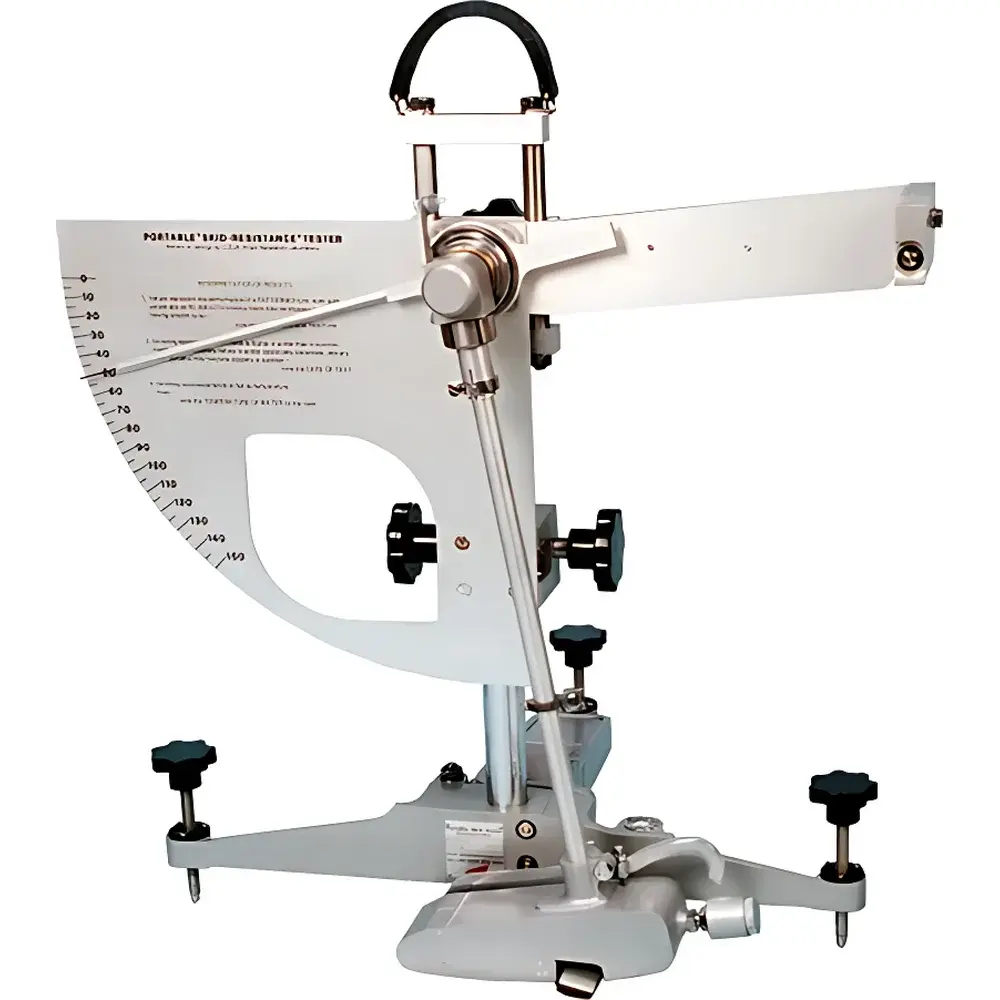
SRT 5800 Pendulum Coefficient of Friction Tester
| Origin | Switzerland |
|---|---|
| Manufacturer Type | Authorized Distributor |
| Origin Category | Imported |
| Model | SRT 5800 |
| Pricing | Upon Request |
Overview
The SRT 5800 Pendulum Coefficient of Friction Tester is a precision-engineered, portable field and laboratory instrument designed to quantify the skid resistance of road surfaces, airport runways, pavement markings, and other trafficked horizontal substrates. It operates on the standardized pendulum principle defined in EN 1436 and EN 13036-4:2017—where a calibrated rubber slider (standardized British Standard rubber, type “D”) mounted on a freely swinging pendulum arm impacts the test surface at a fixed angle and velocity. The energy loss due to friction is measured as the rebound height of the pendulum, converted directly into the Pendulum Test Value (PTV), a dimensionless index linearly correlated with the coefficient of friction under wet conditions. Unlike static or sliding friction testers, the SRT 5800 replicates the dynamic interaction between a braking tire and a wet pavement, delivering field-relevant data critical for safety assessment, maintenance prioritization, and regulatory compliance in highway infrastructure management.
Key Features
- Direct PTV readout with digital display—no manual scale interpolation required, minimizing operator-induced variability.
- Complies fully with EN 1436 (road marking performance) and EN 13036-4 (surface characteristics testing), ensuring traceable, auditable results acceptable to European transport authorities and ISO/IEC 17025-accredited laboratories.
- Integrated water delivery system ensures consistent, metered wetting of the test spot (0.5 mL ±0.1 mL), meeting the moisture control requirements specified in EN 13036-4 for reproducible wet-surface measurements.
- Robust aluminum alloy frame and precision-machined pivot bearing deliver long-term mechanical stability; calibration verification is performed using certified reference blocks traceable to national metrology institutes (e.g., NPL, PTB).
- Portable design (83 cm × 75 cm × 35 cm; 32 kg) enables rapid deployment across diverse site conditions—including active carriageways with minimal traffic disruption—without requiring power supply or ancillary equipment.
- Interchangeable sliders: Supports both standard BS rubber (Type D, Shore A 60 ±2) and optional high-wear variants for extended service life during high-frequency testing campaigns.
Sample Compatibility & Compliance
The SRT 5800 is validated for use on rigid and flexible pavements (asphalt, concrete, epoxy overlays), thermoplastic and cold-plastic road markings, airport taxiway/runway surfaces, and pedestrian walkways. Surface texture must be within the measurable range defined by EN 13036-4 (macrotexture depth ≥0.2 mm; no loose aggregate or standing water). Results are reported as PTV values, which correlate empirically to the wet skid resistance expected under typical vehicle braking conditions (e.g., PTV ≥45 indicates low slip risk; PTV <33 warrants remedial action per UK Highways Agency standards). All test procedures adhere to Good Laboratory Practice (GLP) documentation requirements and support audit readiness for road safety certification schemes including CEN/TS 16449 and national road asset management frameworks.
Software & Data Management
While the SRT 5800 operates as a stand-alone mechanical-electronic instrument, its digital output interface (RS-232 or optional Bluetooth 5.0) enables seamless integration with third-party data acquisition platforms. Field test records—including date/time stamp, GPS coordinates (via paired mobile device), ambient temperature, surface condition notes, and PTV values—are exportable in CSV or XML format. When used with compliant laboratory information management systems (LIMS), the instrument supports electronic signatures, 21 CFR Part 11–compliant audit trails, and automated report generation aligned with ISO 17025 clause 7.8. Calibration history, operator ID, and environmental metadata are embedded in each dataset to ensure full traceability from measurement to regulatory submission.
Applications
- Pre- and post-treatment evaluation of anti-skid surfacings (e.g., chip seal, microsurfacing, polymer-modified overlays)
- Quality assurance of newly applied road markings during construction handover
- Routine network-level skid resistance monitoring for highway asset management programs
- Forensic analysis following slip-related incidents on public infrastructure
- Research and development of novel pavement binders, aggregates, and marking materials
- Validation of friction performance under accelerated aging or de-icing chemical exposure
FAQ
What does PTV stand for, and how is it related to coefficient of friction?
PTV (Pendulum Test Value) is a dimensionless empirical index derived from pendulum energy loss. While not numerically identical to μ (coefficient of friction), PTV correlates strongly with wet-road μ under controlled conditions; a PTV of 40 typically corresponds to μ ≈ 0.40 at 60 km/h.
Is calibration required before each test session?
Yes—daily verification using the supplied calibration block is mandatory per EN 13036-4. Full recalibration by an accredited metrology provider is recommended annually or after impact damage.
Can the SRT 5800 be used on curved or inclined surfaces?
No—the test method assumes a level, stable, and representative horizontal sample area ≥200 mm × 200 mm. Inclined surfaces invalidate the pendulum dynamics and energy transfer assumptions.
Does the instrument meet ASTM or AASHTO standards?
The SRT 5800 is primarily aligned with CEN standards. For U.S. applications, it may be used alongside ASTM E303 (which references pendulum methods) but requires documented correlation studies for jurisdiction-specific acceptance.
How often should the rubber slider be replaced?
BS rubber sliders must be replaced after 100 tests or every 3 months—whichever occurs first—to maintain compliance with EN 13036-4’s wear limits and hardness specifications.






