
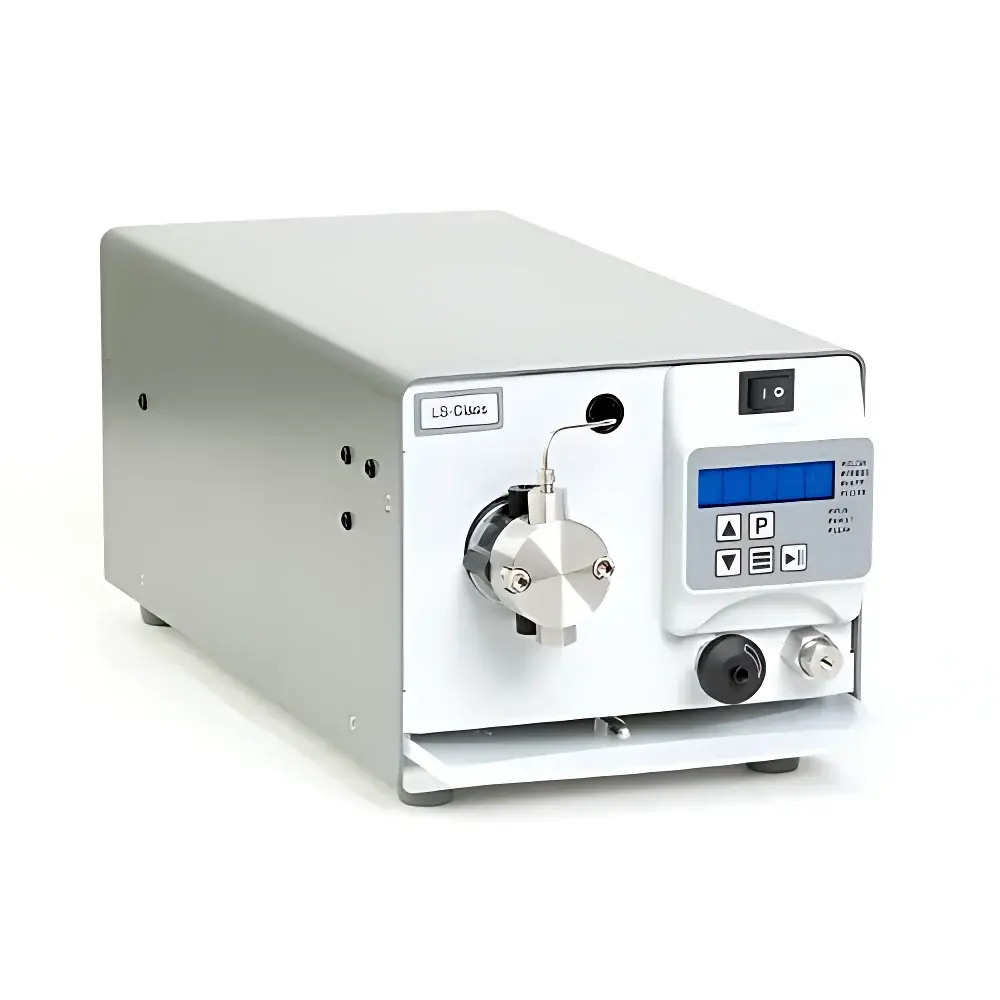
SSI LS Lite Single-Head Constant Flow Pump (Economical HPLC Pump)
| Brand | SSI |
|---|---|
| Model | LS Lite |
| Flow Rate | 0.000–10.00 mL/min (up to 6,000 psi) |
| Pressure Rating | 6,000 psi (stainless steel fluid path), 5,000 psi (PEEK fluid path) |
| Pulsation | ≤2% at 1 mL/min and 1,000 psi |
| Flow Accuracy | <2% deviation (measured with 20% isopropanol/water at 1,000 psi) |
| Flow Precision | ≤0.2% RSD |
| Fluid Path Materials | Stainless Steel, PEEK, Sapphire, Ruby, UHMWPE, PTFE |
| Dimensions | 16.5 × 17.8 × 40.6 cm (H × W × D) |
| Weight | 6.9 kg |
| Power Input | 100–240 VAC ±10%, 50–60 Hz |
| Control Interface | Micro-USB, front-panel keypad with Run/Stop functionality |
| Standard Features | Integrated pulse dampener (low dead volume), prime/purge valve, outlet filter, drip tray |
Overview
The SSI LS Lite Single-Head Constant Flow Pump is an engineered solution for isocratic high-performance liquid chromatography (HPLC) and general laboratory fluid delivery applications requiring precise, repeatable, and pulse-minimized flow under high pressure. Based on a single-plunger positive displacement architecture, the pump delivers stable solvent delivery across its operational range—0.000–10.00 mL/min at pressures up to 6,000 psi—without reliance on complex gradient mixing or dual-pump synchronization. Its low-dead-volume pulse dampener, combined with rapid refill dynamics, ensures virtually pulse-free output critical for baseline stability in UV/VIS detection and reproducible retention time alignment. Designed for robustness and ease of integration, the LS Lite adheres to fundamental HPLC system design principles while maintaining compatibility with both analytical-scale and semi-preparative workflows.
Key Features
- Single-plunger reciprocating mechanism optimized for isocratic operation and long-term mechanical stability
- Low-dead-volume pulse dampener delivering ≤2% pulsation at 1 mL/min and 1,000 psi—validated per ISO 13842:2017 for HPLC pump performance
- Flow accuracy <2% across defined test conditions (20% isopropanol/water, 1,000 psi); precision ≤0.2% RSD over repeated injections
- Modular fluid path constructed from chemically inert, USP Class VI-certified materials: 316 stainless steel, PEEK, sapphire, ruby, UHMWPE, and PTFE—ensuring compatibility with aggressive solvents and bio-compatible separations
- Integrated prime/purge valve and outlet filter for rapid system conditioning and particulate protection
- Front-panel interactive keypad with real-time status display, Run/Stop control, and manual flow/pressure override
- Micro-USB interface supporting direct PC communication for remote monitoring and basic parameter logging (no proprietary software required)
- Compact footprint (16.5 × 17.8 × 40.6 cm) and lightweight chassis (6.9 kg) enabling benchtop deployment in shared lab environments
Sample Compatibility & Compliance
The LS Lite supports a broad spectrum of mobile phases used in reversed-phase, normal-phase, ion-exchange, and size-exclusion chromatography—including acetonitrile, methanol, THF, aqueous buffers, and dilute acids/bases—provided chemical compatibility with PEEK or stainless steel is confirmed. Its fluid path meets ASTM F2028-21 standards for polymer component biocompatibility when configured with PEEK-wetted parts. While not certified for GMP manufacturing use out-of-the-box, the pump’s deterministic flow behavior, audit-ready USB log capability (timestamped Run/Stop events), and mechanical traceability support GLP-aligned method development and QC validation. It is suitable for USP <621> chromatographic system suitability testing when paired with compliant detectors and columns.
Software & Data Management
The LS Lite operates as a standalone instrument without mandatory software dependency. All core functions—including flow rate setting, pressure limit configuration, and Run/Stop initiation—are accessible via the front-panel interface. For integration into automated workflows, the Micro-USB port provides serial-over-USB (CDC ACM class) communication, enabling ASCII command-based control (e.g., “FLOW=5.00”, “PRESSURE=4000”, “RUN”) compatible with LabVIEW, Python (pySerial), or custom SCADA systems. Event logs—including start time, duration, and manual intervention flags—are retained in volatile memory and exportable upon request. Though not 21 CFR Part 11-compliant by default, the pump can be incorporated into validated systems where electronic records are managed externally with appropriate audit trail and electronic signature controls.
Applications
- Analytical HPLC for pharmaceutical impurity profiling, environmental contaminant screening, and food safety testing
- Semi-preparative purification of peptides, natural products, and synthetic intermediates (≤40 mL/min variant)
- Mobile phase delivery in LC-MS interfaces requiring stable isocratic elution
- Calibration standard delivery in flow cytometry and microfluidic assay platforms
- Controlled reagent metering in continuous-flow synthesis reactors
- Quality control testing of excipients and raw materials per pharmacopeial monographs
FAQ
What is the maximum pressure rating for PEEK-wetted configurations?
The LS Lite achieves 5,000 psi when equipped with PEEK fluidic components; stainless steel variants maintain full 6,000 psi capability.
Is the pump compatible with aqueous buffers containing >50 mM phosphate?
Yes—provided pH remains between 2.0 and 12.0 and temperature does not exceed 40°C; extended exposure to high-phosphate buffers may accelerate sapphire/ruby seal wear and warrants periodic inspection.
Can the LS Lite be used in GMP-regulated production environments?
It is intended for R&D, method development, and QC laboratories; formal GMP deployment requires supplementary qualification (IQ/OQ/PQ), documented change control, and integration into a Part 11–compliant data management ecosystem.
Does the pump include built-in leak detection or pressure over-limit shutdown?
No—pressure monitoring is visual/status-based only; external pressure sensors or PLC-level interlocks must be added for automated safety cutoffs.
What maintenance intervals are recommended for routine operation?
Plunger seals and check valves should be inspected every 500 hours of cumulative runtime or after 10,000 injection cycles; replacement kits (e.g., LL010SNN1A) are available with serialized traceability documentation.



