
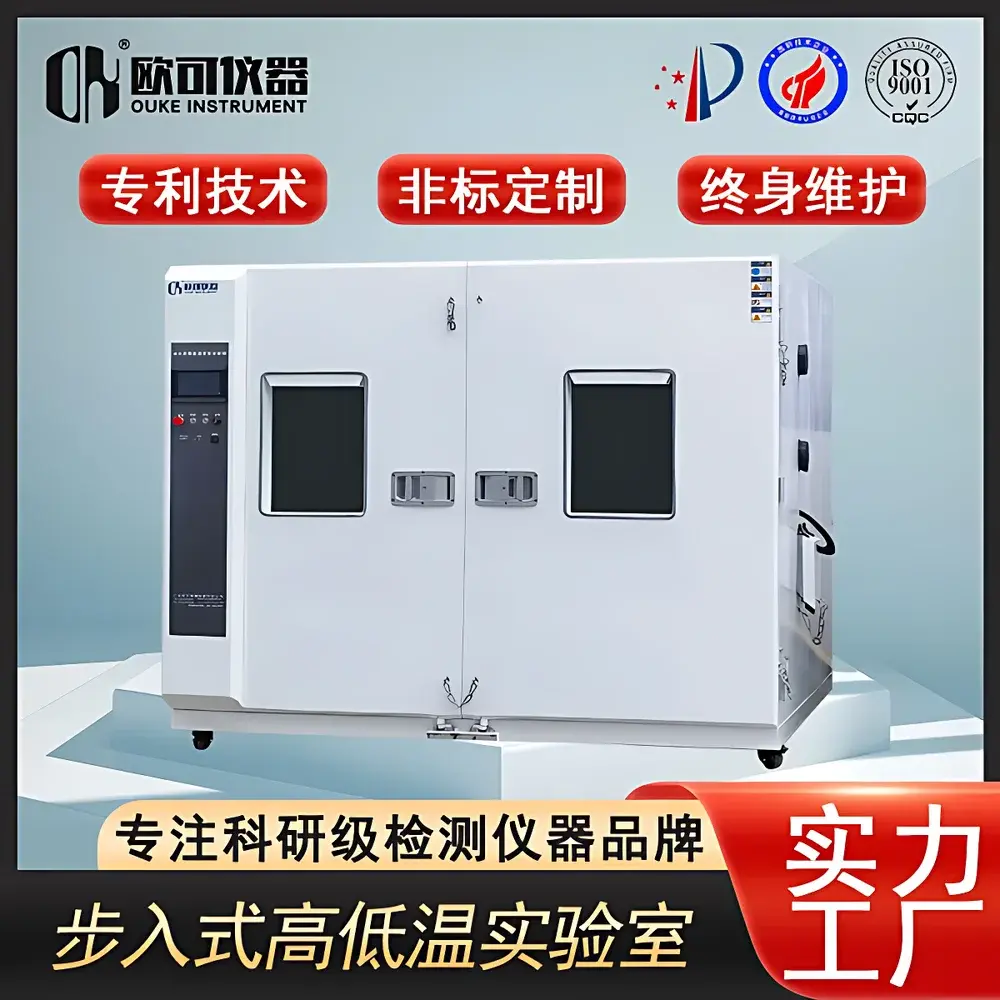
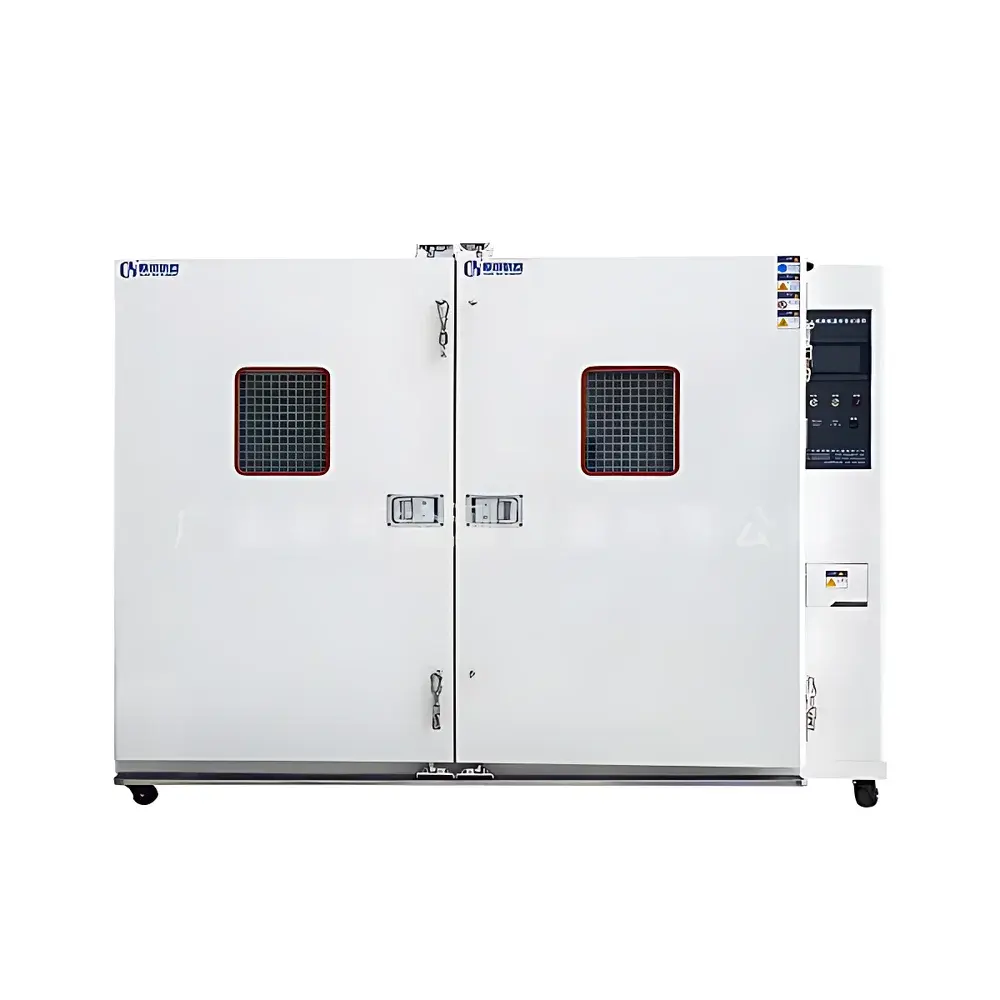
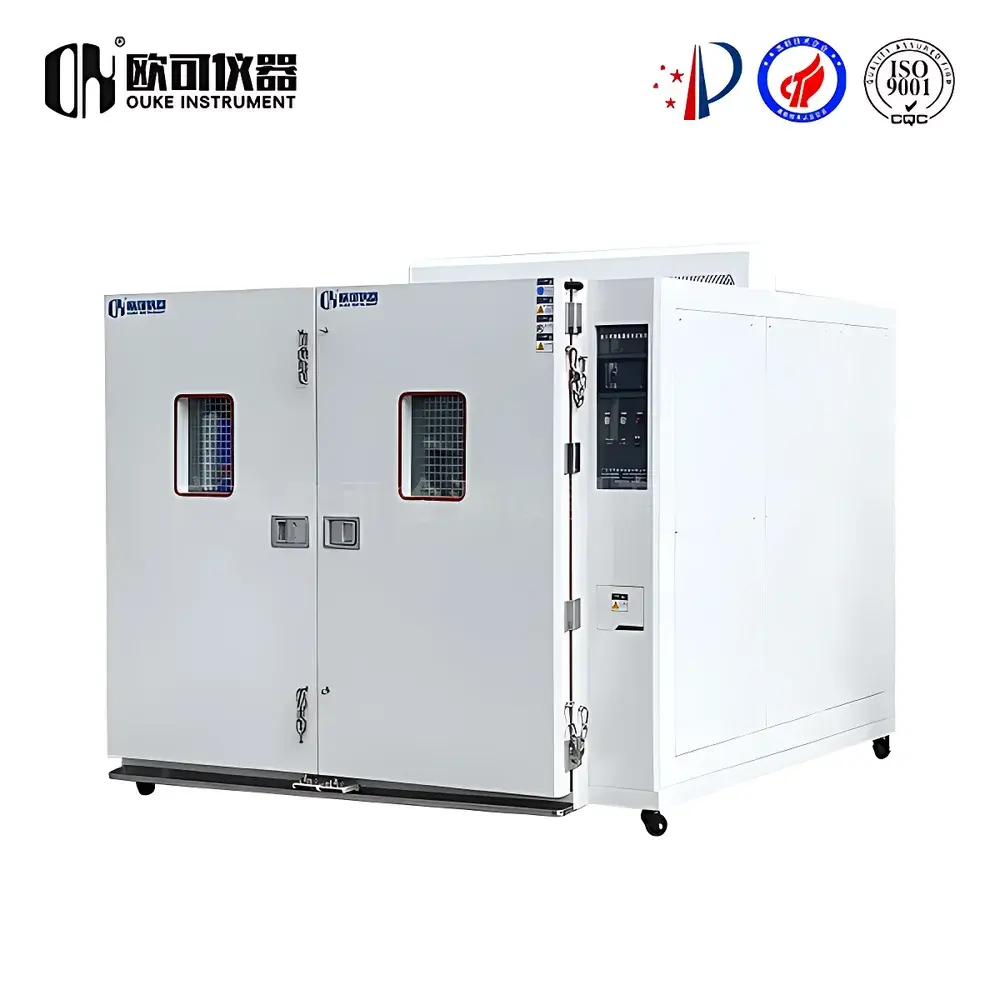
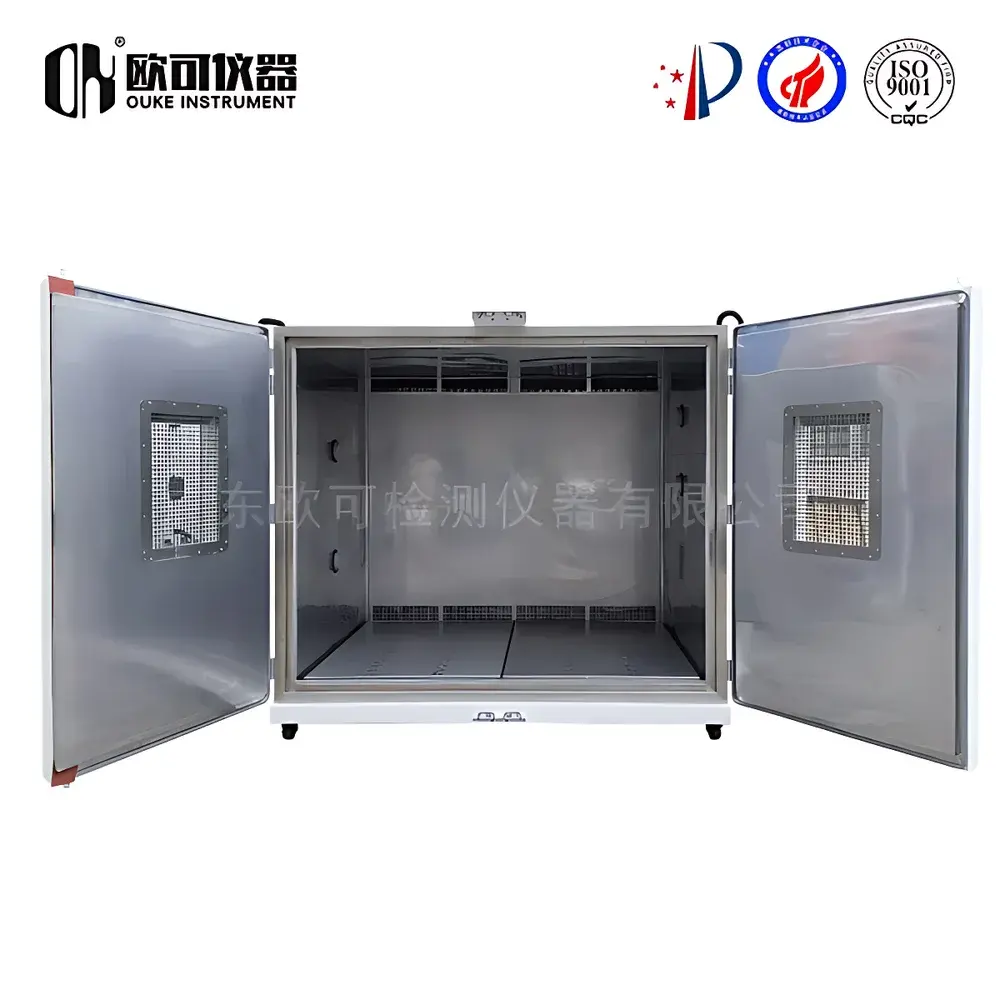
OK ST-H4M2 Walk-in Constant Temperature & Humidity Chamber
| Brand | OK Instruments |
|---|---|
| Origin | Guangdong, China |
| Manufacturer Type | Direct Manufacturer |
| Country of Origin | China |
| Model | OK-STH-4m² |
| Internal Dimensions (D×W×H) | 1500 × 1800 × 1500 mm |
| Temperature Range Options | A: 0°C / B: −20°C / C: −40°C / D: −60°C / E: −70°C |
| Temperature Uniformity | ±3°C |
| Temperature Control Accuracy | ±1°C |
| Heating Rate | 1.0–4.0°C/min |
| Humidity Control | Standard Integrated System |
| Construction | Modular PU-insulated sandwich panels with reinforced steel frame |
| Door | Large-sealed access door with observation window, anti-frost heating, and safety interlock |
| Refrigeration | Cascade dual-stage compressor system |
| Air Circulation | High-volume centrifugal fans with optimized ductwork |
| Control System | Industrial PLC-based touchscreen controller with programmable profiles, data logging, and remote monitoring capability |
Overview
The OK ST-H4M2 Walk-in Constant Temperature & Humidity Chamber is an industrial-grade environmental test system engineered for full-scale, system-level reliability validation under controlled thermal and hygrothermal conditions. Designed around the fundamental principles of convective heat and mass transfer, it maintains precise, stable, and spatially uniform temperature and relative humidity environments across its 4.05 m³ internal volume (1500 × 1800 × 1500 mm). Unlike benchtop or upright environmental chambers, this walk-in configuration enables direct human access—facilitating real-time instrumentation setup, cabling of high-power devices, in-situ sensor calibration, and physical intervention during extended tests. Its architecture integrates a cascade refrigeration cycle, high-capacity resistive heating, and a dedicated humidification/dehumidification subsystem to support steady-state and dynamic testing protocols per ISO 16750-4, ASTM D4332, IEC 60068-2-1, IEC 60068-2-2, and IEC 60068-2-30. The chamber serves as a foundational infrastructure platform for qualification testing where sample size, power dissipation, or operational complexity preclude use of compact enclosures.
Key Features
- Modular structural design using 150 mm thick polyurethane (PU) insulated sandwich panels with stainless steel or color-coated steel cladding—providing thermal resistance (R-value) exceeding 3.8 m²·K/W and structural rigidity for long-term dimensional stability.
- Reinforced load-bearing steel frame supporting ceiling-mounted air distribution plenums and integrated cable management pathways for multi-channel signal and power routing.
- Large-format insulated access door (≥900 mm clear opening) equipped with electrothermal anti-frost film, magnetic safety interlocks, and argon-filled double-glazed observation window for visual monitoring without thermal leakage.
- Cascade refrigeration system comprising separate high-temperature and low-temperature compressor stages, enabling stable operation down to −70°C while maintaining ≤±3°C spatial uniformity across the working volume.
- Programmable PLC-based control system with 10.4″ TFT touchscreen interface, supporting up to 99 segments per test profile, ramp/soak logic, and real-time deviation alarms with configurable thresholds.
- Comprehensive data acquisition: continuous logging of chamber setpoints, actual values (temperature/humidity), compressor status, heater output, and fan speed—with timestamped CSV export and optional Ethernet/IP or Modbus TCP integration.
Sample Compatibility & Compliance
The OK ST-H4M2 accommodates physically large or thermally active test articles—including electric vehicle battery packs (up to 2.5 m tall), photovoltaic inverters, server racks, avionics line-replaceable units (LRUs), and complete cockpit instrument clusters. Its open interior layout supports custom mounting fixtures, liquid-cooled load simulators, and high-current feedthroughs via sealed penetration ports (IP65-rated). The chamber complies with essential regulatory frameworks for test integrity: temperature and humidity uniformity validation per ISO 16750-4 Annex B; data security and audit trail functionality aligned with FDA 21 CFR Part 11 requirements when paired with optional electronic signature modules; and mechanical safety conforming to EN 61000-6-2 (immunity) and EN 61000-6-4 (emissions). Optional GMP/GLP-compliant validation packages—including IQ/OQ/PQ documentation, uncertainty budgets, and calibration traceability to NIM (China National Institute of Metrology)—are available upon request.
Software & Data Management
The embedded control firmware supports deterministic real-time execution of multi-step environmental profiles, including simultaneous temperature-humidity ramps, dwell periods, and cyclic stress sequences. Data is stored locally on industrial-grade SD card (≥32 GB) with automatic rollover and time-synchronized UTC timestamps. Remote supervision is enabled via secure HTTPS web interface or OPC UA server, permitting live parameter adjustment, alarm acknowledgment, and historical trend review from any authorized workstation. All logged data includes metadata such as operator ID, test ID, chamber serial number, and firmware revision—ensuring full traceability required under ISO/IEC 17025 accredited laboratory practices. Optional cloud synchronization enables centralized fleet-wide monitoring across geographically dispersed test facilities.
Applications
- Automotive: Whole-vehicle cold-start validation at −40°C; HVAC performance mapping across −20°C to +85°C; battery thermal runaway propagation studies under controlled humidity.
- Aerospace: Environmental screening of unmanned aerial systems (UAS) prior to flight; thermal vacuum pre-conditioning of satellite payload assemblies.
- Energy Storage: Accelerated life testing of grid-scale BESS cabinets under combined thermal cycling (−20°C ↔ +55°C) and 85% RH stress.
- Telecom & Data Centers: Thermal load simulation of 19″ rack-mounted equipment under sustained 40°C/95% RH conditions per Telcordia GR-3108.
- Industrial Electronics: Burn-in of high-power converters and motor drives with real-time IR thermography integration through optical viewport.
FAQ
What is the maximum allowable internal heat load for sustained operation at −40°C?
Sustained internal heat dissipation must not exceed 3.5 kW at −40°C ambient; higher loads require derating or optional auxiliary cooling integration.
Can the chamber be validated to ISO 17025 requirements?
Yes—factory-installed calibrated reference sensors (NIST-traceable Pt100 and capacitive RH probes) and documented uncertainty budgets are provided as part of the optional IQ/OQ/PQ package.
Is field installation and commissioning included?
Standard delivery includes on-site mechanical assembly, refrigerant charging, electrical connection verification, and functional performance testing by certified OK field engineers.
How is humidity controlled below 0°C?
Sub-zero humidity control employs chilled-mirror dew point measurement coupled with steam injection and desiccant-assisted dehumidification—enabling stable RH generation down to −40°C.
What power supply specifications are required?
Three-phase 380 VAC ±10%, 50 Hz, with minimum 63 A circuit breaker and dedicated grounding electrode meeting IEC 60364-5-54 standards.



