
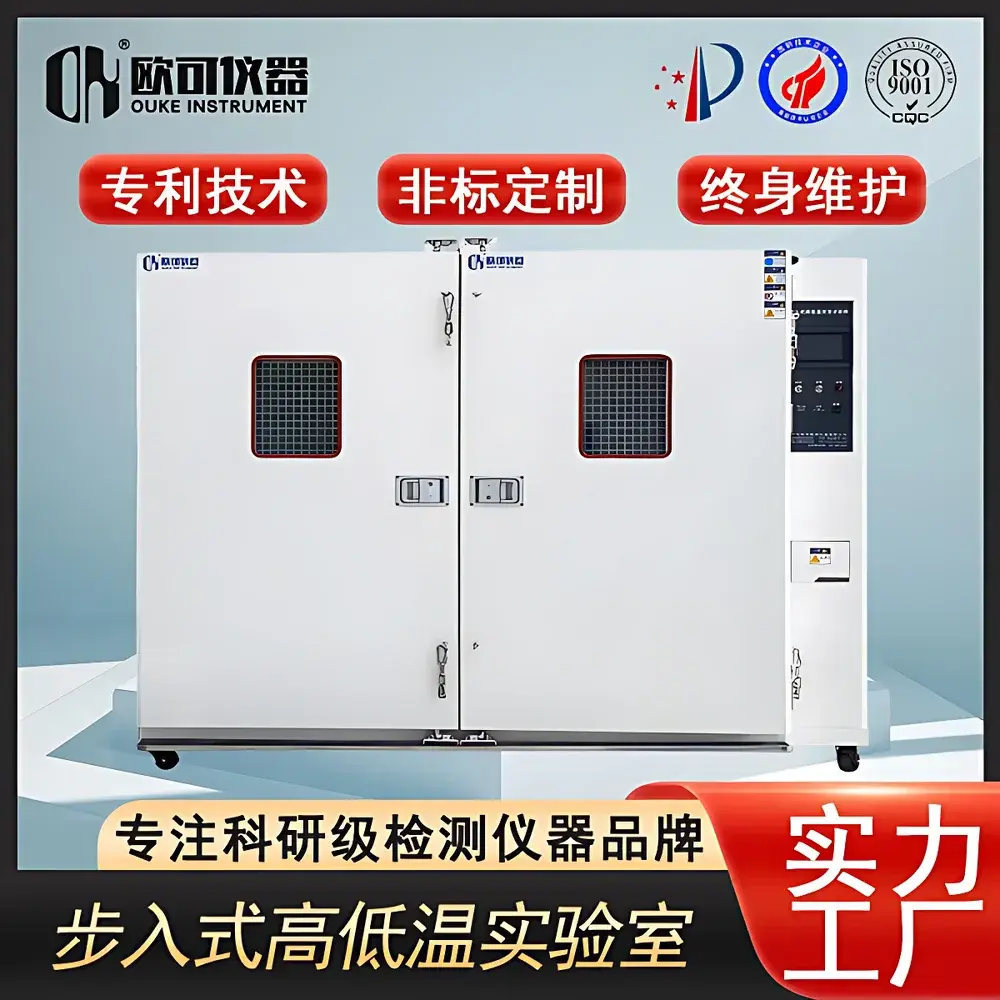
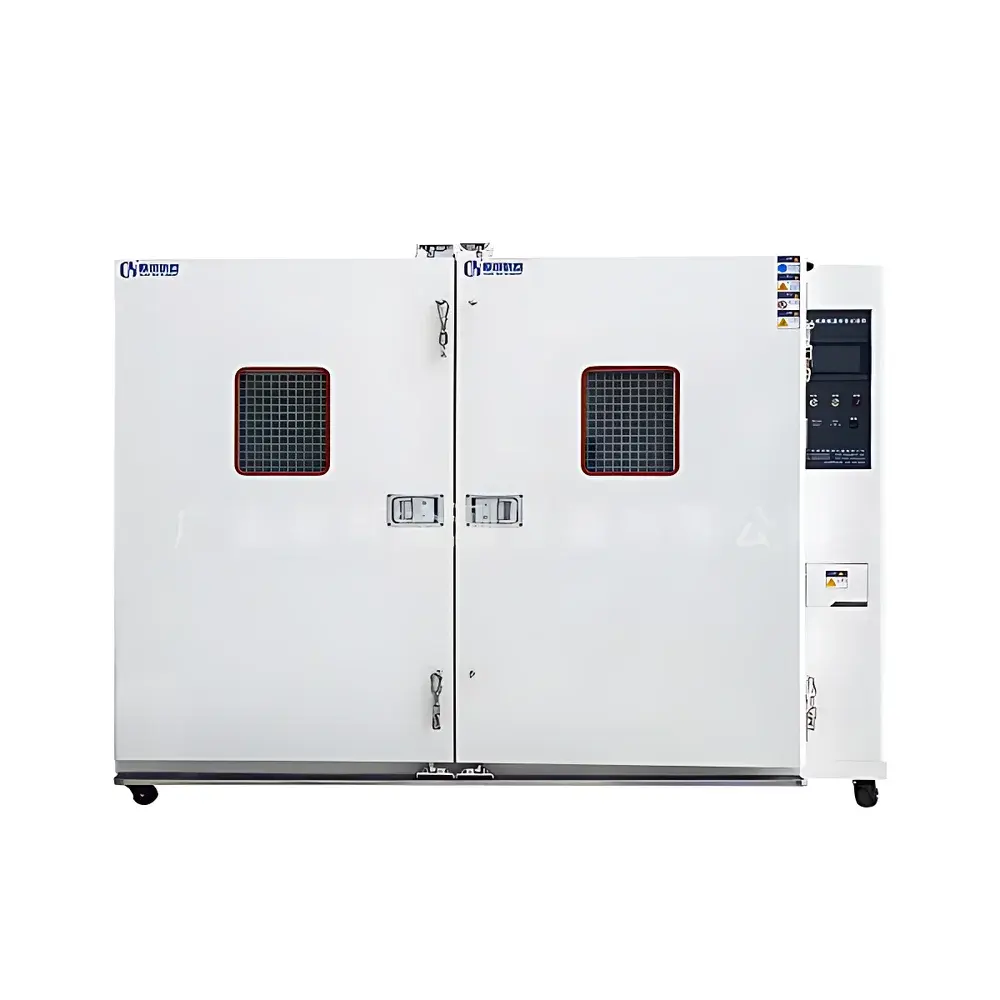
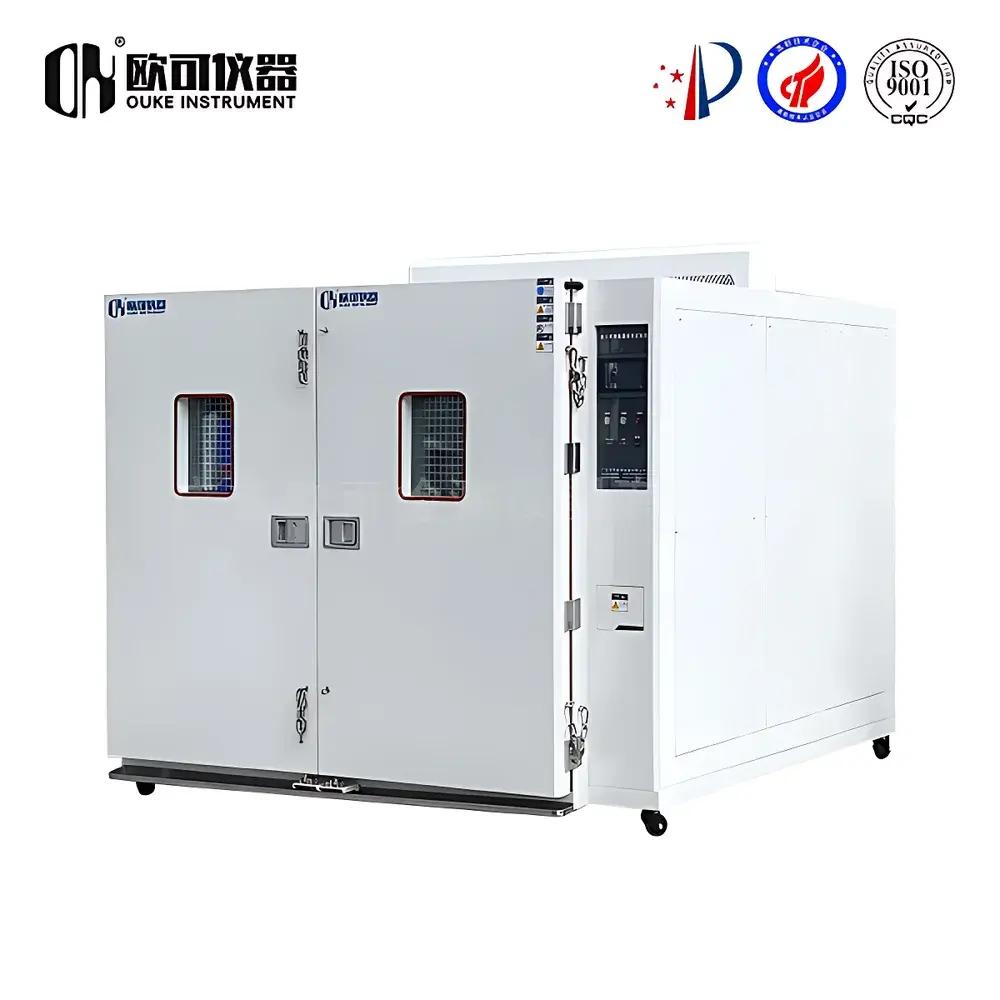
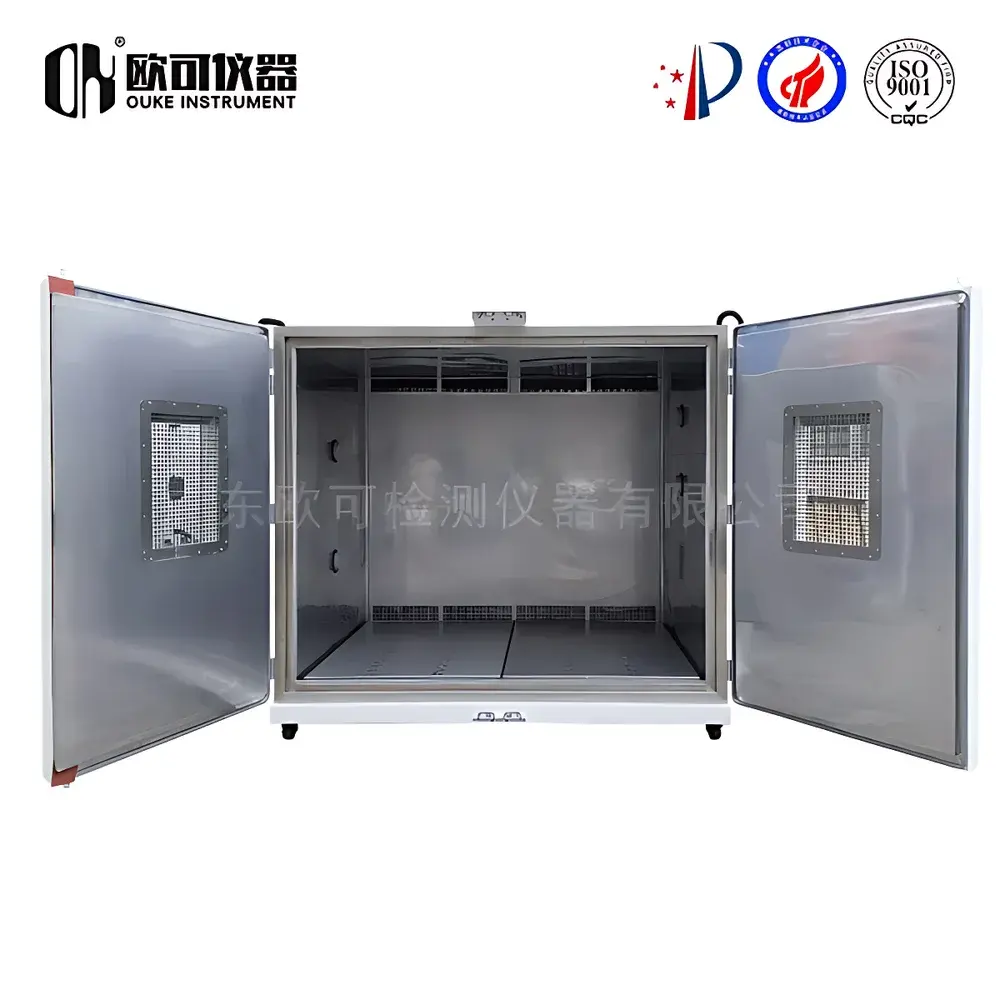
OK ST-H Series Walk-in Environmental Test Chamber (Model OK-STH-4.6m²)
| Brand | OK Instruments |
|---|---|
| Origin | Guangdong, China |
| Manufacturer Type | Direct Manufacturer |
| Country of Origin | China |
| Model | OK-STH-4.6m² |
| Internal Dimensions (D×W×H) | 1500 × 1800 × 1500 mm |
| Temperature Range Options | A: 0°C to +85°C |
| B | −20°C to +85°C |
| C | −40°C to +85°C |
| D | −60°C to +85°C |
| E | −70°C to +85°C |
| Temperature Uniformity | ±3°C |
| Temperature Control Accuracy | ±1°C |
| Heating Rate | 1.0–4.0°C/min |
| Construction | Modular PU-insulated sandwich panels with steel frame, hermetic walk-in door, integrated air circulation and multi-stage refrigeration system |
Overview
The OK ST-H Series Walk-in Environmental Test Chamber (Model OK-STH-4.6m²) is a fully engineered, large-volume environmental simulation system designed for system-level reliability validation under controlled temperature and humidity conditions. Unlike benchtop or upright climate chambers, this walk-in chamber features an internal volume of 4.6 m³—sufficient to accommodate full-scale assemblies such as electric vehicle battery packs, aerospace avionics racks, photovoltaic inverters, server cabinets, or multi-batch component lots. Its operational principle relies on precision-coupled air handling: conditioned air is distributed via high-CFM centrifugal blowers through optimized ductwork, ensuring uniform thermal distribution per ISO 16750-4, IEC 60068-2-1, and MIL-STD-810H requirements. The chamber employs a dual-stage cascade refrigeration system (for models rated to −70°C), industrial-grade electric heating banks, and a stainless-steel steam-humidification module (optional), enabling stable operation across extended test cycles without drift.
Key Features
- Modular structural design using 100 mm thick polyurethane (PU)-filled insulated panels (thermal conductivity ≤ 0.022 W/m·K), certified for fire resistance (GB 8624 B1)
- Reinforced steel framework supporting static load capacity ≥ 500 kg/m²—engineered for long-term structural integrity in industrial environments
- Hermetically sealed walk-in door with double-glazed observation window, anti-frost heating element, and three-point mechanical locking system compliant with EN 1627 security standards
- Multi-zone air circulation architecture featuring four independently adjustable axial fans and baffled return ducting to minimize stratification and achieve ±3°C uniformity per ASTM E145 Annex A3
- Programmable PLC-based controller with 10.4″ color touchscreen interface, supporting up to 99 programmable segments, ramp-soak profiles, and real-time deviation alarms
- Integrated safety interlocks including overtemperature cutoff, refrigerant high-pressure shutdown, door-open alarm, and emergency power-off (EPO) circuit per IEC 61000-6-2 EMC immunity requirements
Sample Compatibility & Compliance
This chamber accommodates physically heterogeneous test loads—including powered systems generating internal heat (e.g., BESS units up to 20 kW thermal dissipation). Optional feedthrough ports (Φ50 mm, IP65-rated) support signal/power line ingress while maintaining environmental integrity. All configurations comply with core international environmental testing standards: ISO 16750-4 (road vehicles), IEC 60068-2-1 (cold), IEC 60068-2-2 (dry heat), IEC 60068-2-30 (damp heat cyclic), and MIL-STD-810H Method 502.7. Humidity-controlled variants meet ISO 16750-4 Annex B for condensation-resistant operation. Data logging meets GLP/GMP traceability requirements with optional 21 CFR Part 11-compliant audit trail functionality when paired with OK’s LabLink™ software suite.
Software & Data Management
The embedded controller supports CSV export of time-stamped temperature/humidity readings at user-defined intervals (1 s to 60 min resolution). Optional Ethernet/Wi-Fi connectivity enables remote monitoring via OK’s LabLink™ web platform—accessible from any modern browser without proprietary client installation. LabLink™ provides role-based access control, automated report generation (PDF/Excel), trend analysis tools, and configurable email/SMS alerts for parameter breaches. Raw data files are stored in open-format .CSV with UTC timestamps and device serial-number metadata—ensuring full compatibility with LIMS, MES, or statistical process control (SPC) systems. Firmware updates are delivered via secure HTTPS and validated with SHA-256 checksums.
Applications
- Automotive: Whole-vehicle cold-start validation, HVAC performance mapping, ADAS sensor thermal drift characterization, and battery pack thermal runaway propagation studies
- Aerospace: Ground-based environmental screening of UAV airframes, flight control computers, and satellite payload modules per DO-160G Section 4 & 5
- Energy Storage: Cycle-life testing of grid-scale lithium-ion battery enclosures under combined thermal and humidity stress (IEC 62619 Annex A)
- Data Center Infrastructure: Thermal validation of 19″ rack-mounted UPS systems, liquid-cooled server chassis, and edge computing nodes under simulated hot-aisle conditions
- Industrial Electronics: Burn-in qualification of railway signaling controllers, wind turbine pitch drives, and marine-grade HMI panels per EN 50121-3-2
- Materials Science: Accelerated aging of composite laminates, conformal coatings, and elastomeric seals under damp-heat exposure (ASTM D4329)
FAQ
What is the maximum allowable internal heat load for sustained operation at −40°C?
For Model OK-STH-4.6m² configured with Option C (−40°C), the system maintains setpoint stability with continuous internal heat dissipation up to 5.2 kW—provided ambient room temperature remains ≤ 25°C and relative humidity ≤ 60% RH.
Can the chamber be relocated or expanded after initial installation?
Yes. The modular panel construction allows disassembly, transport, and reinstallation at new sites. Additional panels and structural kits are available for volume expansion up to 12 m³ without controller replacement.
Is third-party calibration certification included with delivery?
Each unit ships with factory calibration certificates traceable to NIM (China National Institute of Metrology). On-site UKAS-accredited calibration services are available upon request at additional cost.
How is humidity control implemented, and what is its operational range?
Humidity is generated via stainless-steel steam humidifier with PID-controlled dehumidification via refrigerant coil bypass. Standard range: 20–98% RH at +20°C to +85°C; extended low-RH capability (10% RH) available with optional desiccant wheel add-on.
What electrical supply specifications are required?
Three-phase 380 VAC ±10%, 50 Hz, with dedicated 63 A circuit breaker minimum. Voltage imbalance must not exceed 2%. Dedicated grounding rod (≤ 4 Ω resistance) is mandatory for EMC compliance.



