
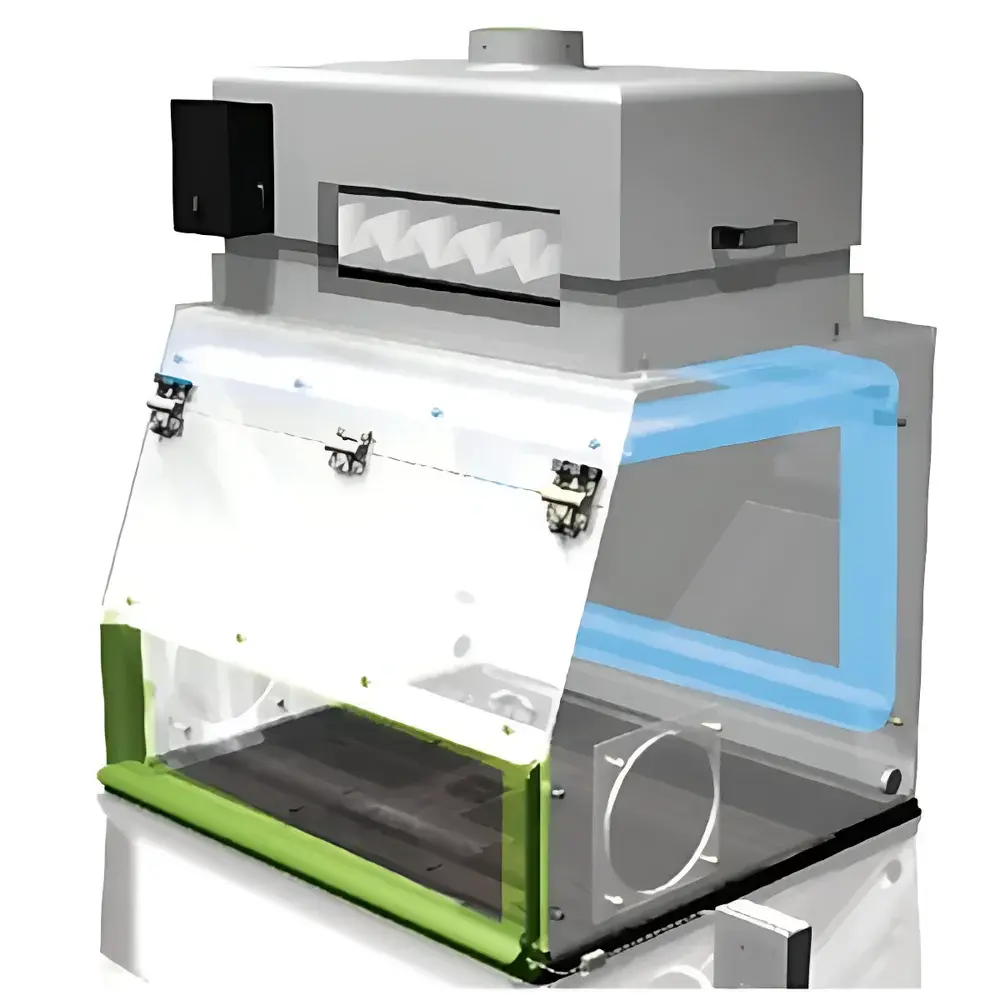
Standard Negative Pressure Weighing Hood ETA-AAC by Flow Sciences
| Brand | Flow Sciences |
|---|---|
| Origin | USA |
| Model | ETA-AAC |
| Filtration | Dual-stage HEPA (BIBO lower stage) |
| Face Velocity Range | 0.3–0.45 m/s (adjustable) |
| Noise Level | <60 dBA at 0.4 m/s |
| Filter Service Life | ≥3 years under typical pharmaceutical weighing conditions |
| Airflow Control | Thermistor-based real-time face velocity monitoring with audible/visual alarm below 0.3 m/s |
| Compliance | Designed to meet ISO 14644-1 Class 5 (ISO Class 5) background environment requirements for containment |
| Construction | Chemically resistant phenolic resin laminate base |
| Documentation | Supplied with full IQ/OQ protocols and third-party OEB validation report (OEL ≤1 µg/m³, tested with surrogate powder per ASTM D6322 and ISO 16000-6) |
Overview
The Flow Sciences ETA-AAC Standard Negative Pressure Weighing Hood is an engineered containment solution designed for safe, reproducible handling of highly potent active pharmaceutical ingredients (HPAPIs), cytotoxic compounds, and other low-OEL (Occupational Exposure Limit) materials in R&D, QC, and pilot-scale manufacturing environments. Operating on the principle of inward airflow containment, the hood maintains a stable negative pressure differential relative to the surrounding laboratory—typically –20 to –30 Pa—ensuring unidirectional, laminar inflow across the workface. This aerodynamic architecture, validated via smoke visualization and tracer gas testing (per ISO 10648-2), prevents operator exposure and cross-contamination during manual or semi-automated powder weighing, dispensing, and sampling tasks. The system integrates a high-efficiency, low-turbulence airflow path: air enters through four perimeter intake zones (top, bottom, left, right), guided by precision-machined curved inlet baffles that eliminate flow separation and vortex formation. Internal laminar flow is further stabilized by a rear-mounted vertical baffle and a seamless, screw-free ceiling panel—both constructed from non-shedding, electrostatic-dissipative materials—to suppress particle resuspension and ensure consistent ISO Class 5 (≤3,520 particles/m³ ≥0.5 µm) performance within the working chamber.
Key Features
- German ebm-papst EC centrifugal fan with variable-speed control: delivers precise face velocity regulation (0.3–0.45 m/s) while maintaining acoustic output <60 dBA at nominal operating point—critical for extended operator comfort in shared lab spaces.
- Dual-stage HEPA filtration: upstream pre-filter + primary HEPA (≥99.995% @ 0.3 µm) + BIBO (Bag-In/Bag-Out) configured lower-stage HEPA—enabling safe, zero-exposure filter changeout without breaching containment integrity.
- Thermistor-based real-time face velocity monitoring: continuously measures inflow velocity; triggers simultaneous audible alarm and red LED warning if velocity drops below 0.3 m/s—meeting ISO 14644-3 Annex B verification criteria for operational continuity.
- Tool-free modular interior: ceiling panel and laminar flow baffle are secured via cam-lock mechanisms—allowing rapid disassembly for cleaning, inspection, or residue verification per cleaning validation protocols (e.g., SWAB recovery per PDA TR29).
- Integrated waste containment: built-in polyethylene bagging sleeve with sealed closure mechanism minimizes secondary handling risk during disposal of weighed containers or spill debris.
- Chemically inert base construction: phenolic resin laminate work surface and fully sealed base enclosure resist corrosion from solvents, acids, and bases—supporting long-term structural integrity under routine decontamination with IPA, hydrogen peroxide vapor, or sodium hypochlorite.
Sample Compatibility & Compliance
The ETA-AAC accommodates standard laboratory vessels—including stainless-steel weigh boats, glass vials, aluminum pans, and HDPE containers—up to 300 mm in height and 400 mm in width. Its internal geometry permits unrestricted access for analytical balances (e.g., Mettler Toledo XSR, Sartorius Cubis) with minimal vibration coupling. The unit complies with international occupational health and safety frameworks: it satisfies the engineering control requirements outlined in ACGIH TLV® documentation for HPAPI handling, aligns with EU Directive 2004/37/EC (Carcinogens and Mutagens Directive), and supports compliance with US OSHA 1910.1200 (Hazard Communication Standard). Third-party OEB validation—conducted using respirable surrogate powder (lactose aerosol, MMAD 2.5 µm) per ASTM D6322 and ISO 16000-6—confirms containment efficiency yielding time-weighted average airborne concentrations ≤1 µg/m³, qualifying the hood for OEB-5 applications (ICH M7 Category 1–2 compounds).
Software & Data Management
While the ETA-AAC operates as a standalone mechanical containment device without embedded firmware, its analog sensor outputs (face velocity, alarm status) are compatible with building management systems (BMS) via 4–20 mA or dry-contact relay interfaces. All delivered units include fully executed Installation Qualification (IQ) and Operational Qualification (OQ) documents—traceable to NIST-calibrated instrumentation and signed by a certified Flow Sciences Field Validation Engineer. Electronic copies are provided in PDF/A-1b format, compliant with FDA 21 CFR Part 11 requirements for electronic records retention. Audit trails for filter replacement, calibration, and maintenance events can be maintained manually within client-controlled LIMS or QMS platforms (e.g., Veeva Vault, MasterControl) using the supplied logbook templates.
Applications
- Weighing and dispensing of oncology APIs, peptide therapeutics, and gene therapy vectors in early-phase development labs.
- Pre-formulation studies involving nanomaterials or inhalable dry powders where airborne mass concentration must remain below regulatory thresholds.
- QC release testing of high-potency batches requiring manual sample preparation under GMP Annex 1 (2022) Grade A-equivalent conditions.
- Stability study sample handling where chemical degradation pathways are accelerated by ambient humidity or oxygen—enabled by optional nitrogen purge integration.
- Teaching laboratories conducting hazard communication training for industrial hygiene students using realistic containment workflows.
FAQ
Does the ETA-AAC require ducted exhaust to outside?
No—it is a recirculating (type B2) design with dual HEPA filtration; >99.995% of recirculated air is purified before reintroduction into the workspace. External ducting is optional only if local ventilation codes mandate 100% exhaust.
Can the hood be validated for use with specific API compounds?
Yes. While the base unit carries third-party OEB-5 validation, compound-specific challenge testing (e.g., using actual API aerosols) can be performed onsite by certified partners using ISO 14644-3 particle counters and real-time aerosol spectrometry (TSI APS 3321).
What maintenance intervals are recommended for the HEPA filters?
Under continuous operation (8 h/day, 5 days/week) with typical pharmaceutical powders, the dual HEPA system is rated for ≥36 months. Filter life is monitored via differential pressure sensors; replacement is triggered when ΔP exceeds 250 Pa across the primary stage.
Is the IQ/OQ package suitable for FDA inspection?
Yes—the protocols follow ASTM E2500-13 and ISPE GAMP5 principles, include instrument calibration certificates, acceptance criteria traceability matrices, and deviation logs. They are routinely accepted during FDA pre-approval inspections and MHRA GMP audits.
How is airflow uniformity verified during commissioning?
Per ISO 14644-3 Section 8.2.2, six-point face velocity mapping is conducted using a calibrated hot-wire anemometer (±2% accuracy), with all readings required to fall within ±20% of the mean value and no single reading below 0.3 m/s.
Related Products



