
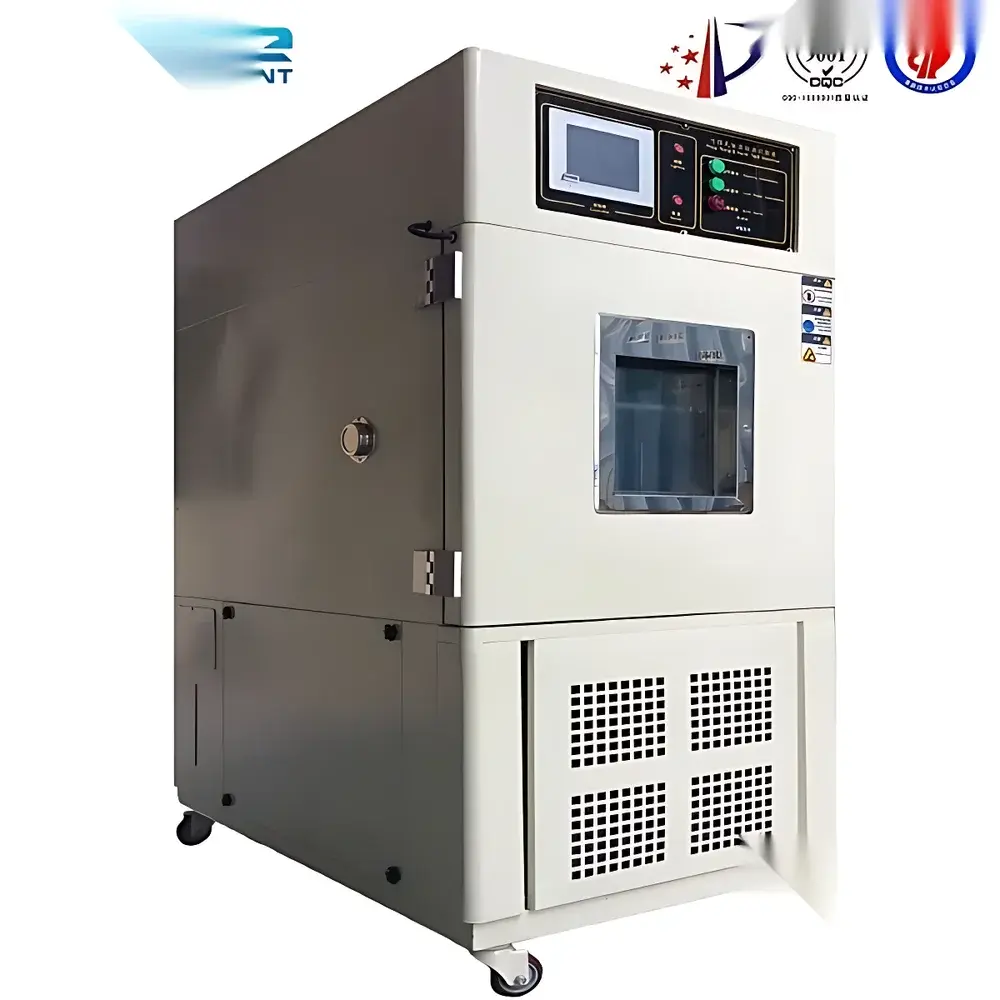
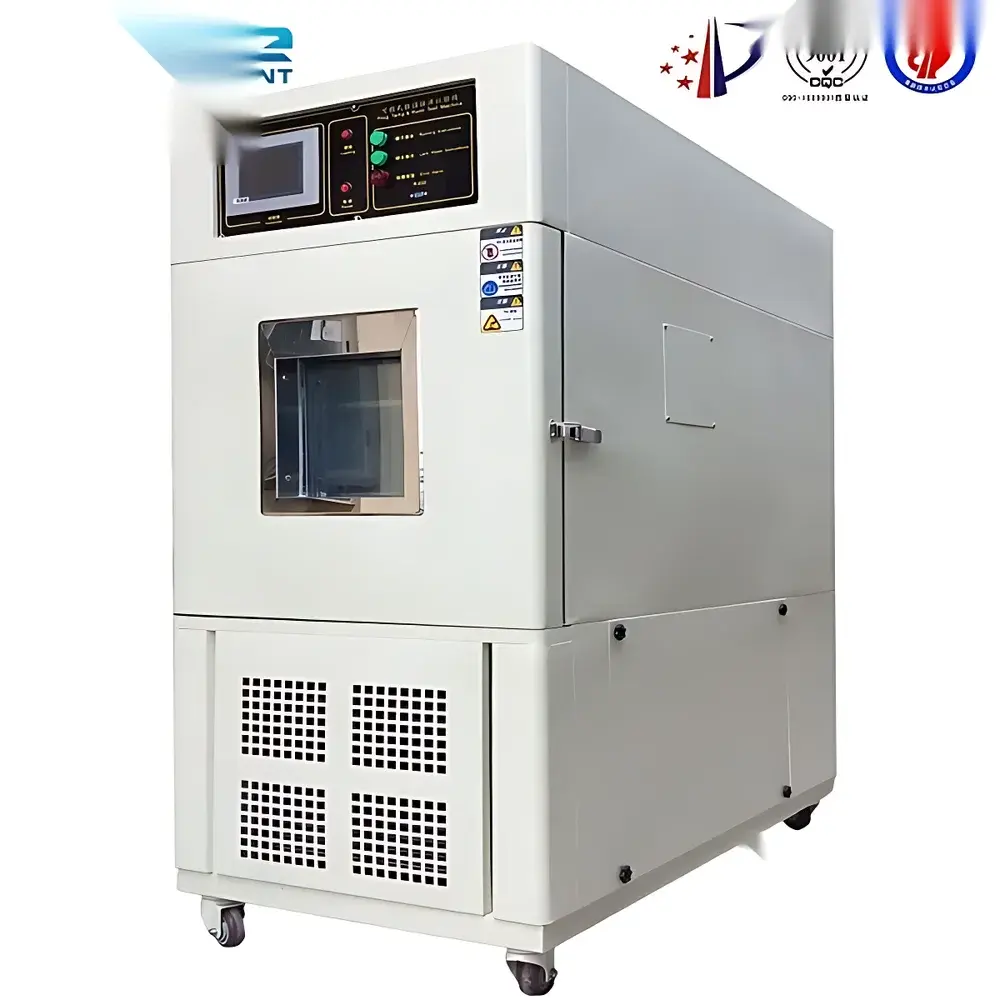
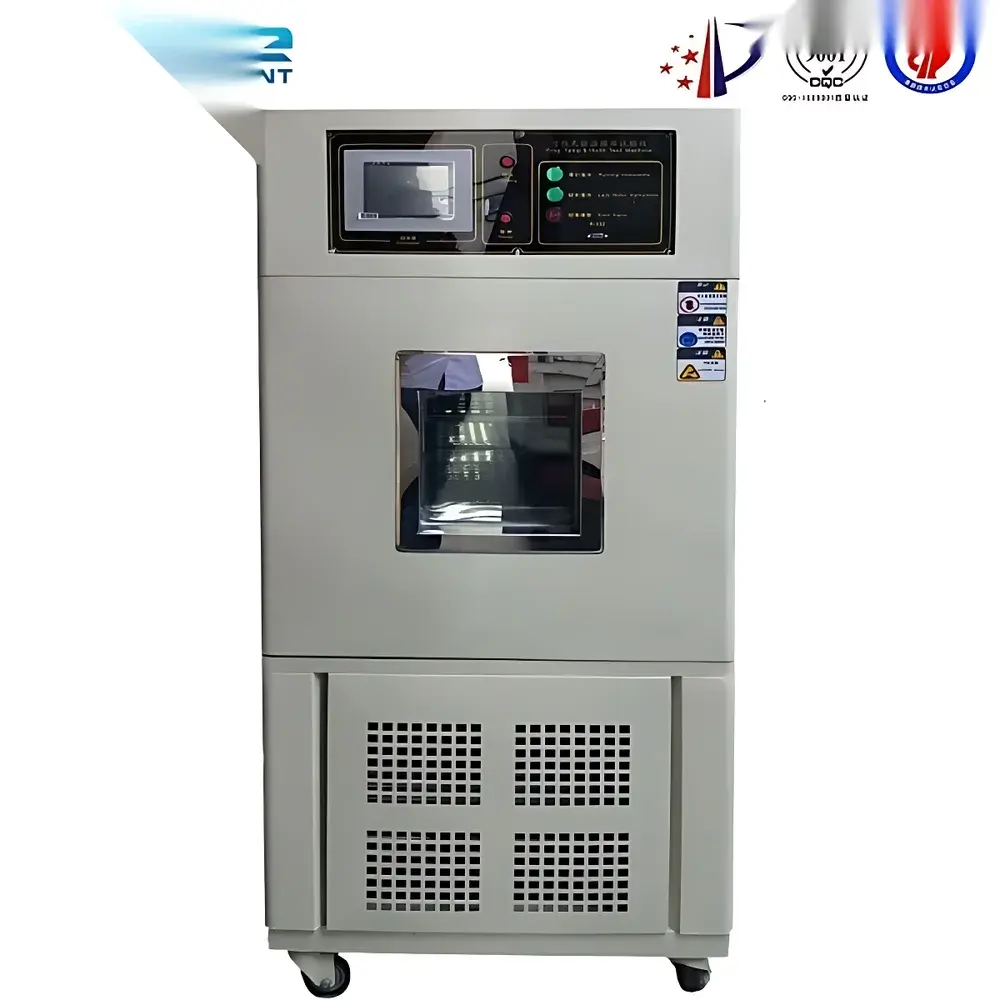
Standard Temperature and Humidity Controlled Chamber
| Brand | OEM |
|---|---|
| Origin | Imported |
| Manufacturer Type | Authorized Distributor |
| Price | USD 2,650 (FOB) |
| Temperature Range | −40°C to +150°C |
| Humidity Range | 20%–98% RH |
| Uniformity | ±0.5°C / ±2% RH |
| Control Accuracy | ±0.3°C / ±1% RH |
| Ramp Rate (Typical) | 3°C/min (air average, unloaded) |
| Cooling Water Requirement | 10–28°C, 0.1–0.3 MPa |
| Power Supply | 380 VAC, 3-phase, 50/60 Hz |
| Compliance | GB/T 2423.1–2023, GB/T 2423.2–2023, IEC 60068-2-1, IEC 60068-2-2, GJB 1032A–2012, MIL-STD-2164A |
Overview
The Standard Temperature and Humidity Controlled Chamber is an engineered environmental test system designed for precise, repeatable simulation of temperature and humidity profiles under controlled laboratory or production floor conditions. It operates on a balanced heating, cooling, and humidification principle—commonly referred to as Balanced Temperature and Humidity Control (BTHC)—where PID-regulated SSR outputs dynamically match thermal and moisture load demands to achieve long-term stability without overshoot or drift. This architecture ensures compliance with rigorous international test standards for environmental stress screening (ESS), reliability qualification, and accelerated life testing across electronics, automotive components, aerospace hardware, and industrial materials. The chamber employs a fully capillary-based refrigeration circuit with R404A refrigerant (non-ozone-depleting, zero ODP), coupled with a stainless-steel steam-type humidifier featuring distilled water recovery—minimizing consumables while maintaining traceable moisture delivery. All operational parameters are validated under ISO/IEC 17025-accredited third-party calibration, with certificates traceable to NIM (National Institute of Metrology, China) or equivalent national metrology institutes.
Key Features
- Robust structural design with seamless arc-shaped interior chamber and powder-coated steel exterior; door equipped with flat, non-reactive handle and double-layer insulated glass viewport
- Advanced touchscreen controller with multi-language UI (English, German, Japanese, Chinese), programmable step-and-ramp profiles, real-time data logging, and USB export capability
- BTHC control algorithm using dual PID loops for independent temperature and humidity regulation—ensuring ±0.3°C and ±1% RH control accuracy in steady-state operation
- Full-capillary refrigeration system with automatic capacity modulation—eliminating mechanical expansion valve wear and improving thermal response linearity and longevity
- Integrated safety architecture: dry-run protection for humidifier, independent over-temperature cutoff, low-water-level sensor, compressor overcurrent/overheat/overpressure detection, high-pressure refrigerant switch, and Class I earth-leakage circuit breaker (30 mA)
- Energy-optimized design: optimized airflow ducting and insulation reduce power consumption by up to 30% versus conventional chambers; auto-filtered tap-water feed eliminates need for deionized or distilled supply
Sample Compatibility & Compliance
This chamber accommodates standard test specimens up to 500 mm × 500 mm × 500 mm (W×D×H), with two adjustable stainless-steel shelves included as standard. Load configuration, material emissivity, and thermal mass directly influence achievable ramp rates—per Clause 2 of IEC 60068-3-5, all specified ramp values (e.g., 3°C/min) reflect air-average rates measured at chamber center under no-load, 25°C ±6°C ambient conditions. The system meets full requirements for GB/T 2423.1 (cold test), GB/T 2423.2 (dry heat test), IEC 60068-2-1 (cold), IEC 60068-2-2 (dry heat), GJB 1032A–2012 (environmental stress screening), and MIL-STD-2164A (electronic equipment ESS). Optional validation packages include IQ/OQ documentation aligned with GLP and GMP Annex 15 expectations, supporting FDA 21 CFR Part 11-compliant electronic records when paired with audit-trail-enabled software modules.
Software & Data Management
The embedded controller firmware supports standalone operation with up to 100 programmable test cycles, each containing 99 segments (ramp/soak/humidity modulation). Data is stored internally for ≥30 days at 1-second resolution and exportable via USB to CSV or Excel-compatible formats. Optional PC-based software (OC-EnvLink v3.x) provides remote monitoring, multi-chamber synchronization, alarm email/SMS notification, PDF report generation with digital signature, and integration into MES/LIMS platforms via Modbus TCP or OPC UA. All software modules comply with ISO/IEC 17025:2017 clause 7.7.1 for measurement traceability and support version-controlled firmware updates with SHA-256 integrity verification.
Applications
- Environmental stress screening (ESS) of PCB assemblies, connectors, sensors, and embedded controllers per MIL-STD-2164A and GJB 1032A
- Temperature-humidity bias testing of lithium-ion battery cells and BMS modules under combined thermal and hygroscopic stress
- Validation of sealing integrity and material degradation in automotive lighting housings, infotainment enclosures, and ADAS radar modules
- Accelerated aging of polymer-based medical device packaging per ISO 11607-1
- Stability testing of precision optical components and MEMS devices under cyclic dew-point exposure
- Qualification of aerospace-grade adhesives and composites per ASTM D5229/D5229M (moisture absorption) and ASTM D618 (conditioning)
FAQ
What is the difference between “air-average ramp rate” and “product temperature ramp rate”?
Per IEC 60068-3-5, air-average ramp rate refers to the mean change in chamber air temperature measured at geometric center—not the actual thermal response of the DUT. Product-specific rates depend on mass, surface area, emissivity, and mounting method, and must be verified separately using embedded thermocouples.
Can this chamber operate continuously at 98% RH above 85°C?
No. Sustained operation above 85°C and >85% RH is not recommended due to condensation risk on internal sensors and controller electronics. Maximum combined operating envelope is 85°C / 85% RH per IEC 60068-2-30.
Is third-party calibration included with shipment?
Yes—a NIM-traceable certificate covering temperature uniformity, humidity accuracy, and controller setpoint fidelity is provided with every unit. Full ISO/IEC 17025 calibration with uncertainty budgets is available as an optional service.
Does the system support 21 CFR Part 11 compliance?
When configured with OC-EnvLink Pro software and network authentication, the system supports electronic signatures, audit trails, role-based access control, and data encryption—meeting core technical requirements of 21 CFR Part 11 Subpart B.
What maintenance intervals are recommended?
Humidifier tank cleaning every 72 operating hours; refrigerant circuit inspection annually; air filter replacement quarterly; full performance verification every 12 months per ISO/IEC 17025 guidelines.



