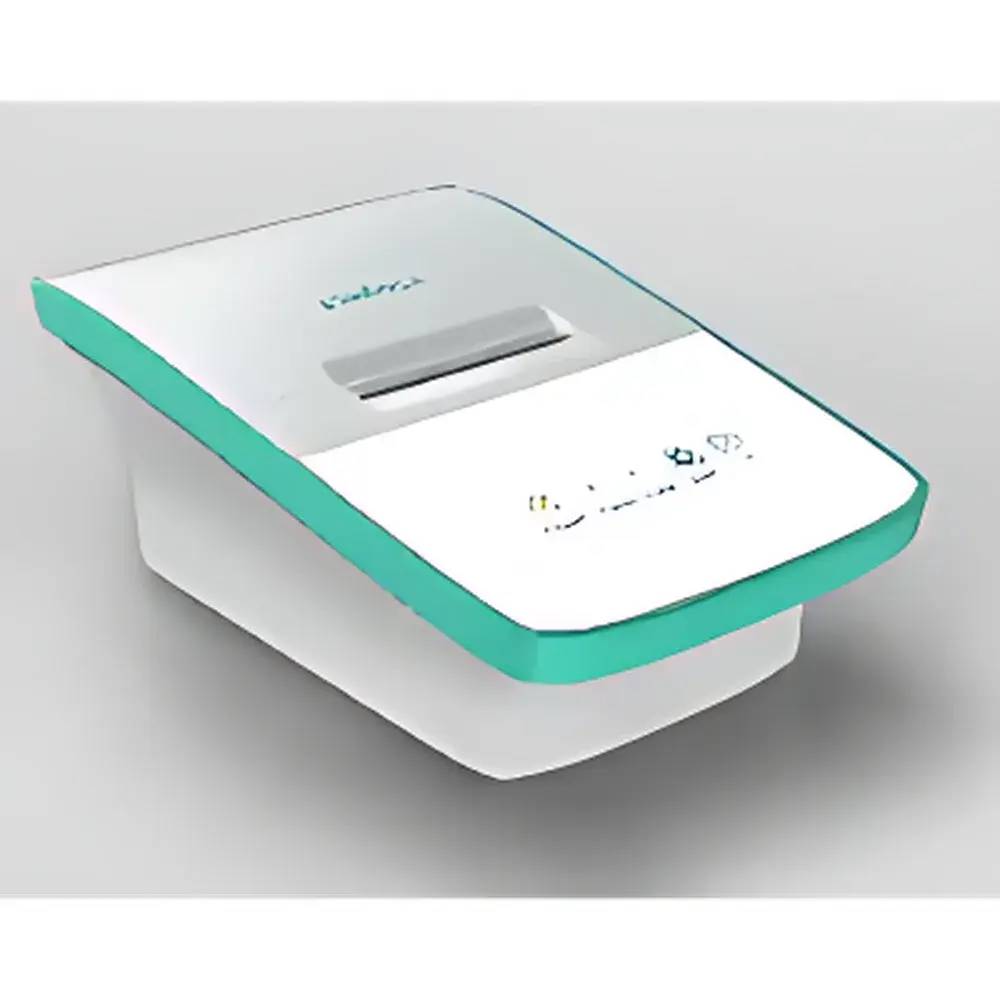
STARiTECH TX-900 Balance Data Printer
| Brand | STARiTECH |
|---|---|
| Origin | Beijing, China |
| Model | TX-900 |
| Print Resolution | 448 dots/line |
| Paper Width | 76 mm |
| Printing Technology | 9-pin dot matrix |
| Ribbon Type | Long-life fabric ribbon |
| Buffer Memory | 8 MB |
| Print Mode | High-speed bidirectional printing |
| Media | Plain paper only |
| Compliance | Suitable for GLP/GMP environments requiring permanent record retention |
Overview
The STARiTECH TX-900 Balance Data Printer is a dedicated serial interface printer engineered for reliable, audit-ready data output from analytical balances, titrators, moisture analyzers, spectrophotometers, and water quality analyzers. Designed specifically for laboratory instrumentation with RS-232 or TTL-level serial output, the TX-900 employs proven 9-pin dot matrix technology to produce physically durable, chemically stable hard copies—essential for regulated environments where electronic records alone do not satisfy long-term archival requirements. Unlike thermal printers subject to fading or inkjet printers vulnerable to humidity and smudging, the TX-900’s impact-based printing mechanism ensures permanent legibility of weight logs, titration curves, calibration reports, and spectral traces over decades when stored under standard ambient conditions. Its mechanical architecture prioritizes operational continuity: no warm-up time, no consumable cartridges, and no dependency on proprietary media—only standard 76 mm plain paper and a replaceable fabric ribbon.
Key Features
- 448-dot-per-line horizontal resolution enables accurate rendering of line graphs, calibration curves, and multi-parameter tables—critical for instruments generating time-series or multi-channel output (e.g., potentiometric titration endpoints or absorbance vs. wavelength plots).
- 8 MB built-in serial receive buffer decouples instrument operation from print latency; balances and analyzers resume measurement cycles immediately after data transmission, eliminating workflow bottlenecks in high-throughput QC labs.
- Bidirectional high-speed printing reduces report generation time by up to 40% compared to unidirectional equivalents, maintaining throughput during peak sample processing periods.
- 76 mm paper width accommodates standard laboratory roll formats while providing sufficient lateral space for dual-column weight logs, timestamped metadata, and instrument ID headers without truncation.
- Industrial-grade 9-pin print head rated for ≥50 million characters lifetime; combined with low-tension ribbon drive mechanics, it delivers consistent character density across extended duty cycles typical in 24/7 pharmaceutical stability chambers or environmental monitoring stations.
Sample Compatibility & Compliance
The TX-900 interfaces seamlessly with all major balance and analyzer brands supporting ASCII-based serial protocols—including METTLER TOLEDO, Sartorius, OHAUS, Shimadzu, Hach, and Thermo Fisher Scientific instruments—via configurable baud rate (1200–115200 bps), parity, and stop-bit settings. It meets fundamental data integrity prerequisites for Good Laboratory Practice (GLP) and Good Manufacturing Practice (GMP) compliance: printed output constitutes an original, contemporaneous, attributable, legible, and enduring record (ALCOA+ principles). While the printer itself is not FDA 21 CFR Part 11 certified (as standalone peripherals fall outside software validation scope), its deterministic, non-editable output supports Part 11-compliant workflows when paired with validated host instruments that enforce electronic signature and audit trail controls prior to data transmission.
Software & Data Management
No driver installation or PC intermediary is required—the TX-900 operates as a transparent serial pass-through device. Instrument firmware sends ASCII or ESC/P-compatible control codes directly; the printer interprets line feeds, form feeds, and font selection commands without interpretation layer or firmware update dependency. All configuration (e.g., line spacing, left margin, international character set) is performed via hardware DIP switches or front-panel command sequences—eliminating software compatibility risks across Windows, Linux, or embedded OS platforms. The absence of internal storage or network interface precludes unauthorized data retention or remote access vectors, reinforcing data sovereignty in air-gapped analytical networks.
Applications
- Pharmaceutical QC labs: Permanent recording of balance tare sequences, assay weight entries, and dissolution test results per USP & EP monographs.
- Environmental testing facilities: Hard-copy archiving of TOC analyzer outputs, pH/mV logs from multiparameter sondes, and BOD incubation weight differentials.
- Academic research cores: Documentation of gravimetric precipitate yields, Karl Fischer titration water content curves, and UV-Vis kinetic scans where peer-reviewed publication requires traceable primary data.
- Food safety laboratories: Audit-ready printouts of net weight verification reports for HACCP prerequisite programs and FSMA recordkeeping obligations.
FAQ
Does the TX-900 support barcode or QR code printing?
No—it is optimized for alphanumeric and basic vector graphics (e.g., lines, boxes, simple curves) using dot-addressable raster mode. Barcode generation must be handled by the host instrument’s firmware.
Can it be used with modern USB-only balances?
Only if the balance provides a physical RS-232 port or a validated USB-to-serial adapter with native CDC ACM class drivers and stable latency characteristics.
What is the expected ribbon lifespan under continuous lab use?
Approximately 2 million characters per ribbon under standard 10-pt courier font usage—equivalent to 12–18 months in a medium-volume QC lab performing 50–100 print jobs daily.
Is paper jam detection or automatic cut-sheet feeding available?
No—the TX-900 uses continuous-feed 76 mm paper with manual tear-off; it lacks sensors or mechanical cutters to minimize failure points and service downtime.
Does it comply with RoHS or REACH directives?
Yes—manufactured in accordance with EU Directive 2011/65/EU (RoHS2) and Regulation (EC) No 1907/2006 (REACH), with full material declaration documentation available upon request from STARiTECH authorized distributors.