
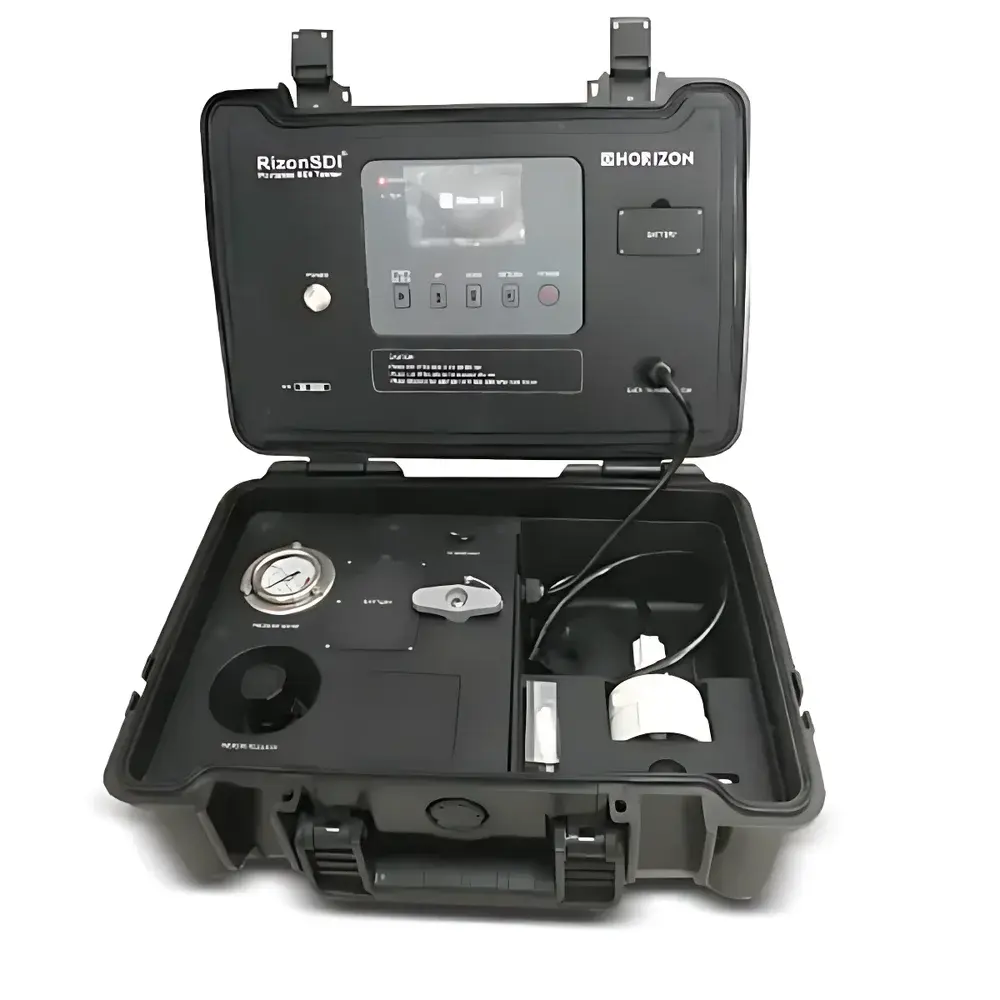
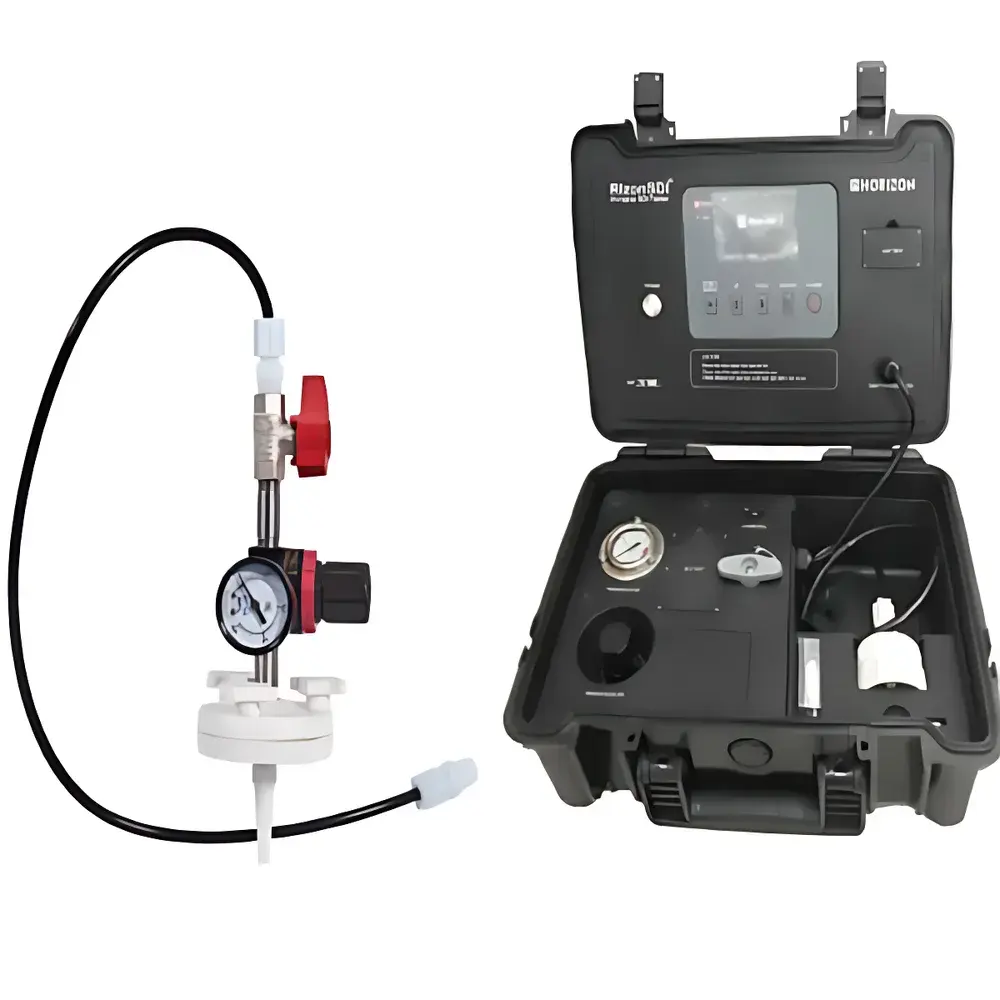
Starwood RizonSDI Portable Silt Density Index Tester
| Brand | Starwood |
|---|---|
| Origin | Beijing, China |
| Manufacturer Type | Manufacturer |
| Model | RizonSDI |
| Operating Temperature | 0–65 °C |
| Operating Humidity | ≤90% RH |
| Sample Flow Rate | >2 L/min |
| Test Pressure Range | 0.3–0.5 MPa |
| Dimensions | 365 mm × 270 mm × 150 mm |
| Weight | 4.5 kg |
| Housing Material | Reinforced Engineering Plastic |
| Inlet Connection | 5/16″ Quick-Connect Fitting |
| Inlet Tubing OD | 5/16″ |
| Inlet Temperature Range | −5–40 °C (non-freezing) |
| Battery Capacity | 4400 mAh |
| Operating Voltage | DC 12 V |
| Continuous Operation Time | Up to 25 h |
| Charging Time | 6 h |
| Data Storage | 100 test records with timestamp (real-time clock) |
| SDI Calculation | SDI₅, SDI₁₀, SDI₁₅ per ASTM D4189-07 |
| Optional Accessories | Diaphragm Booster Pump (DC 24 V, 5 A, max. 0.7 MPa, 4 L/min), 47 mm MCE Membranes (0.45 µm) |
Overview
The Starwood RizonSDI Portable Silt Density Index Tester is a field-deployable, microprocessor-controlled instrument engineered for precise, standardized measurement of the Silt Density Index (SDI) in feedwater streams for membrane-based water treatment systems. SDI quantifies colloidal and particulate fouling potential by measuring the rate of flux decline across a 0.45 µm microporous membrane under constant pressure (2.07 bar / 30 psi), as defined in ASTM D4189-07. This test is a critical pre-commissioning and operational monitoring parameter for reverse osmosis (RO), nanofiltration (NF), and ultrafiltration (UF) systems—particularly in desalination plants, power generation, pharmaceutical water systems, and municipal water reclamation facilities. Unlike manual SDI kits requiring stopwatch timing, graduated cylinder collection, and manual calculation, the RizonSDI automates flow control, time logging, and SDI computation, eliminating operator-dependent variability and ensuring compliance with industry-accepted reproducibility criteria.
Key Features
- Integrated pressure regulation and real-time flow monitoring (>2 L/min at 0.3–0.5 MPa inlet pressure) to maintain ASTM-specified test conditions
- Automated SDI calculation for three standard intervals: SDI5, SDI10, and SDI15, with built-in algorithm per ASTM D4189-07
- Rechargeable 4400 mAh lithium-ion battery enabling up to 25 hours of continuous field operation without external power
- Real-time digital flow display and automatic time-stamped logging—no manual stopwatch or volumetric collection required
- 100-test non-volatile memory with embedded real-time clock (RTC), preserving date/time metadata for audit-ready traceability
- Ruggedized engineering plastic enclosure (365 × 270 × 150 mm; 4.5 kg) rated for industrial field environments and transport in mobile labs
- Quick-connect 5/16″ inlet interface compatible with standard flexible tubing; optional diaphragm booster pump extends applicability to low-pressure source water
Sample Compatibility & Compliance
The RizonSDI is validated for use with both freshwater and seawater matrices, including pretreated RO feedwater, UF permeate, surface water, groundwater, and reclaimed wastewater. It accepts standard 47 mm mixed cellulose ester (MCE) membranes with 0.45 µm pore size (e.g., AikeSDI® HAK-47-MCE). The instrument’s pressure control architecture ensures stable 30 psi (2.07 bar) test pressure across variable inlet conditions, satisfying the hydraulic consistency requirement of ASTM D4189-07. Its design supports GLP-aligned data integrity: each stored result includes test start time, duration, initial and final flow rates, and computed SDI values—enabling retrospective review and regulatory readiness for ISO 9001, ISO/IEC 17025, or FDA 21 CFR Part 11–governed environments where electronic records are subject to audit.
Software & Data Management
The RizonSDI operates autonomously without PC dependency. All measurements are processed and stored onboard using embedded firmware calibrated against NIST-traceable flow and pressure references. Data export is not supported via USB or Bluetooth; however, the 100-entry memory retains full test context—including RTC timestamp, flow decay curve points, and pass/fail flags against common SDI thresholds (e.g., SDI15 < 3.0 for RO feed acceptance). For laboratory integration, users may manually transcribe results into LIMS or QA/QC spreadsheets. Firmware updates are performed via proprietary service mode accessible only through authorized Starwood technical support—ensuring configuration stability and preventing unauthorized modification of calibration parameters.
Applications
- Pre-RO system commissioning and routine feedwater qualification in desalination and industrial water reuse plants
- Performance validation of multimedia filters, cartridge filters, and activated carbon units in pretreatment trains
- Field assessment of seasonal particulate loading in surface water intakes or reservoir-fed distribution systems
- Research-grade SDI correlation studies with turbidity, particle count, and organic carbon (TOC) metrics in academic and utility R&D labs
- Mobile QA/QC verification during membrane element installation, cleaning protocol validation, or post-maintenance restart procedures
- Regulatory compliance documentation for ISO 20426 (seawater desalination) and EP 2.2.27 (pharmaceutical water systems)
FAQ
What standards does the RizonSDI comply with?
It conforms to ASTM D4189-07 for SDI measurement methodology, including pressure control, membrane specification, and calculation logic.
Can it be used with seawater without modification?
Yes—its wetted components are corrosion-resistant, and its pressure regulation is stable across salinity-induced viscosity changes; however, membrane fouling kinetics differ, so interpretation must follow marine desalination guidelines (e.g., ISO 20426 Annex B).
Is the internal clock battery-backed to retain time during charging cycles?
Yes—the real-time clock uses a dedicated backup capacitor, ensuring timestamp continuity across power cycles and battery replacement.
Does the instrument require annual recalibration?
No scheduled recalibration is mandated; however, users should verify pressure accuracy annually using a certified deadweight tester and validate flow sensor linearity with a master rotameter per ISO/IEC 17025 clause 6.5.
How is membrane change performed in the field?
The filtration module features a tool-free quarter-turn latch; membrane replacement takes <60 seconds and requires no alignment tools or torque wrenches.
Related Products







