
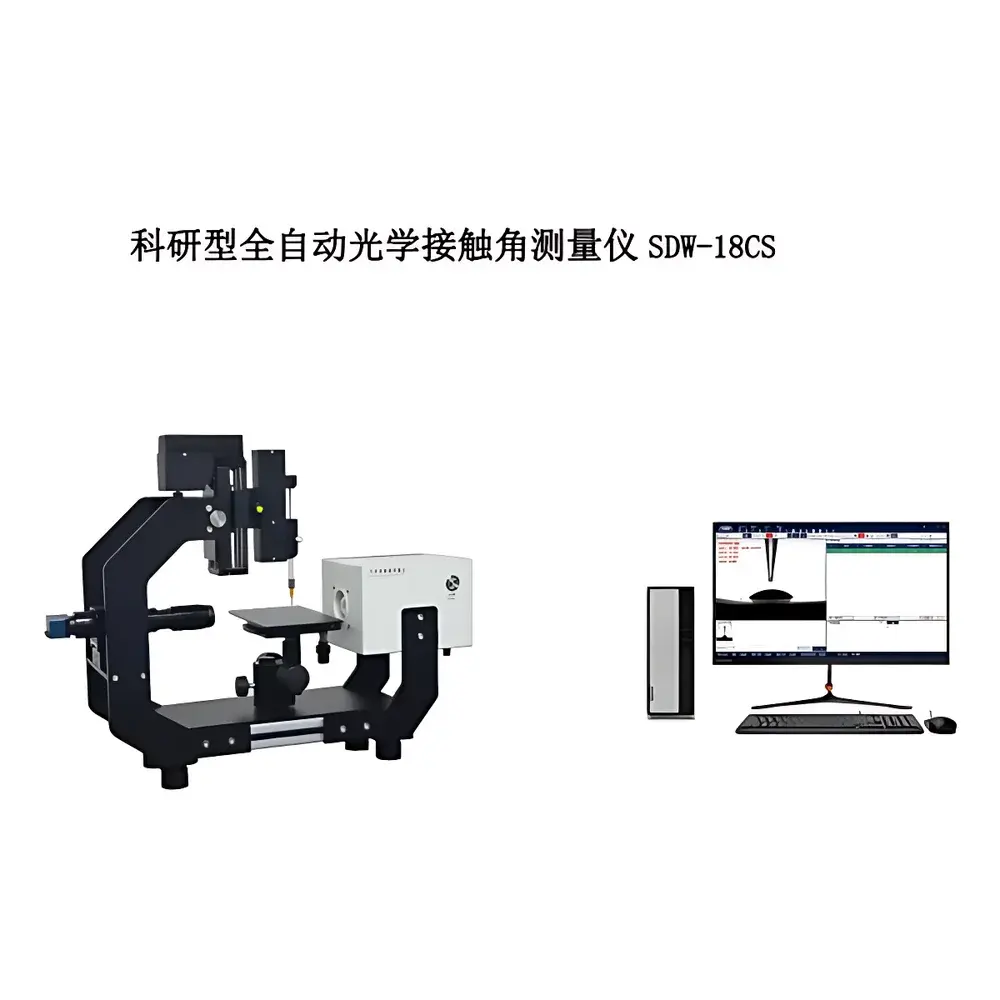
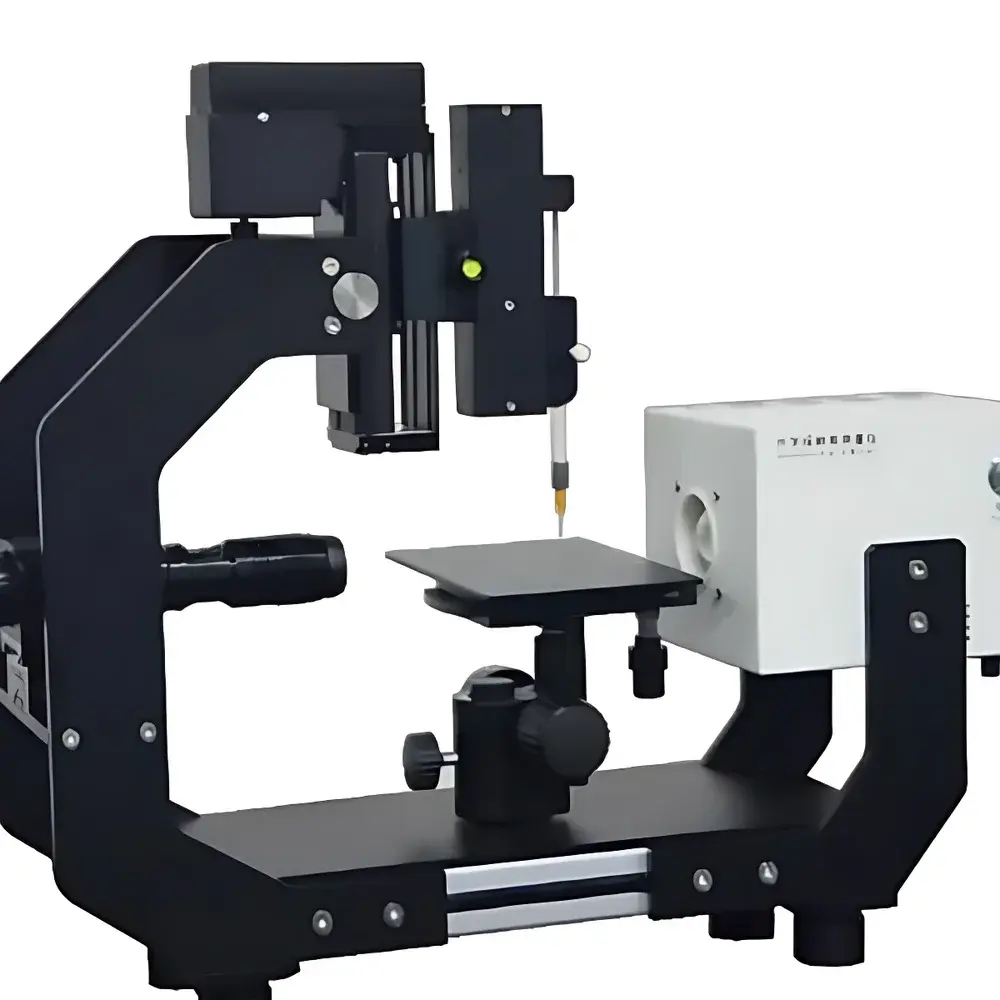
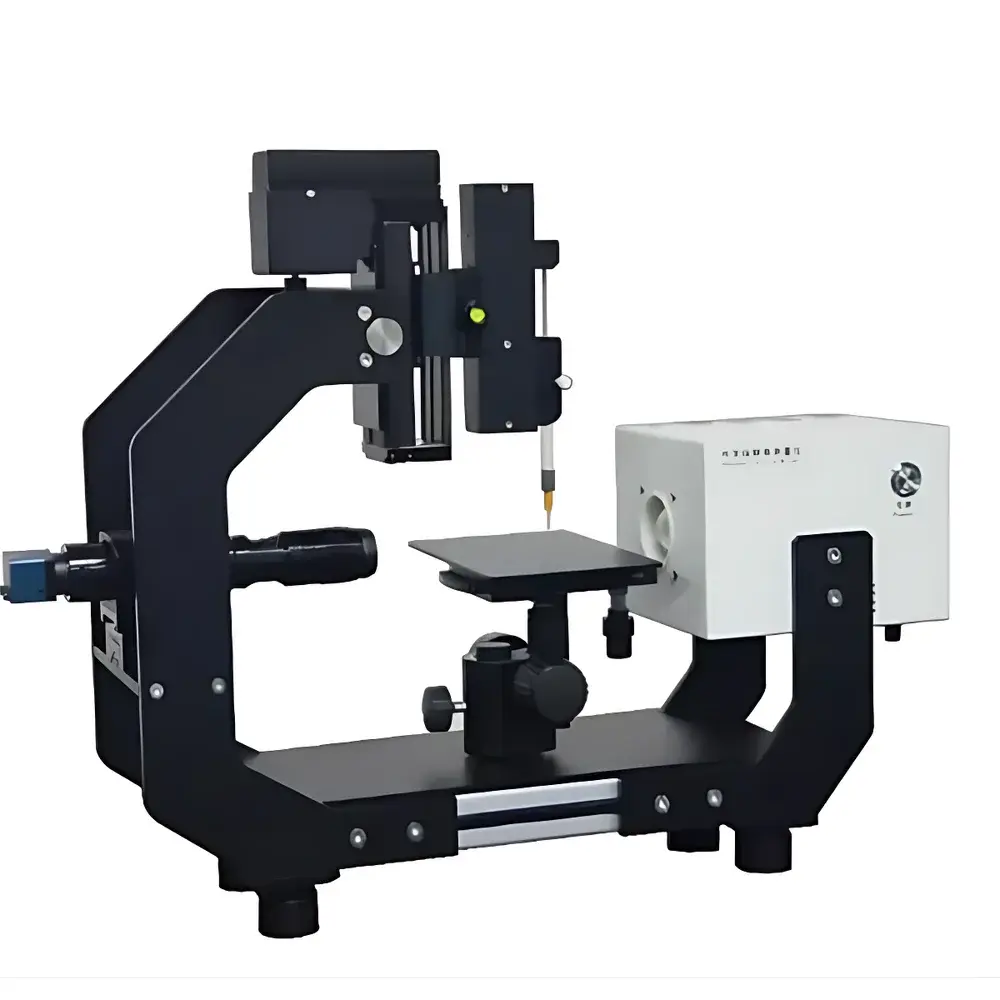
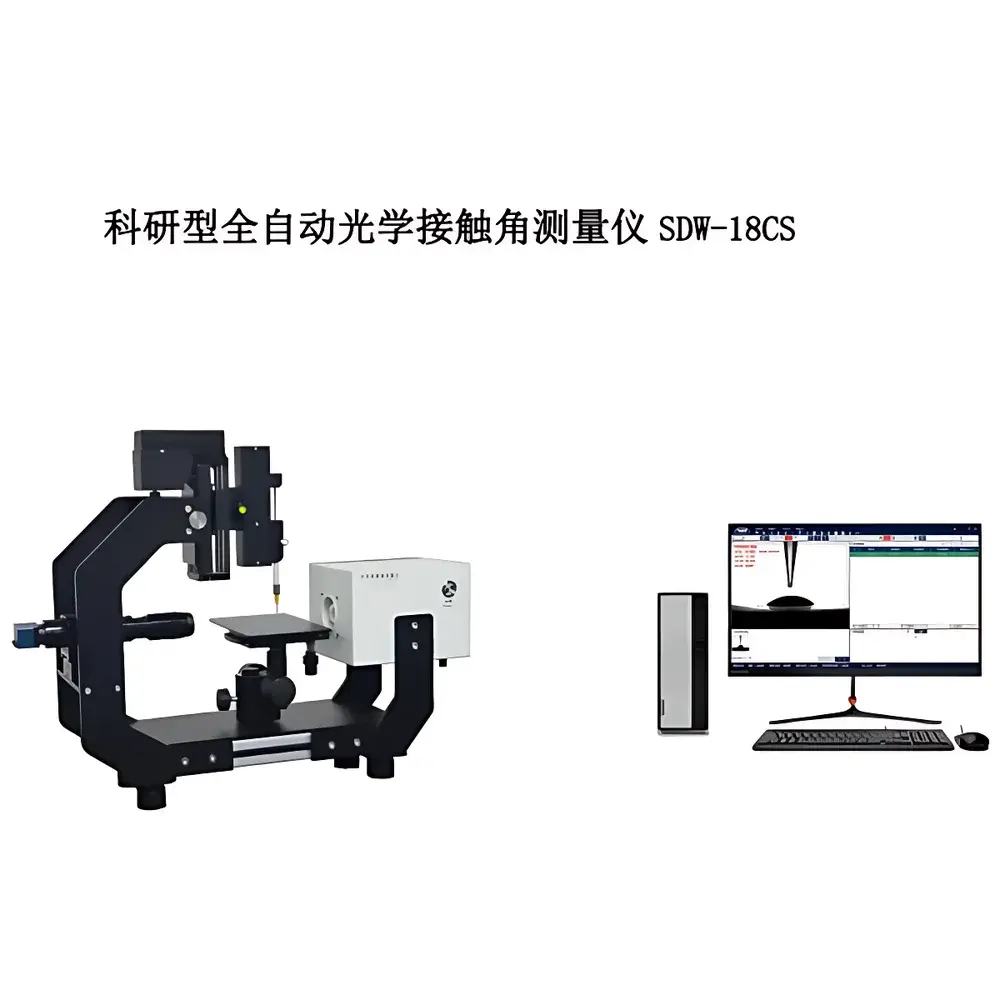
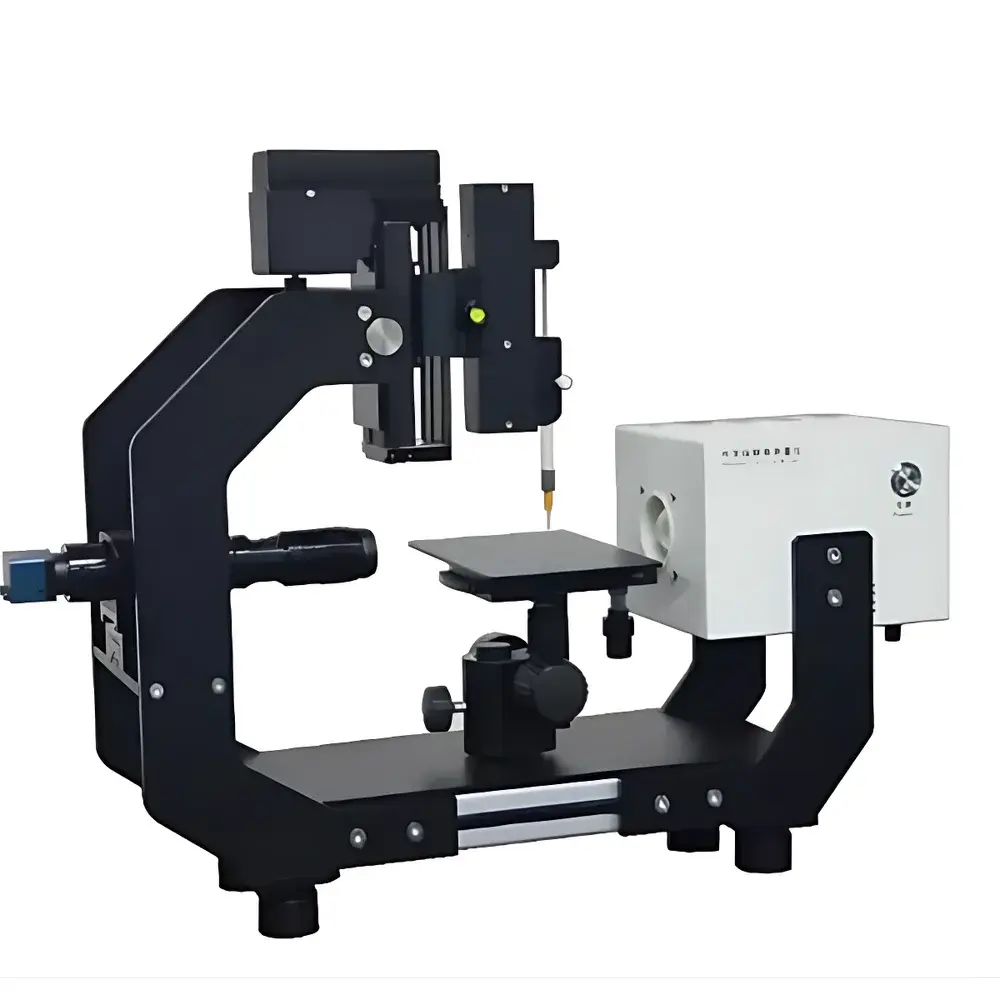
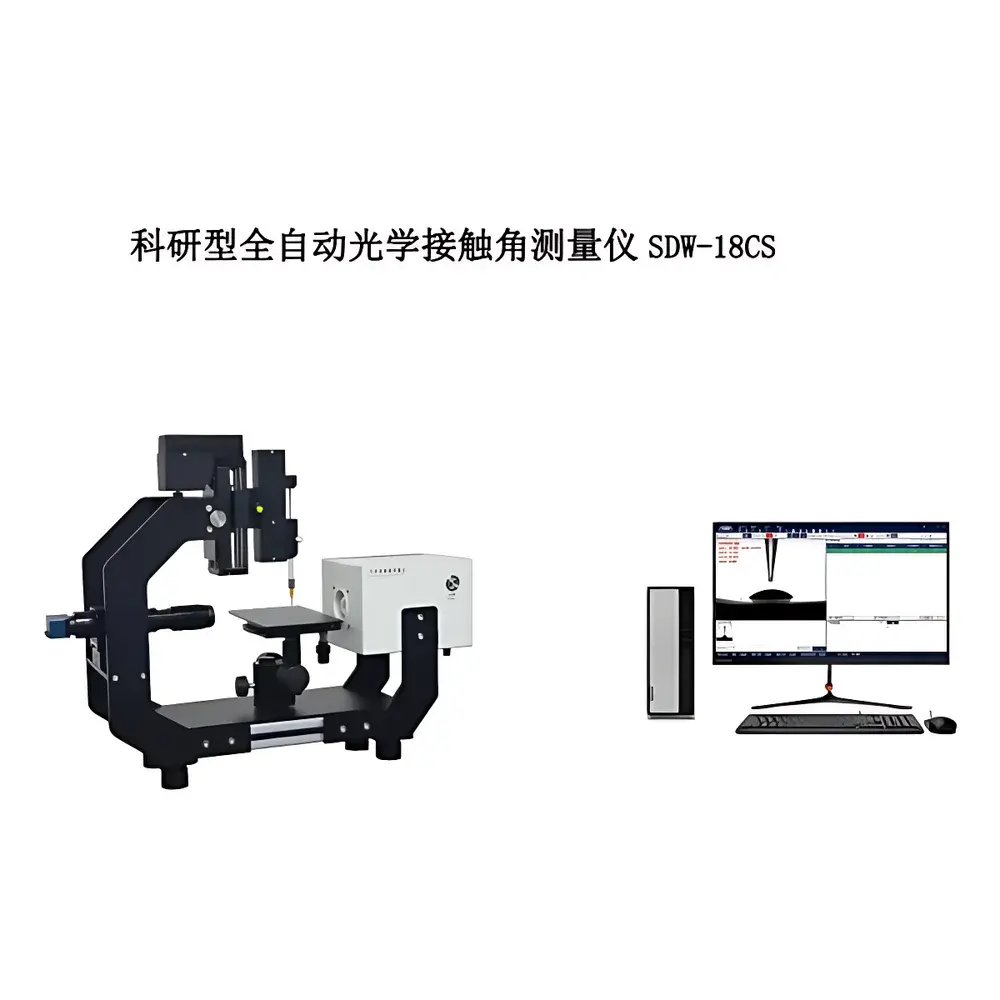
Starwood SDW-18CS Research-Grade Fully Automated Optical Contact Angle Analyzer
| Brand | Starwood |
|---|---|
| Model | SDW-18CS |
| Type | Research-Grade Fully Automated Optical Contact Angle Analyzer |
| Construction Material | Aerospace-Grade Aluminum Alloy |
| Power Supply | 220 V, 50–60 Hz |
| Power Consumption | 10 W |
| Dimensions (W × L × H) | 655 × 180 × 520 mm |
| Weight | ~16 kg |
| Sample Stage Travel (X/Y/Z) | 30/50/30 mm (manual, 0.1 mm resolution) |
| Leveling | Full-system + camera-level XY precision leveling (included professional-grade XY level) |
| Sample Platform Size | 130 × 150 mm (customizable) |
| Max Sample Size | 200 (W) × ∞ (L) × 30 (H) mm |
| Dispensing System Y/Z Travel | 40/35 mm (0.1 mm resolution) |
| Dropping Stroke | 60 mm (0.01 mm resolution) |
| Droplet Volume Precision | 0.01 µL |
| Syringe Capacity | 500 µL (auto liquid-level detection) |
| Standard Needles | 0.5 mm stainless steel (20 pcs), 0.25 mm superhydrophobic needle (20 pcs) |
| Camera | Japan Sony industrial-grade CMOS (Onsemi global shutter), 1/1.8″ progressive scan, 1280 × 1024 resolution |
| Lens Magnification | 0.7×–4.5×, focus adjustment ±2.5 mm |
| Max Frame Rate | 80 fps |
| Light Source | US-sourced industrial white cold LED (400–760 nm), quartz diffuser for uniform illumination, 50,000 h lifetime, PWM + software brightness control |
| Contact Angle Methods | Sessile drop, pendant drop, captive bubble, tilting plate (dynamic) |
| Static CA Fitting Algorithms | Circle, Oblique Circle, Ellipse, Oblique Ellipse, B-Snake, concave/convex surface fitting |
| Dynamic CA Analysis | Advancing, receding, hysteresis angles (batch image & video-based analysis) |
| Baseline Detection | Auto/manual |
| Angular Range | 0° < θ < 180° |
| Angular Accuracy | ±0.1° |
| Angular Resolution | 0.001° |
| Surface Energy Models | Fowkes, OWRK, Zisman, EOS, Acid-Base Theory, Wu Harmonic Mean, Extended Fowkes (37 preloaded liquids |
| Surface Tension Range | 0.1–2000 mN/m |
| Surface Tension Accuracy | ±0.01 mN/m |
| Work of Adhesion / Spreading Coefficient / Adhesion Tension | Auto-calculated, resolution 0.001 mN/m |
| Software | CA V2.0 (static/dynamic CA + surface energy + interfacial tension modules) |
| OS Requirement | Windows 10 (64-bit) |
| Compliance | Designed for GLP/GMP-aligned workflows |
Overview
The Starwood SDW-18CS Research-Grade Fully Automated Optical Contact Angle Analyzer is an engineered platform for quantitative characterization of solid–liquid interfacial phenomena. Based on high-resolution optical imaging and advanced edge-detection algorithms, the instrument measures contact angle—the thermodynamically defined angle formed at the three-phase boundary between a liquid droplet, solid substrate, and surrounding vapor phase. This parameter serves as a direct indicator of surface wettability, critical for evaluating plasma treatment efficacy, cleaning validation, coating adhesion propensity, and functional surface modification. The SDW-18CS implements multiple standardized measurement geometries—including sessile drop, pendant drop, and captive bubble configurations—enabling comprehensive analysis across hydrophilic, hydrophobic, and superhydrophobic surfaces. Its architecture integrates a globally shuttered industrial CMOS sensor, telecentric zoom optics, and a thermally stable cold-light illumination system to eliminate thermal drift-induced evaporation artifacts during acquisition. Designed for repeatable, operator-independent results, the system supports both static equilibrium angle determination and dynamic contact angle profiling under controlled displacement or tilt conditions.
Key Features
- Aerospace-grade aluminum frame ensures mechanical rigidity and long-term dimensional stability under laboratory environmental fluctuations.
- Motorized, programmable dispensing module with 0.01 µL volumetric resolution and real-time liquid-level monitoring enables reproducible droplet deposition across heterogeneous substrates.
- High-speed imaging subsystem captures up to 80 frames per second with global shutter synchronization, facilitating precise temporal resolution for dynamic wetting studies.
- Multi-algorithm contact angle fitting engine includes circle, ellipse, oblique variants, B-Snake contour optimization, and specialized models for non-planar or topographically complex surfaces.
- Comprehensive surface energy quantification suite implements seven peer-reviewed theoretical frameworks (OWRK, Acid-Base, Extended Fowkes, etc.) with a fully editable library of 37 reference liquids and custom parameter entry.
- Integrated cold-white LED illumination (400–760 nm) coupled with quartz diffusion optics delivers spatially uniform, low-thermal-load lighting—critical for minimizing evaporation bias in low-volatility or micro-droplet measurements.
- Full-system and camera-specific XY leveling mechanism, supplied with calibrated professional-grade bubble levels, guarantees optical axis orthogonality to sample plane—a prerequisite for sub-degree angular accuracy.
Sample Compatibility & Compliance
The SDW-18CS accommodates samples up to 200 mm wide and 30 mm thick, with unlimited length due to its open-stage design. Its manually adjustable XYZ translation stage (30/50/30 mm travel, 0.1 mm resolution) permits precise positioning of irregular or oversized specimens—common in glass panel evaluation, flexible electronics substrates, or textile fiber arrays. The standard 130 × 150 mm aviation-aluminum sample platform is corrosion-resistant and compatible with solvent-based cleaning protocols. From a regulatory standpoint, the system’s deterministic software architecture, timestamped data logging, and configurable user access controls align with foundational requirements for Good Laboratory Practice (GLP) and Good Manufacturing Practice (GMP) environments. When deployed with validated network storage and role-based authentication, CA V2.0 supports audit trail generation compliant with FDA 21 CFR Part 11 for electronic records and signatures.
Software & Data Management
CA V2.0 is a modular, Windows 10 (64-bit) native application built for scientific traceability. It separates acquisition, analysis, and reporting functions into discrete workflows while maintaining full metadata linkage—capturing instrument configuration, environmental timestamps, operator ID, and raw image provenance. Static contact angle analysis employs ms-level automated contour fitting with optional manual refinement; dynamic measurements support batch processing of video sequences to extract advancing/receding angles with hysteresis quantification. Surface energy calculations automatically propagate uncertainty from contact angle input and liquid property databases, outputting dispersive, polar, acidic, basic, and total surface energy components in mJ/m². All results export to CSV, PDF, or structured XML formats; project files retain embedded images and intermediate fitting parameters for full reanalysis. Software updates are delivered via secure HTTPS channels with SHA-256 integrity verification.
Applications
This analyzer is routinely deployed in R&D and QC laboratories across diverse sectors: semiconductor fabrication (wafer surface activation verification), display manufacturing (ITO/glass plasma treatment mapping), biomedical device development (polymer scaffold wettability screening), pharmaceutical packaging (foil laminate seal integrity assessment), inkjet printing formulation (droplet spreading kinetics), and advanced battery electrode coating (slurry-substrate affinity prediction). In academic research, it supports fundamental investigations into nanoscale surface heterogeneity, stimuli-responsive polymer swelling, and bio-inspired superhydrophobic surface design. Its ability to quantify work of adhesion and spreading coefficients provides thermodynamic grounding for predicting delamination risk, coating uniformity, and colloidal stability in formulation science.
FAQ
What contact angle methods does the SDW-18CS support?
Sessile drop, pendant drop, captive bubble, and dynamic tilting plate methods—all implemented with automated baseline detection and multi-algorithm contour fitting.
Can the system measure contact angles on curved or textured surfaces?
Yes. The B-Snake algorithm and convex/concave surface fitting modules enable robust contour extraction on non-planar geometries, including cylindrical lenses, micropatterned PDMS, and fiber bundles.
Is surface energy calculation automated and traceable?
Surface energy modeling is fully automated within CA V2.0; all selected models, input liquids, and derived component energies are logged with timestamps and operator metadata for full auditability.
Does the software comply with FDA 21 CFR Part 11?
The software architecture supports Part 11 compliance when deployed in validated IT environments—including electronic signatures, audit trails, and role-based access control—but final validation remains the responsibility of the end-user organization.
What maintenance is required for long-term accuracy?
Annual calibration verification using NIST-traceable reference standards (e.g., certified contact angle slides) is recommended; optical components require only periodic dust removal with lens-grade air and non-abrasive wipes.
Related Products



