
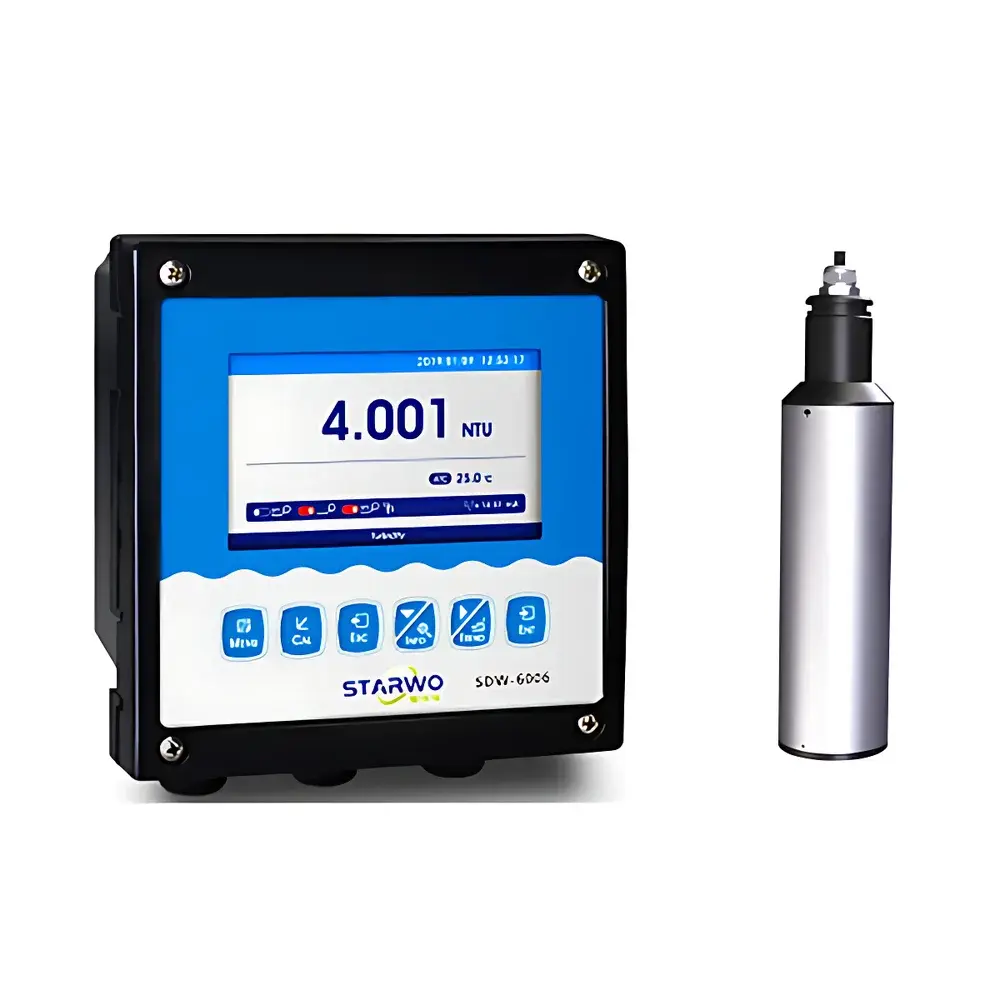
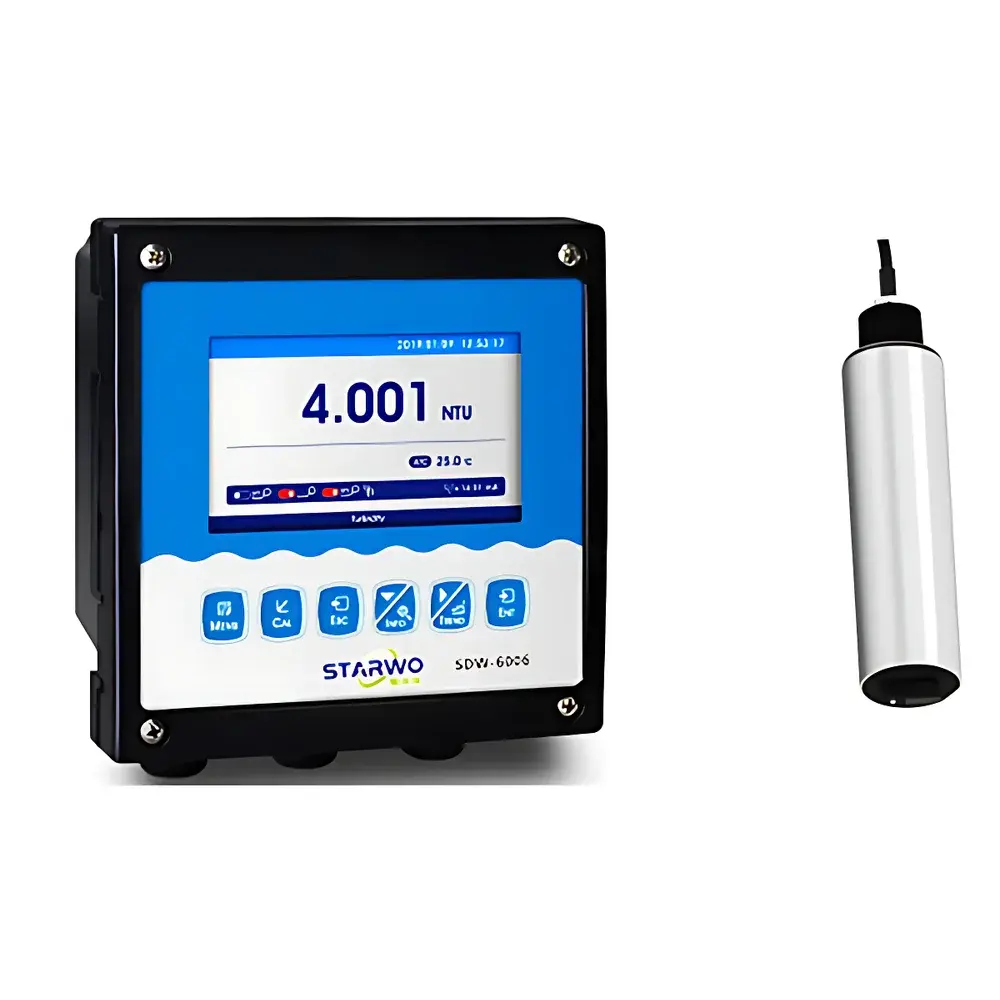
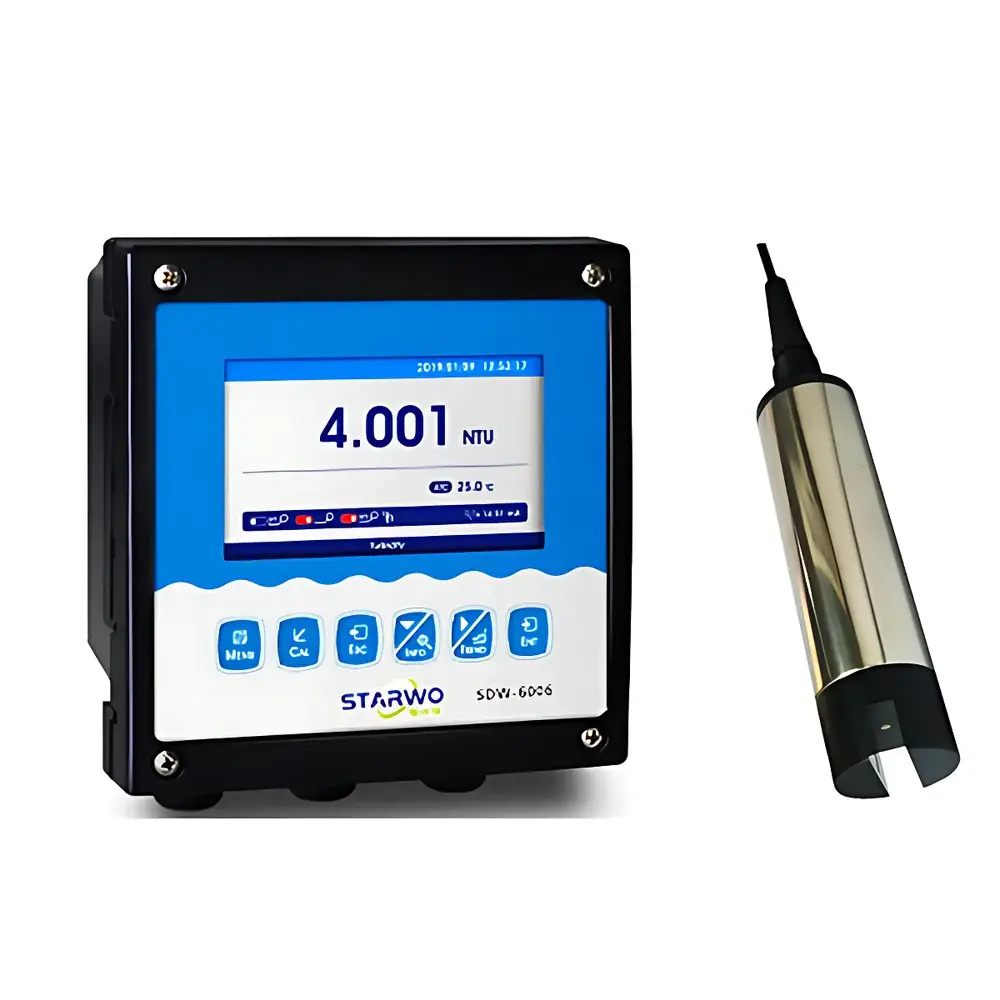
Starwood SDW-6008 Online Suspended Solids (Sludge) Concentration Meter
| Brand | Starwood |
|---|---|
| Model | SDW-6008 |
| Measurement Range | 0–100 g/L (Suspended Solids) |
| Temperature Range | 0–50.0 °C |
| Resolution | 0.01 mg/L / 0.01 g/L (SS), 0.1 °C (Temp) |
| Accuracy | ±1% F.S. (SS), ±0.3 °C (Temp) |
| Output | Dual 4–20 mA (≤750 Ω), RS485 MODBUS RTU |
| Relay Outputs | 2 × SPDT, 3 A @ 250 VAC / 30 VDC |
| Power Supply | 85–265 VAC ±10%, 50 ±1 Hz or 9–36 VDC |
| Enclosure Rating | IP65 |
| Dimensions | 98 × 98 × 130 mm |
| Mounting | Panel or Wall |
| Weight | 0.6 kg |
| Operating Environment | −10 to +60 °C, ≤90% RH, non-condensing |
| Sensor Compatibility | CS7860D Digital Turbidity/Suspended Solids Sensor (IP68, G3/4 thread, 0.01–50,000 mg/L, ±5% or ±0.5 NTU, 0–45 °C, 12 VDC, RS485 MODBUS RTU) |
Overview
The Starwood SDW-6008 Online Suspended Solids (Sludge) Concentration Meter is a microprocessor-based continuous monitoring instrument engineered for real-time quantification of suspended solids concentration in aqueous process streams. It operates on the principle of infrared light scattering at 180° geometry—optimized to minimize interference from color, bubble formation, and flow turbulence—making it suitable for both turbidity-correlated and direct sludge mass concentration estimation in industrial and municipal water treatment applications. Unlike optical turbidimeters calibrated solely in NTU, the SDW-6008 supports dual-unit reporting (mg/L and g/L) and enables field calibration against reference slurries or standard formazin solutions, ensuring traceable alignment with site-specific particulate characteristics. Its architecture integrates a rugged transmitter housing with modular sensor interface capability, supporting long-term deployment in high-humidity, chemically aggressive, or mechanically dynamic environments such as clarifier effluents, activated sludge return lines, and thickened sludge pipelines.
Key Features
- High-contrast color LCD display with intuitive menu navigation and multi-parameter overlay (concentration, temperature, current output status)
- Configurable dual 4–20 mA analog outputs with independent scaling, supporting simultaneous transmission to DCS and local control loops
- Two programmable SPDT relays (3 A, 250 VAC / 30 VDC) with adjustable hysteresis, high/low alarm thresholds, and latching/non-latching modes
- Automatic or manual temperature compensation using integrated Pt1000 RTD input, referenced to ISO 7027-compliant temperature dependence models
- Secure access control via user-defined password protection (three-tier privilege levels: operator, engineer, administrator)
- Robust enclosure rated IP65 for panel or wall mounting; compact footprint (98 × 98 × 130 mm) with standardized 93 × 93 mm cutout
- Wide-input power options: universal AC (85–265 VAC) or DC (9–36 VDC), both delivering ≤3 W consumption for energy-constrained installations
Sample Compatibility & Compliance
The SDW-6008 is designed for continuous measurement in low-to-high solids content aqueous matrices—including raw sewage, primary and secondary clarifier effluents, return activated sludge (RAS), waste activated sludge (WAS), anaerobic digester feed, and dewatered cake filtrate. When paired with the CS7860D submersible sensor (IP68-rated, POM + 316 stainless steel housing, G3/4 threaded mounting), it meets mechanical durability requirements for submerged operation up to 0.3 MPa pressure and temperatures up to 45 °C. The system complies with electromagnetic compatibility standards per IEC 61326-1 (industrial environment) and supports audit-ready operation under GLP and GMP frameworks through timestamped calibration logs, relay event history, and parameter change tracking—all accessible via RS485 MODBUS RTU. While not certified to USP <85> or ASTM D6477, its calibration methodology aligns with EPA Method 180.1 principles for suspended solids quantification when validated against gravimetric reference methods.
Software & Data Management
Data acquisition and configuration are managed exclusively through the built-in serial interface (RS485 MODBUS RTU, slave ID configurable 1–247). No proprietary software or USB drivers are required: standard industrial SCADA systems, PLCs (e.g., Siemens S7, Allen-Bradley ControlLogix), or HMI platforms can poll real-time values—including SS concentration, temperature, mA output status, relay states, and internal diagnostics—at user-defined intervals (default 1 s). All calibration events (zero, span, multi-point), parameter modifications, and alarm activations are time-stamped and stored in non-volatile memory for ≥12 months. The system supports MODBUS function codes 03 (read holding registers) and 06 (write single register), enabling full remote commissioning and firmware-agnostic integration into existing IIoT architectures without middleware dependency.
Applications
- Municipal wastewater treatment: continuous monitoring at influent channels, primary sedimentation basins, aeration tank mixed liquor, secondary clarifier underflow, sludge thickening units, and dewatering feed lines
- Industrial process water: pulp concentration control in paper mills, coal slurry density in washing plants, lime slurry consistency in flue gas desulfurization (FGD), and yeast/biomass concentration in fermentation bioreactors
- Power generation: fly ash slurry monitoring in ash handling systems, condensate polishing backwash streams, and cooling tower blowdown solids loading
- Food & beverage: monitoring suspended yeast in brewing fermenters, starch concentration in corn wet-milling, and fiber content in juice clarification
- Pharmaceutical manufacturing: tracking suspended catalysts or cell debris in bioprocessing skids where gravimetric sampling is impractical
FAQ
Does the SDW-6008 require periodic factory recalibration?
No. Field calibration using certified reference suspensions (e.g., kaolin, polymer standards) or process-matched slurries is sufficient. The transmitter retains calibration coefficients across power cycles.
Can the CS7860D sensor be installed in pressurized pipelines?
Yes—up to 0.3 MPa static pressure—but requires proper isolation valve and drain port integration. Direct insertion into flowing pipes must follow ISO 5167 guidelines for representative sampling location.
Is the 4–20 mA output intrinsically safe for hazardous area installation?
Not by default. For Zone 1/21 or Class I Div 2 environments, an approved galvanic isolator or safety barrier (e.g., Pepperl+Fuchs KFD2-STC4-Ex1) must be installed between transmitter and control system.
How does temperature compensation affect measurement accuracy in cold influent streams?
The Pt1000-based compensation algorithm corrects for optical path refractive index shifts and detector responsivity drift, maintaining ±1% F.S. performance down to 0 °C—verified per IEC 62264-2 test protocol.
What maintenance is required for long-term reliability?
Quarterly visual inspection of sensor window fouling; semi-annual cleaning with mild detergent and soft cloth; annual verification against lab-gravimetric analysis per ISO 11923.







