
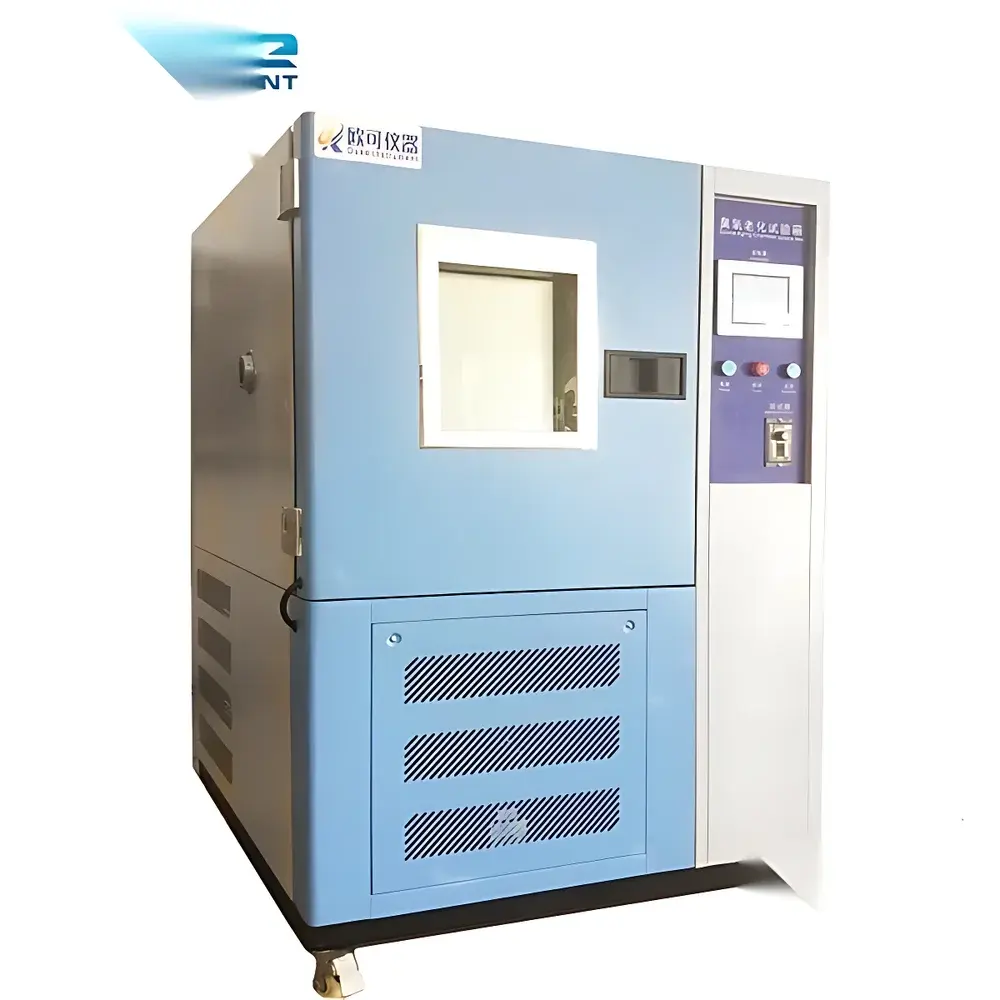
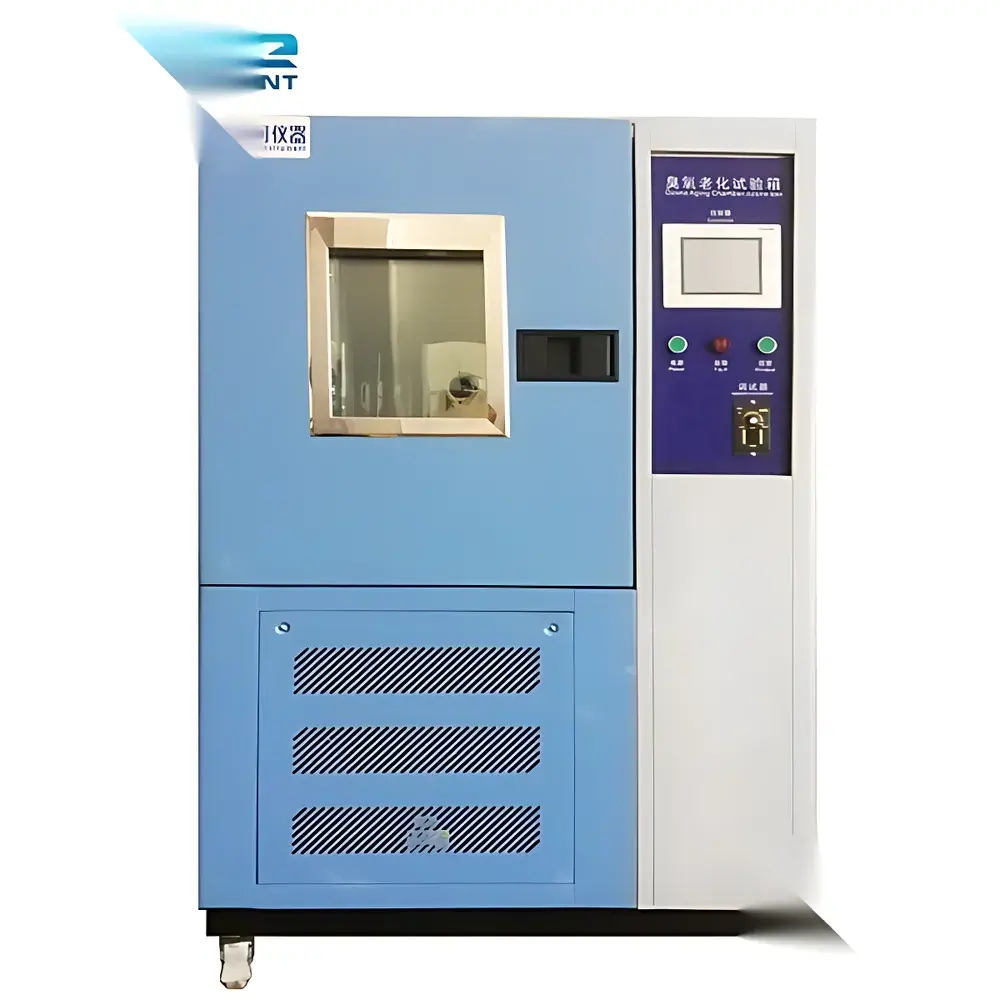
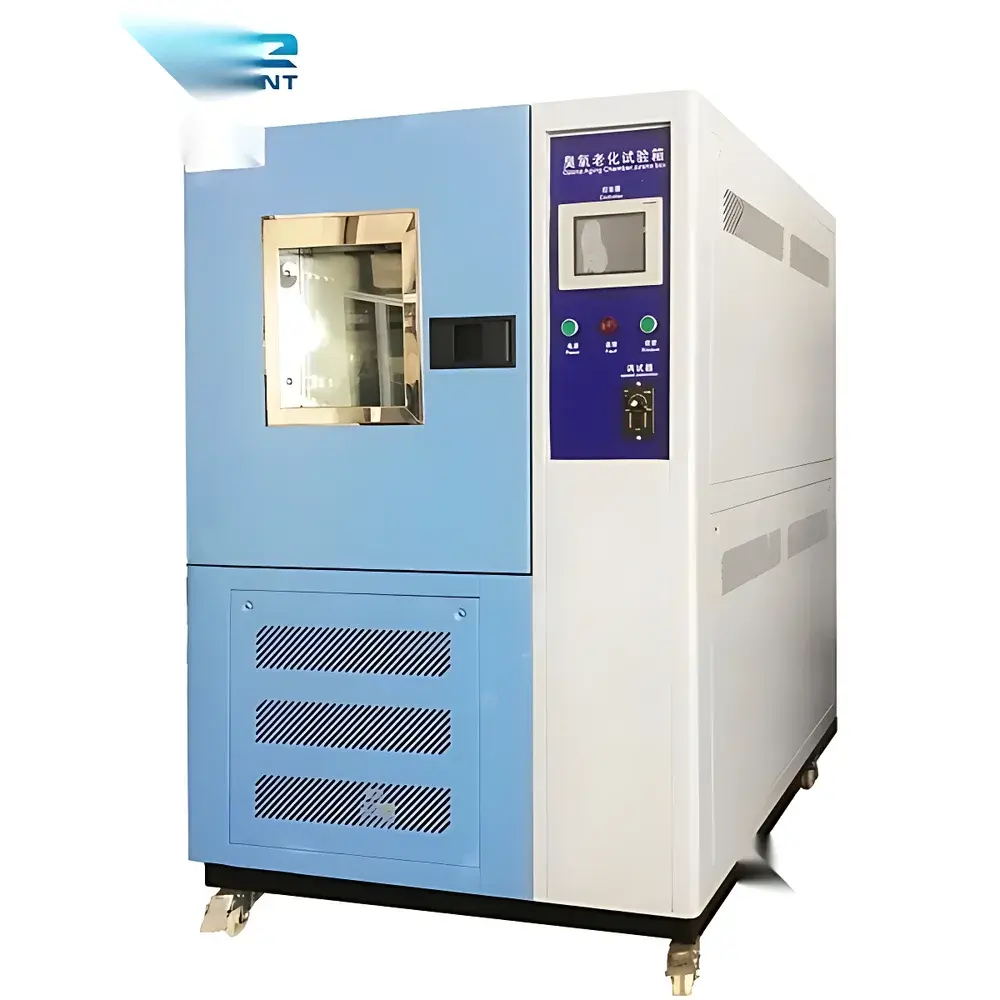
Static Ozone Aging Test Chamber
| [Brand | OEM |
|---|---|
| Origin | Imported |
| Manufacturer Type | Authorized Distributor |
| Ozone Concentration Range | 50–1500 ppmv (pphm) |
| Temperature Range | 25–40 °C |
| Humidity Range | 30–65% RH |
| Temp. Uniformity | ±0.5 °C |
| Chamber Volumes | 80 L / 225 L / 500 L / 1000 L |
| Sample Rotation | Static or Optional 360° Rotating Rack (1 rpm) |
| Ozone Generation | Silent Discharge Tube |
| Ozone Detection | Nondispersive UV Absorption Analyzer (≥5 yr service life) |
| Control System | Siemens PLC + Weintek HMI Touchscreen |
| Compliance | GB/T 7762–2003, GB/T 2951.21–2008, GB/T 11206–2009, ISO 1431-1:2004] |
Overview
The Static Ozone Aging Test Chamber (QY Series) is a precision-engineered environmental test system designed to evaluate the ozone resistance of elastomeric materials—particularly vulcanized rubber compounds—under accelerated, standardized atmospheric conditions. Ozone-induced cracking remains one of the most prevalent and insidious failure modes in rubber components exposed to ambient air, especially in automotive seals, cable jackets, conveyor belts, and aerospace gaskets. Unlike thermal or UV aging, ozone degradation occurs at ambient temperatures via direct electrophilic attack on unsaturated carbon–carbon bonds, resulting in surface microcracking without significant bulk property loss. This chamber replicates that mechanism by generating and maintaining stable, trace-level ozone concentrations (50–1500 ppmv) within a sealed stainless-steel test volume, enabling reproducible assessment of material susceptibility and antioxidant efficacy per internationally recognized test protocols.
Key Features
- Hermetically sealed stainless-steel test chamber with full-circuit ozone generation, circulation, and destruction—eliminating operator exposure and ensuring compliance with occupational safety limits (OSHA PEL: 0.1 ppm).
- High-stability silent discharge ozone generator with integrated catalytic ozone destruct unit; no external venting required.
- Nondispersive ultraviolet (NDUV) absorption ozone analyzer providing continuous, drift-free concentration monitoring with ≤±2% FS accuracy and ≥5-year sensor lifetime.
- Static sample configuration as standard (ASTM D1149-compliant), with optional motor-driven rotating rack (1 rpm, 360° continuous rotation) for dynamic testing per ISO 1431-1.
- Siemens S7-1200 PLC coupled with Weintek MT8071iE color touchscreen HMI, supporting PID auto-tuning for temperature and ozone setpoint control.
- Dedicated metrology port compliant with national calibration standards (JJG 518–2021), enabling third-party traceable verification of ozone output and chamber uniformity.
- Integrated safety interlocks: overtemperature cutoff, ozone leakage detection, motor overload protection, and ground-fault circuit interruption.
Sample Compatibility & Compliance
The QY Series accommodates flat, molded, or extruded rubber specimens up to 100 × 100 × 100 cm (QY-1000 model), with customizable fixture interfaces for ASTM D1149 dumbbell strips, ISO 1431-1 ring samples, or user-defined geometries. All models are fully compliant with GB/T 7762–2003 (identical to ISO 1431-1:2004), GB/T 2951.21–2008 (for electric cable insulation), and GB/T 11206–2009 (rubber physical property retention after aging). The chamber’s closed-loop gas architecture meets GLP documentation requirements for test method validation, including audit-ready data logs for ozone concentration, temperature, humidity, and exposure duration—supporting 21 CFR Part 11–compliant electronic records when paired with validated software.
Software & Data Management
Embedded firmware supports real-time trending of all critical parameters (ozone ppmv, chamber temp, RH%) with configurable alarm thresholds and automatic CSV export via RS232 or optional Ethernet module. The controller stores ≥30 days of high-resolution (1-second interval) historical data onboard. For laboratory integration, optional LabVIEW-compatible drivers and Modbus TCP protocol support enable seamless connection to LIMS or MES platforms. All measurement channels—including the 4–20 mA analog output from the UV ozone analyzer—are calibrated against NIST-traceable reference standards, and calibration certificates are provided with each unit shipment.
Applications
- Accelerated evaluation of antiozonant performance (e.g., para-phenylenediamine derivatives) in natural rubber (NR), styrene-butadiene rubber (SBR), and nitrile rubber (NBR).
- Qualification testing of rubber-to-metal bonded assemblies under static strain conditions.
- Comparative aging studies across compound variations during R&D formulation screening.
- Quality assurance release testing for automotive OEM Tier-1 suppliers adhering to VW 80101 or GMW 15635 specifications.
- Supporting ISO/IEC 17025-accredited testing laboratories seeking scope expansion in polymer durability assessment.
FAQ
What ozone concentration accuracy is guaranteed across the 50–1500 ppmv range?
The NDUV analyzer maintains ±2% full-scale accuracy across the entire operating range, verified at three points (100, 500, and 1000 ppmv) during factory calibration.
Can this chamber be used for dynamic (tensioned) ozone testing?
Yes—optional rotating sample racks (1 rpm, 360° continuous motion) comply with ISO 1431-1 Annex A for dynamic strain application; static mode remains default and is mandatory for GB/T 7762–2003 conformance.
Is humidity control actively regulated or passively maintained?
Humidity is actively controlled via integrated humidifier/dehumidifier modules with feedback from capacitive RH sensors, holding 30–65% RH within ±3% RH tolerance.
Does the system include validation documentation for GxP environments?
Yes—each unit ships with IQ/OQ documentation templates, as-found/as-left calibration reports, and a traceable certificate of conformity aligned with ISO/IEC 17025 clause 6.5 requirements.
What maintenance intervals are recommended for the ozone generator and UV sensor?
The silent discharge tube requires annual inspection and cleaning; the UV ozone sensor is field-replaceable with no recalibration needed—its 5-year rated lifespan assumes continuous operation at ≤80% of max concentration.



