
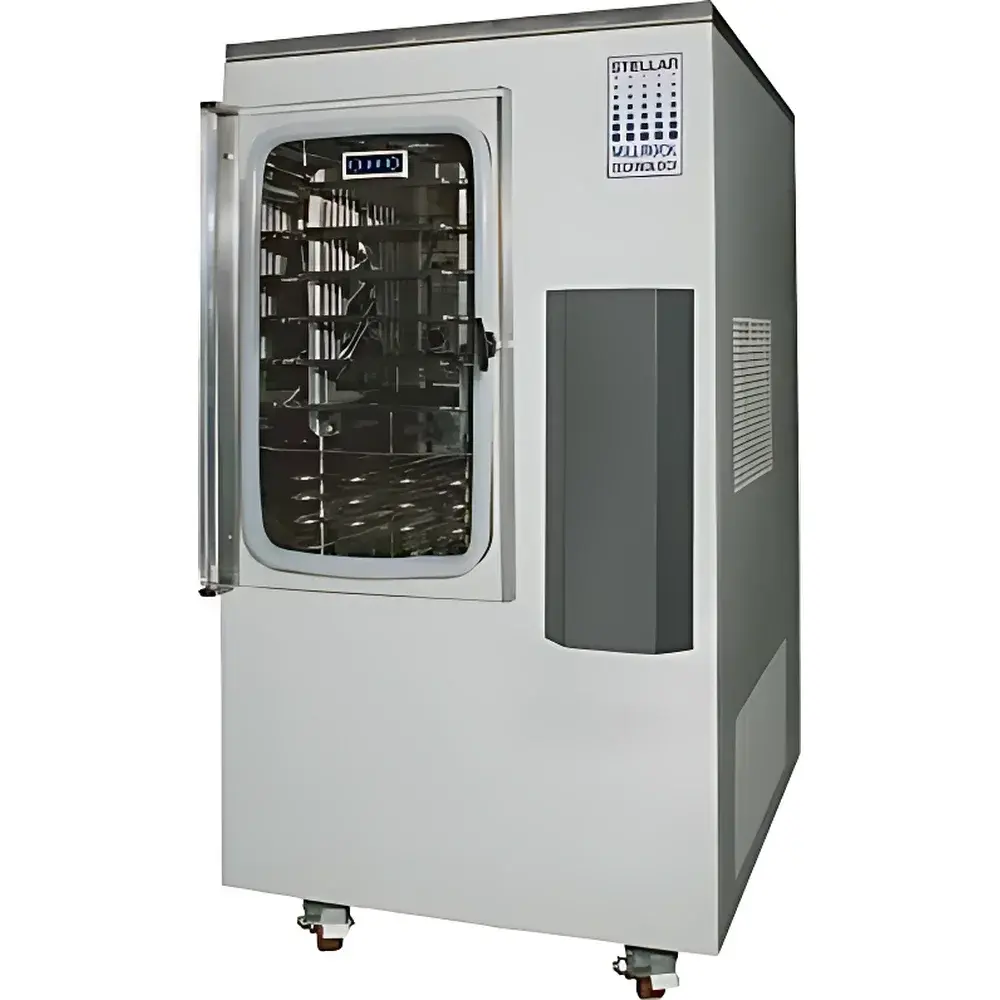
STELLAR® Series Freeze Dryer – Millrock STELLAR 53/85
| Brand | Millrock |
|---|---|
| Origin | USA |
| Model | STELLAR 53/85 |
| Shelf Area | 0.348–0.58 m² |
| Shelf Spacing | 63 mm |
| Condenser Capacity | 12 L |
| Condenser Temperature | −53 °C or −85 °C |
| Shelf Temperature Range | −45 °C / −70 °C to +65 °C |
| Chamber Material | 316L Stainless Steel |
| Vacuum Pump Flow Rate | 200 L/min |
| Vacuum Sensor | Pirani Gauge |
| Condenser Type | Coil-Type with Hot-Gas Defrost |
| Optional Features | ISO Class 5 Cleanroom Configuration, H₂O₂ Sterilization Port, Isolation Interface |
Overview
The STELLAR® Series Freeze Dryer by Millrock is a benchtop-to-pilot-scale lyophilization system engineered for precision, reproducibility, and operational flexibility in R&D laboratories and small-batch cGMP manufacturing environments. Utilizing primary drying via sublimation under controlled vacuum and secondary drying via desorption at elevated shelf temperatures, the system adheres to fundamental lyophilization thermodynamics—maintaining product integrity through precise thermal management and pressure regulation. Unlike conventional compact dryers, the STELLAR platform integrates architectural features typically reserved for larger industrial units: a robust 316L stainless steel chamber, coil-type condenser with hot-gas defrost, and an integrated Opti-Dry PC/PLC control architecture compliant with deterministic process logic. Its design supports both tray-based freeze-drying and stoppering-in-vacuum (SIV) operations, making it suitable for formulation development, stability studies, and early-phase clinical batch production.
Key Features
- Shelf area options from 0.348 m² to 0.58 m², configurable with 3 or 5 shelves to accommodate shallow trays or vial racks for lyophilization and vacuum stoppering.
- Two condenser temperature configurations: −53 °C (standard) or −85 °C (deep-cold), enabling efficient water vapor capture across diverse formulations—including high-moisture or low-eutectic-point products.
- Shelf temperature range of −45 °C or −70 °C to +65 °C, programmable with ±0.5 °C accuracy, supporting controlled ice nucleation, annealing, and desorption phases.
- Coil-type condenser (12 L capacity) with hot-gas defrost system—reducing cycle downtime and eliminating manual ice removal while maintaining condenser surface integrity over repeated cycles.
- Integrated Pirani vacuum sensor with digital feedback loop; compatible with optional capacitance manometer for high-accuracy pressure validation down to 0.001 mbar.
- Opti-Dry PC/PLC control system featuring Ethernet connectivity (RJ45), remote monitoring via secure web interface, and full audit trail logging per FDA 21 CFR Part 11 requirements.
- Corrosion-resistant vacuum system: dual-stage oil-free rotary vane pump rated at 200 L/min, certified for continuous operation under ≤0.1 mbar conditions.
Sample Compatibility & Compliance
The STELLAR series accommodates standard 100–500 mL glass trays, 2R–50R serum vials, and custom aluminum pans. Chamber geometry and uniform shelf heating support consistent product temperature profiles across all load configurations—validated per ASTM F2695-21 (Standard Practice for Validation of Lyophilization Processes). The 316L stainless steel interior meets USP material compatibility criteria for pharmaceutical contact surfaces. Optional ISO Class 5 cleanroom-rated enclosures comply with ISO 14644-1, while the H₂O₂ sterilization port enables validated bioburden reduction per ISO 14937. For regulated environments, firmware supports electronic signatures, user role-based access control, and immutable data export in CSV/PDF formats aligned with GLP and GMP documentation standards.
Software & Data Management
Opti-Dry software provides real-time visualization of shelf temperature, chamber pressure, condenser temperature, and vacuum rate. Process recipes are stored with version control and timestamped metadata. All critical parameters are logged at ≤1-second intervals and archived locally on internal SSD storage (≥128 GB) with automatic backup to network-attached storage (NAS) via SMB/CIFS protocol. The system supports IQ/OQ documentation packages and includes built-in tools for calibration verification (shelves, sensors, vacuum transducers). Audit trails record operator actions, parameter changes, alarm events, and system state transitions—fully traceable and exportable for regulatory submissions.
Applications
- Pharmaceutical R&D: Formulation screening, excipient compatibility testing, and cycle development for parenteral biologics and mRNA-LNPs.
- Vaccine stabilization: Thermal mapping and residual moisture analysis (Karl Fischer integration ready) for live-attenuated and subunit vaccines.
- Diagnostics & reagents: Lyophilization of enzyme conjugates, immunoassay controls, and PCR master mixes requiring long-term ambient storage.
- Academic research: Cryopreservation of microbial cultures, plant tissue extracts, and nanomaterial dispersions without structural collapse.
- Contract development organizations (CDOs): Scalable process transfer from STELLAR to production-scale lyophilizers using identical control logic and data structure.
FAQ
What vacuum level can the STELLAR achieve during primary drying?
The system achieves ≤0.01 mbar (1 Pa) with the standard 200 L/min vacuum pump; optional turbomolecular pumping extends performance to ≤1×10⁻⁴ mbar.
Is the Opti-Dry software compliant with 21 CFR Part 11?
Yes—electronic signatures, audit trails, and role-based permissions are enabled by default and validated in the factory IQ/OQ package.
Can I retrofit an existing STELLAR unit with H₂O₂ sterilization capability?
H₂O₂ port integration requires mechanical and firmware updates; only available as factory-installed option at time of order.
What is the maximum allowable load mass for a full 0.58 m² shelf configuration?
Maximum recommended load is 8 kg per shelf for aqueous solutions (≤15% solids); load limits scale linearly with total shelf area and formulation-specific heat transfer coefficients.
Does Millrock provide installation qualification (IQ) support?
Yes—Millrock Field Applications Engineers deliver on-site IQ execution, including utility verification, sensor calibration, and system boundary testing per ISO 13485 and ASTM E2500 guidelines.



