
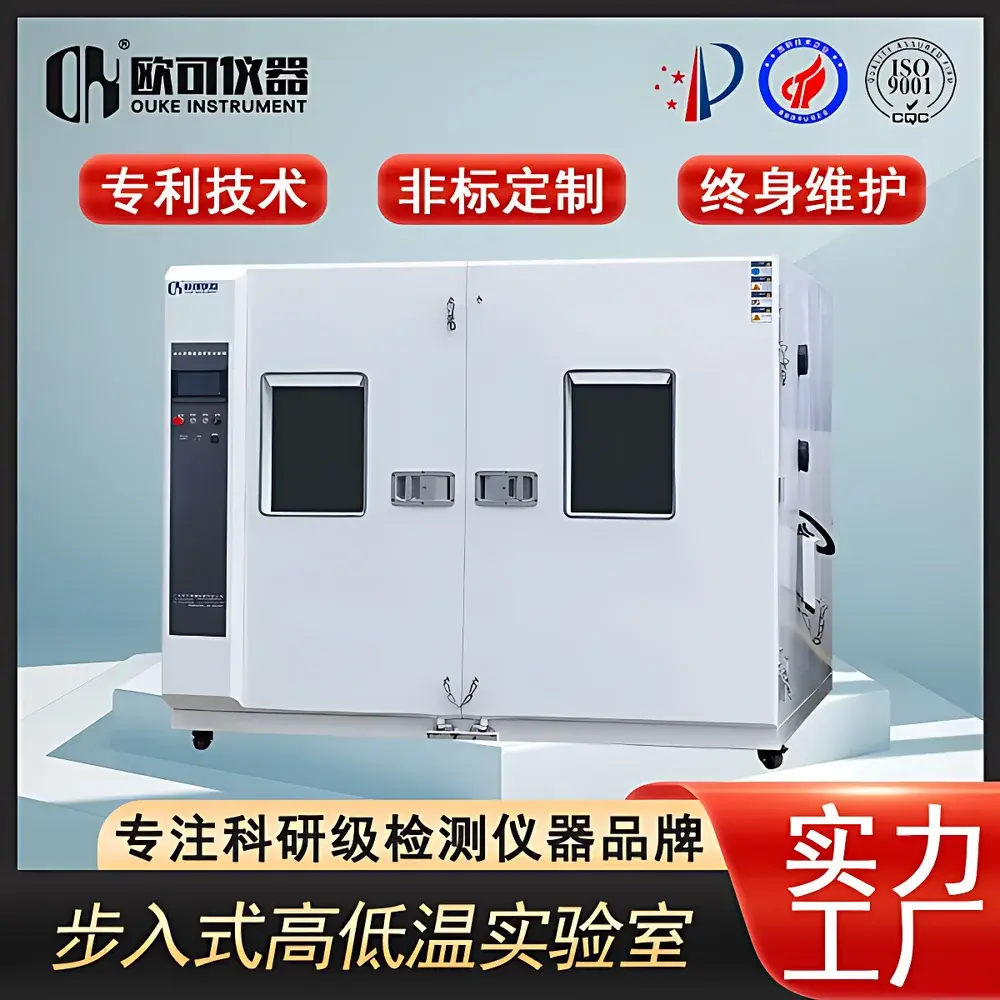
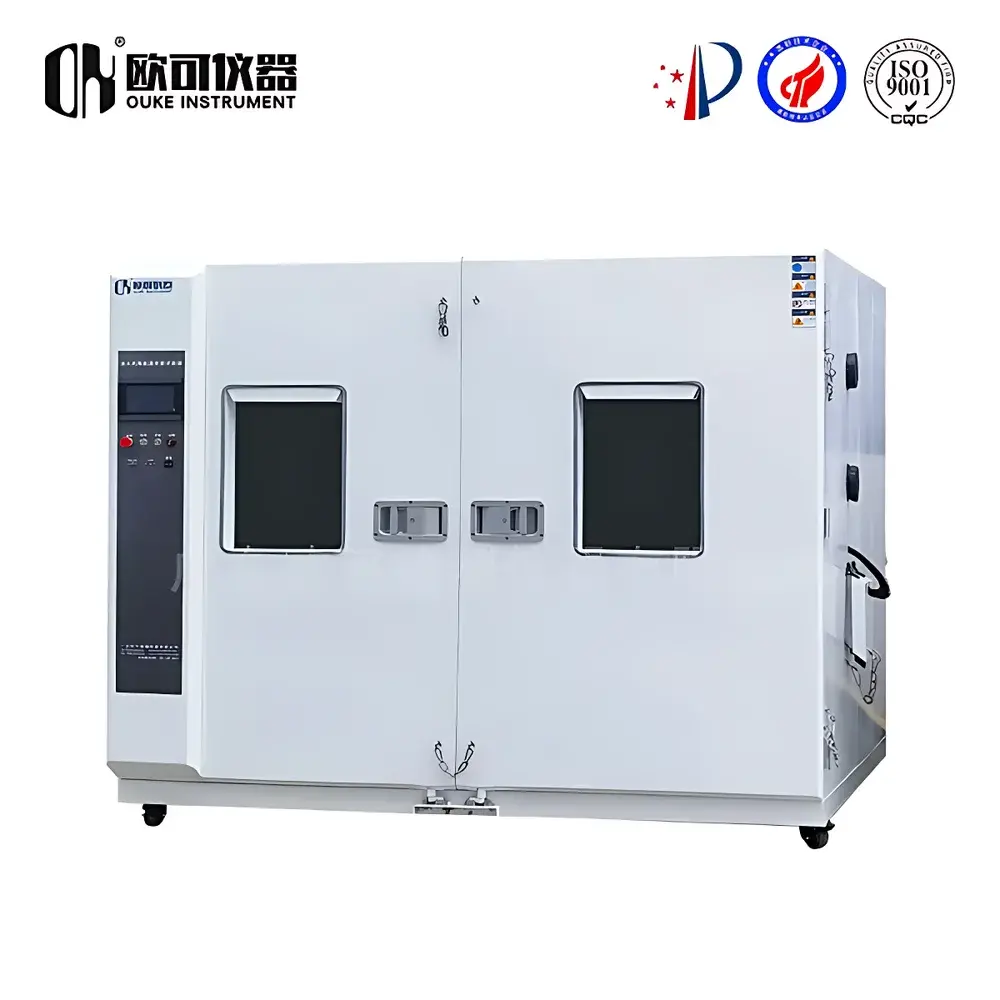
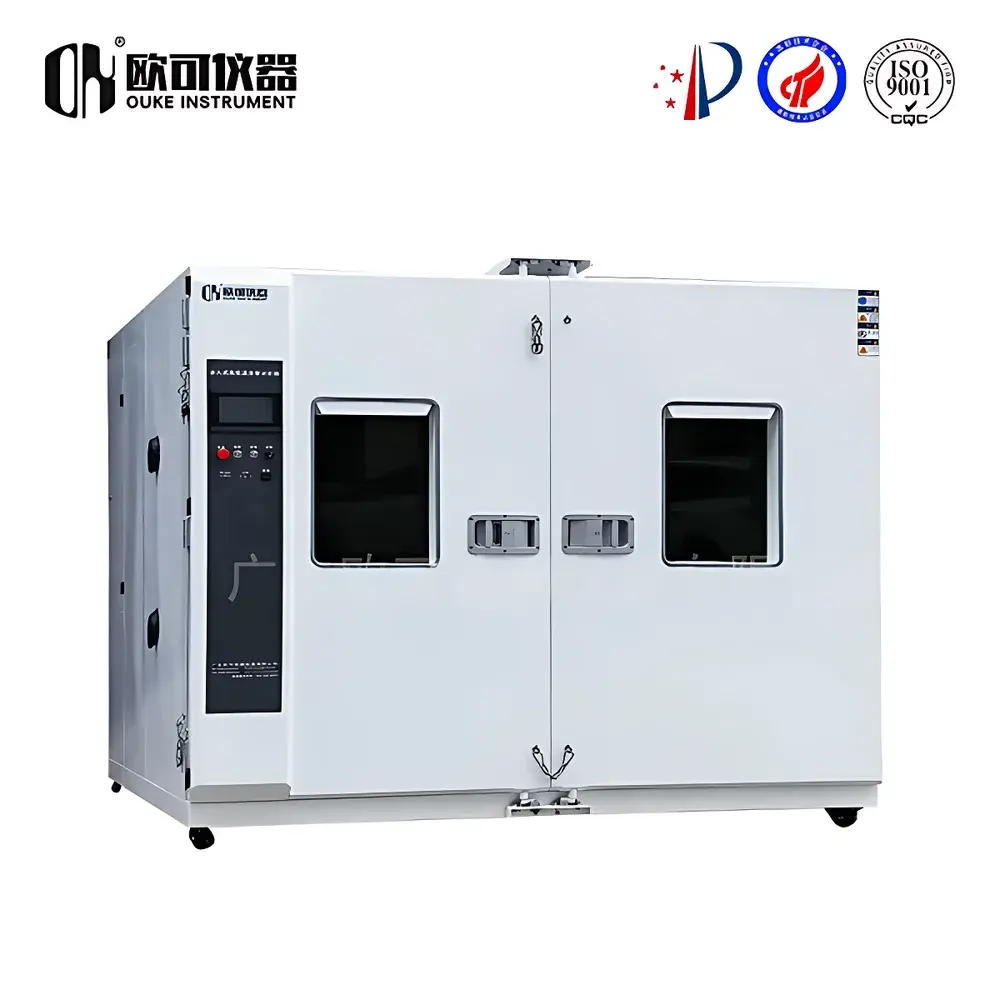
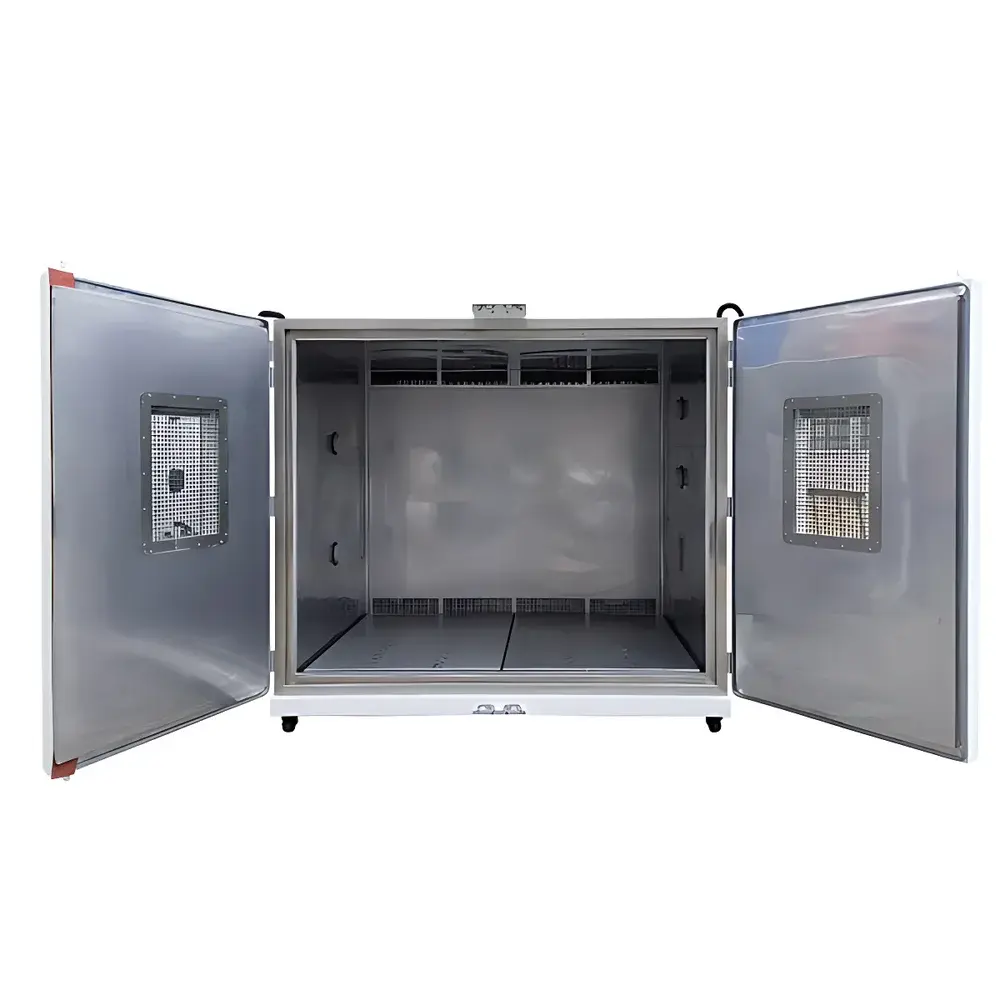
OK-STH Series Walk-in Environmental Test Chamber
| Brand | OK Instruments |
|---|---|
| Origin | Guangdong, China |
| Manufacturer Type | Direct Manufacturer |
| Country of Origin | China |
| Model | OK-STH-Custom Volume |
| Temperature Range | A: 0°C / B: -20°C / C: -40°C / D: -60°C / E: -70°C |
| Temperature Uniformity | ±3°C |
| Temperature Control Accuracy | ±1°C |
| Heating Rate | 1.0–4.0°C/min |
| Internal Dimensions | Custom-engineered per client specification (D×W×H) |
| Structural Design | Modular insulated chamber with reinforced steel frame and walk-in access door |
| Refrigeration System | Cascade refrigeration (dual-stage compressors) or optional LN₂ assist for enhanced cooling performance |
| Air Circulation | High-capacity centrifugal fans with optimized ductwork for uniform thermal distribution |
| Control System | Industrial-grade PLC-based controller with multi-segment programmable profiles, real-time data logging, Ethernet/RS485 interface, and audit-trail-capable software |
Overview
The OK-STH Series Walk-in Environmental Test Chamber is an industrial-scale, room-sized climate simulation system engineered for system-level environmental reliability validation. Unlike benchtop or upright chambers, the OK-STH is designed as a fully accessible, structural enclosure—typically ranging from 1 m³ to over 100 m³ in internal volume—that enables personnel ingress for installation, cabling, real-time monitoring, and functional verification of large-format test articles. Its operational principle centers on precise thermodynamic control within a highly insulated, sealed environment, utilizing cascade refrigeration cycles (high-temperature and low-temperature compressor stages) combined with high-power resistive heating and forced-air convection to achieve stable, repeatable temperature profiles across extreme ranges—from +85°C to –70°C (model-dependent). This architecture supports both steady-state thermal exposure and dynamic temperature cycling per IEC 60068-2-14, MIL-STD-810H Method 502.7, and automotive OEM-specific protocols such as GM W3177 and Ford ES-XW7T-1A278-AC. The chamber serves as foundational infrastructure for qualification testing where physical scale, thermal mass, and operational complexity preclude use of compact alternatives.
Key Features
- Modular insulated panel construction: Double-skinned galvanized steel or stainless-steel cladding with high-density polyurethane (PU) or mineral wool core (thermal conductivity ≤ 0.022 W/m·K), rated for long-term cryogenic service down to –70°C.
- Reinforced structural framework: Heavy-duty welded steel skeleton ensuring dimensional stability, seismic compliance, and safe integration into facility floors with load-bearing capacity ≥ 5 kN/m².
- Walk-in access door: Fully gasketed, counterbalanced, electrically heated anti-frost viewing window (≥ 400 × 600 mm), integrated safety interlock, and emergency egress mechanism compliant with ISO 13857.
- Dual-stage cascade refrigeration: Optimized for rapid cooldown and deep-cold retention; optional liquid nitrogen (LN₂) injection module available for accelerated thermal transitions in qualification-grade testing.
- High-uniformity air management: Multi-point supply and return ducting with variable-frequency centrifugal blowers (airflow ≥ 3× chamber volume per minute) ensures temperature deviation ≤ ±3°C throughout the working volume per ASTM E145 Class I requirements.
- Industrial control platform: Programmable logic controller (PLC) with 10.4″ touchscreen HMI, supporting up to 999 segments per profile, ramp/soak sequences, alarm history, and configurable digital I/O for external device synchronization.
Sample Compatibility & Compliance
The OK-STH accommodates full-system and bulk-lot test configurations—including complete electric vehicles (EVs), battery energy storage systems (BESS), avionics racks, telecom server cabinets, photovoltaic inverters, and aerospace subsystems. Its open interior layout supports custom mounting fixtures, power distribution units (PDUs), and signal breakout panels. All models are designed to meet structural and electrical safety standards including IEC 61000-6-2 (immunity), IEC 61000-6-4 (emissions), and UL 61010-1. Optional configurations support GLP/GMP-aligned operation via 21 CFR Part 11-compliant software packages with electronic signatures, audit trails, and user-role-based access control. Humidity-add-on variants (OK-STH-H) integrate steam humidification and desiccant dehumidification for combined temperature-humidity testing per IEC 60068-2-30.
Software & Data Management
The integrated OK-ClimateControl™ software provides local and remote supervision via Ethernet or RS485 Modbus RTU. It enables real-time visualization of up to 32 independent sensor channels (including chamber setpoint, internal ambient, product surface, and exhaust air), automatic generation of PDF/CSV test reports, and scheduled backups to network drives or cloud storage. Data integrity safeguards include cyclic redundancy check (CRC)-verified logging, time-stamped event records (door openings, alarms, profile changes), and tamper-resistant archive encryption. For regulated environments, optional validation documentation packages (IQ/OQ/PQ protocols) and calibration traceability to NIST or CNAS-accredited labs are available upon request.
Applications
- Automotive: Whole-vehicle cold-start validation at –40°C; thermal soak testing of ADAS ECUs; battery pack thermal runaway propagation studies under controlled ambient gradients.
- Aerospace: Environmental stress screening (ESS) of flight-critical avionics; thermal vacuum pre-screening of satellite payloads; UAV endurance testing across diurnal temperature cycles.
- Energy Storage: Accelerated life-cycle evaluation of grid-scale BESS cabinets under repeated charge/discharge and thermal cycling; fire containment validation in UL 9540A-compliant enclosures.
- Telecom & Data Centers: Thermal performance benchmarking of 5G baseband units (BBUs) and edge computing nodes under sustained 45°C ambient loads; airflow resistance mapping using thermal wire arrays.
- Industrial Electronics: High-volume burn-in of power converters and motor drives; HALT/HASS screening of industrial PLCs and HMIs using programmable thermal shock profiles.
FAQ
What is the minimum recommended internal clearance between test article and chamber walls?
A minimum 15% clearance margin (relative to longest dimension) is required to maintain specified airflow uniformity and avoid localized thermal shadowing.
Can the chamber be relocated or expanded after initial installation?
Yes—the modular panel design allows disassembly, transport, and reconfiguration; additional sections can be added to increase volume without replacing core systems.
Is LN₂ consumption included in the standard operating cost estimate?
No—liquid nitrogen is an optional auxiliary cooling method; its usage, storage, and delivery infrastructure must be separately scoped and budgeted.
How is temperature uniformity verified during factory acceptance testing (FAT)?
Per ISO 16750-4 Annex A, 9-point sensor mapping (3×3 grid at mid-height) is performed under steady-state conditions at three representative temperatures (–40°C, 25°C, +70°C), with results documented in the FAT report.
Does the system support third-party SCADA integration?
Yes—Modbus TCP/IP, OPC UA, and MQTT interfaces are available for seamless integration with enterprise MES, CMMS, or centralized lab monitoring platforms.



