
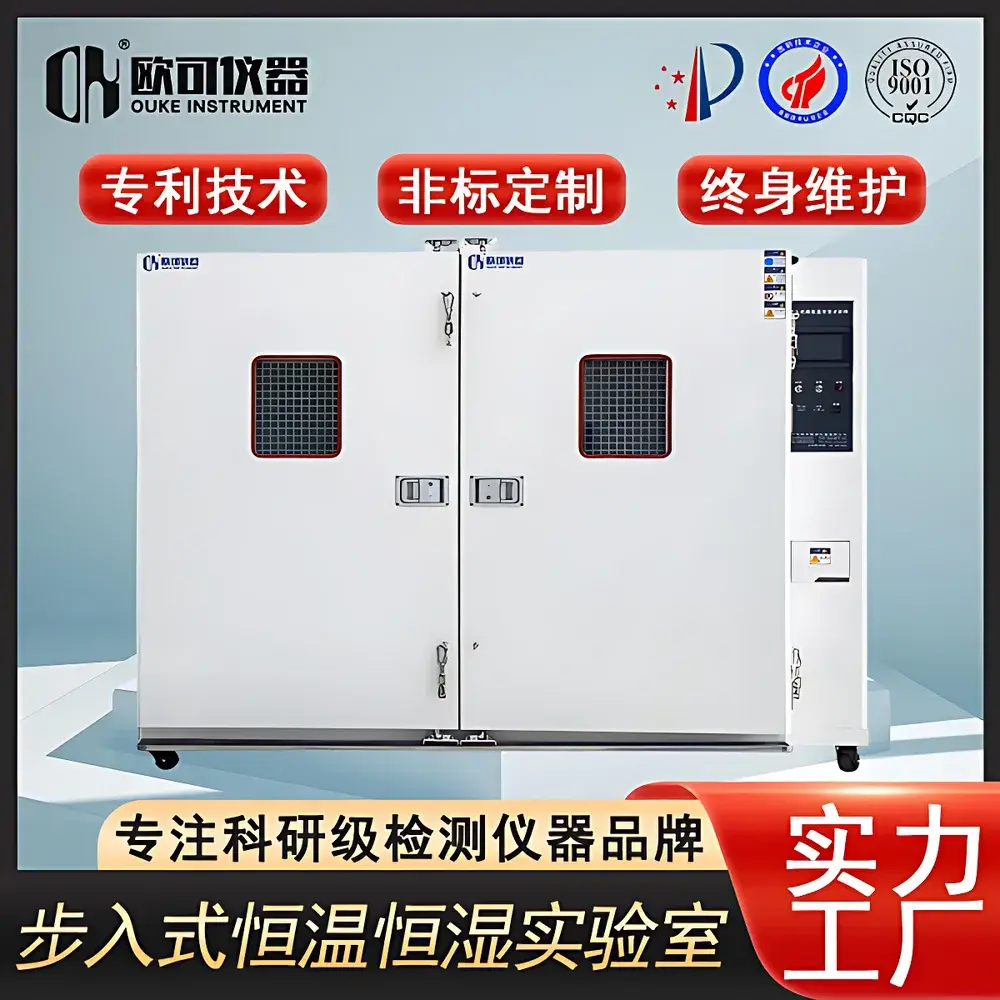
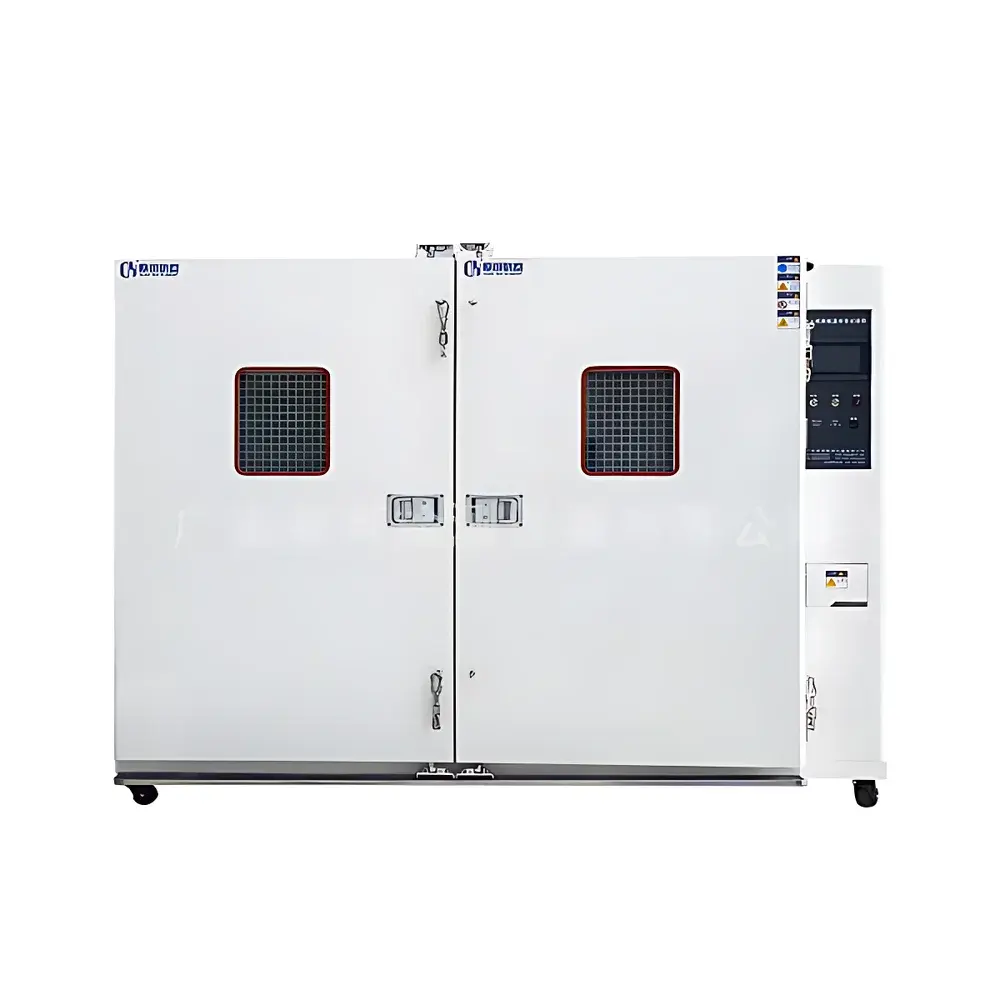
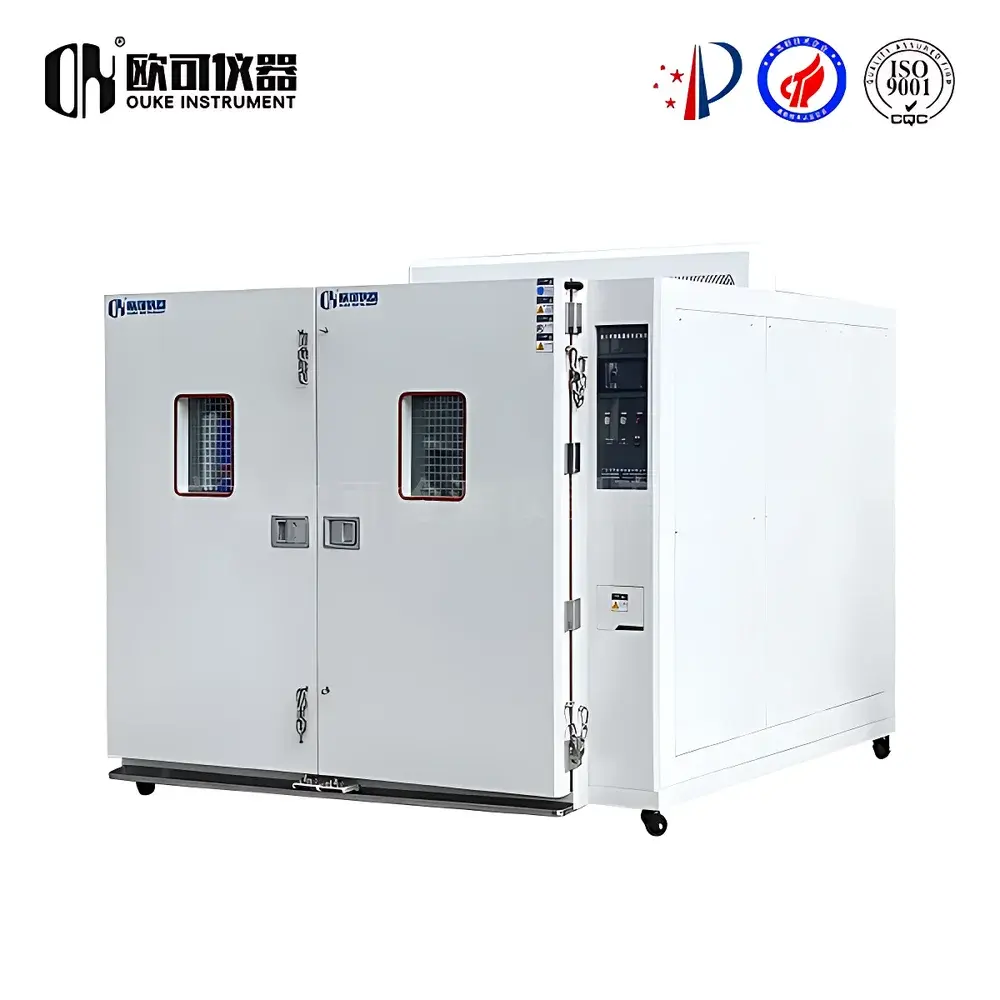
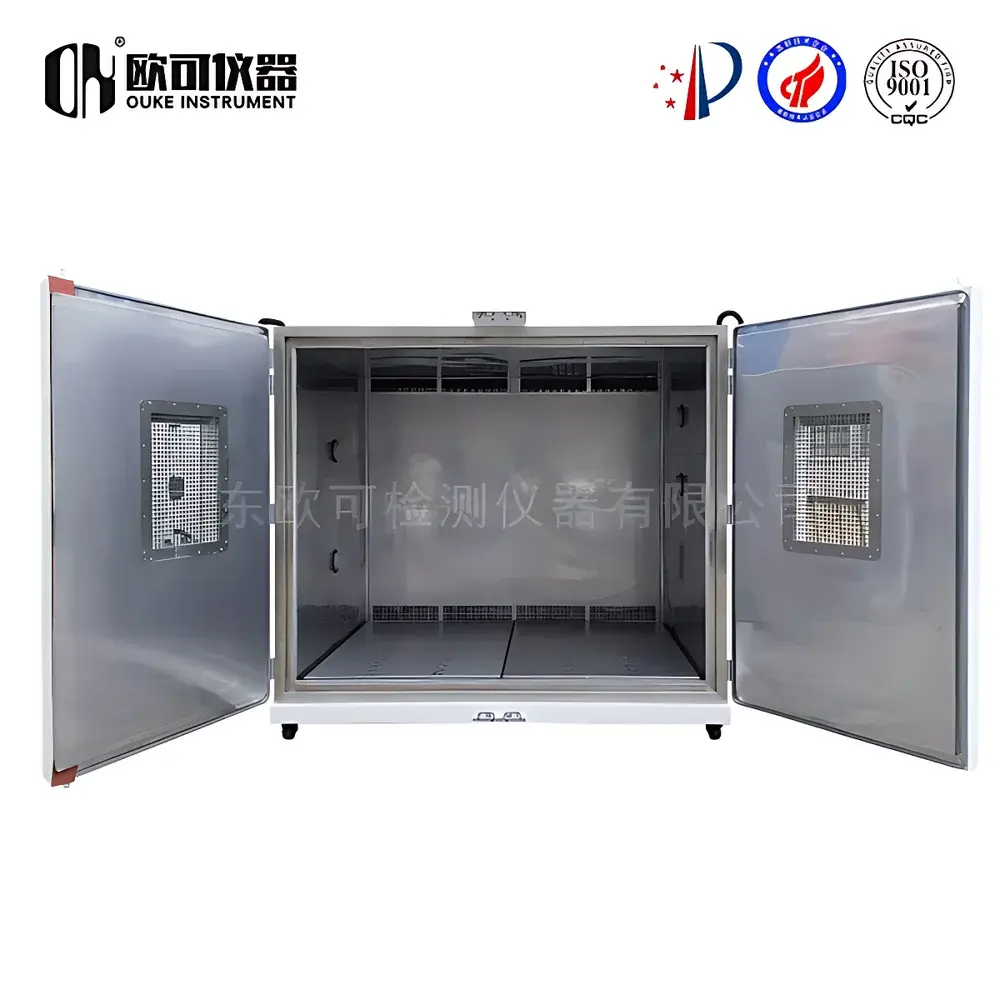
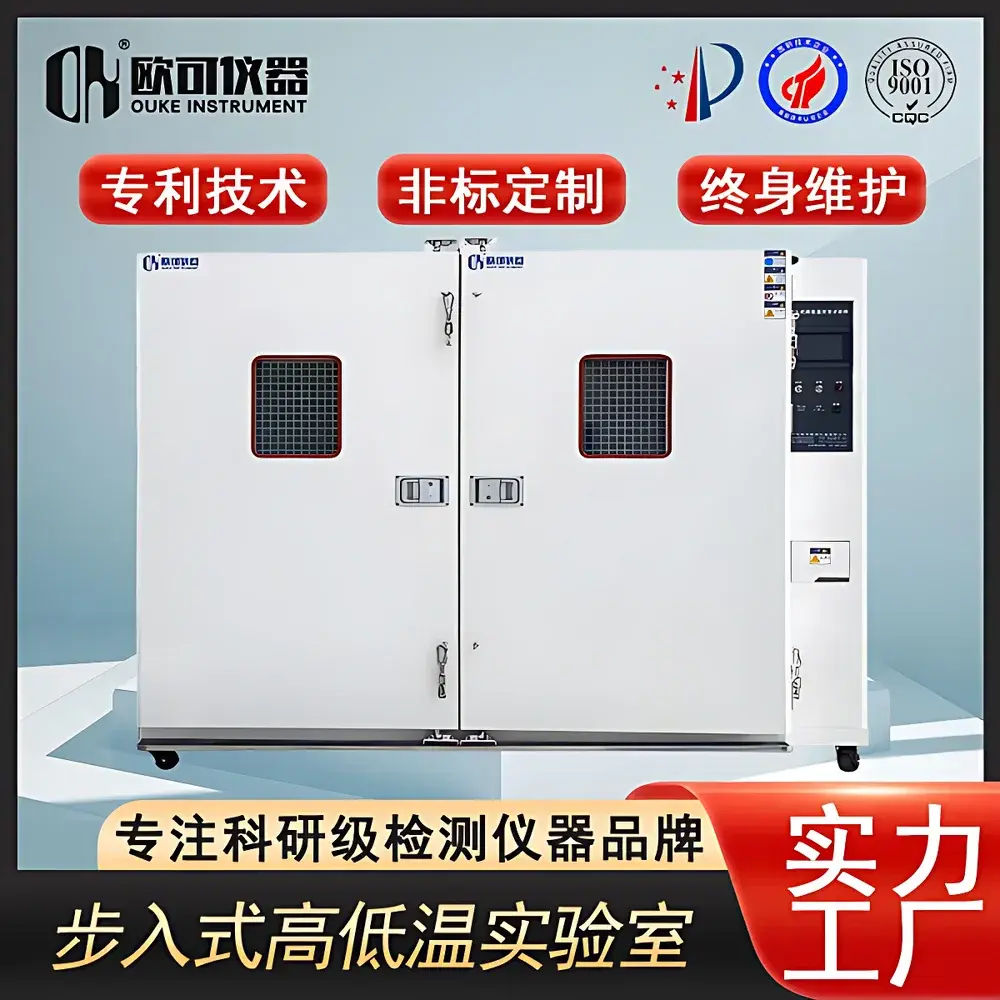
OK-STH Walk-in Environmental Test Chamber (High-Low Temperature Aging Room)
| Brand | OK Instruments |
|---|---|
| Origin | Guangdong, China |
| Manufacturer Type | Direct Manufacturer |
| Country of Origin | China |
| Model | OK-STH-3 m³ (Custom Volume) |
| Temperature Range | Selectable Options: 0°C / -20°C / -40°C / -60°C / -70°C |
| Temperature Uniformity | ±3°C |
| Temperature Control Accuracy | ±2°C |
| Heating Rate | 1.0–4.0°C/min |
| Construction | Modular PU-insulated sandwich panels with reinforced steel frame |
| Door | Large insulated walk-in door with observation window, anti-frost heater, and safety interlock |
| Refrigeration System | Cascade refrigeration (dual-stage compressors) |
| Air Circulation | High-volume centrifugal fans with optimized ductwork |
| Control System | Programmable PLC-based controller with multi-segment ramp-soak profiles, data logging, and remote monitoring capability |
| Compliance | Designed to support GLP/GMP-aligned validation protocols |
Overview
The OK-STH Walk-in Environmental Test Chamber is an industrial-grade, large-volume climate simulation system engineered for high-fidelity thermal aging, temperature cycling, and long-term reliability validation of system-level products. Unlike benchtop or upright environmental chambers, the OK-STH is architecturally designed as a fully accessible, room-scale enclosure—enabling direct human ingress for sample loading, instrumentation setup, real-time sensor calibration, and in-situ operational monitoring. Its core measurement principle relies on precision-controlled convective heat transfer within a thermally isolated, dynamically balanced air volume. The chamber employs a cascade refrigeration architecture—comprising independent high- and low-temperature compressor stages—to achieve stable sub-zero operation down to –70°C, while integrated high-wattage resistive heaters ensure accurate ramping across the full specified range. Uniformity is maintained via a calibrated airflow distribution system: multiple high-CFM centrifugal blowers drive conditioned air through a symmetrical duct network, minimizing thermal stratification and ensuring spatial temperature deviation remains within ±3°C (per IEC 60068-3-5). This architecture meets the physical and thermal inertia demands of massive thermal masses—including electric vehicle battery packs, avionics racks, photovoltaic inverters, and server cabinets—where ambient stabilization must occur without compromising gradient control or repeatability.
Key Features
- Modular structural design using 100–150 mm thick polyurethane (PU) insulated sandwich panels (steel or stainless steel cladding), providing thermal conductivity ≤ 0.022 W/m·K and structural rigidity for volumes up to 100 m³
- Reinforced load-bearing steel frame enabling floor-mounted installation and integration with vibration isolation platforms
- Walk-in access door with double-glazed tempered glass viewport, electric anti-frost heating element, pneumatic safety lock, and emergency interior release
- Dedicated cable/port penetrations (IP65-rated) with silicone grommets for power, signal, and fluid lines—maintaining chamber integrity during live testing
- Programmable PLC controller with 10.4″ color touchscreen interface, supporting up to 99 programmable segments per test profile, including ramp, soak, and cycle functions
- Real-time data acquisition with ≥16-channel analog/digital input capability; optional Ethernet/RS485 Modbus TCP for SCADA integration and centralized lab management systems
- Multi-layer safety architecture: independent high-limit temperature cut-off, refrigerant pressure monitoring, door interlock, and audible/visual alarm outputs compliant with EN 61000-6-2 EMC requirements
Sample Compatibility & Compliance
The OK-STH accommodates physically heterogeneous test loads—including complete vehicles, energy storage systems (ESS), telecom base stations, and aerospace subsystems—without dimensional compromise. Its scalable internal volume (starting at 3 m³, extendable modularly) ensures sufficient clearance for natural convection, cable routing, and operator maneuverability. The chamber satisfies critical compliance prerequisites for regulated industries: its temperature stability and uniformity performance align with ISO 16750-4 (road vehicles), ASTM D3574 (flexible cellular materials), and IEC 60068-2-1/2/14 (cold, dry heat, and change-of-temperature tests). When configured with audit-trail-enabled software and electronic signature modules, it supports FDA 21 CFR Part 11-compliant validation workflows. All electrical components conform to CE marking directives (LVD 2014/35/EU, EMC 2014/30/EU), and insulation materials meet UL94 V-0 flame retardancy standards.
Software & Data Management
The embedded control firmware supports automated test sequencing, real-time deviation tracking, and time-stamped event logging (start/stop, alarms, setpoint changes). Optional OK-LogSuite software provides PC-based visualization, statistical process analysis (SPC), and PDF/CSV report generation—including uncertainty estimation per ISO/IEC 17025 guidelines. Data files are stored locally on industrial-grade SSD and mirrored via configurable FTP/SFTP upload to secure enterprise servers. Audit trails record user identity, timestamp, action type, and pre-/post-value for every parameter modification—ensuring full traceability for GLP, GMP, or AS9100 audits. Remote access is enabled via TLS-secured web interface, allowing authorized personnel to monitor chamber status, download logs, or initiate emergency shutdown from offsite locations.
Applications
- Automotive: Full-vehicle cold-start validation at –40°C; HVAC system performance mapping; battery thermal runaway propagation studies under controlled ambient drift
- Energy Storage: Cycle-life evaluation of BESS cabinets under dynamic thermal profiles simulating desert-to-alpine deployment scenarios
- Aerospace: Pre-flight thermal vacuum compatibility screening of satellite payload bays and UAV endurance testing at sustained –60°C
- Data Infrastructure: Thermal stress validation of 48V DC-powered edge computing racks under simultaneous load-induced self-heating and ambient cooling
- Industrial Electronics: HASS (Highly Accelerated Stress Screening) of rail signaling controllers using rapid 3°C/min transitions between –20°C and +85°C
- Materials Science: Long-duration polymer aging per ASTM G154 UV+thermal cycles when integrated with optional UV lamp arrays
FAQ
What is the minimum recommended clear space required around the chamber for maintenance and heat dissipation?
A minimum of 800 mm clearance on all sides and 1200 mm above the unit is required for compressor service access, condenser airflow, and electrical cabinet ventilation.
Can the chamber be validated for IQ/OQ/PQ protocols?
Yes—OK Instruments provides documented validation templates, sensor calibration certificates (NIST-traceable), and on-site commissioning support aligned with Annex 15 and ISO 13485 requirements.
Is liquid nitrogen (LN₂) injection available as an upgrade for faster cooling?
LN₂ assist is optionally integrated for applications requiring >5°C/min cooling rates; however, standard OK-STH configurations rely on cascade mechanical refrigeration for optimal long-term stability and operational cost efficiency.
How is internal humidity controlled in this model?
The base OK-STH is a dry-temperature-only chamber. Humidity control requires specification of the OK-STH-H variant, which adds steam humidification, dehumidification coils, and RH sensors calibrated to ±2% RH accuracy.
What power supply specifications are required for the –70°C configuration?
Three-phase 380 VAC ±10%, 50 Hz, with dedicated 63 A circuit breaker and grounding resistance 200 ms to prevent compressor trip events.



