
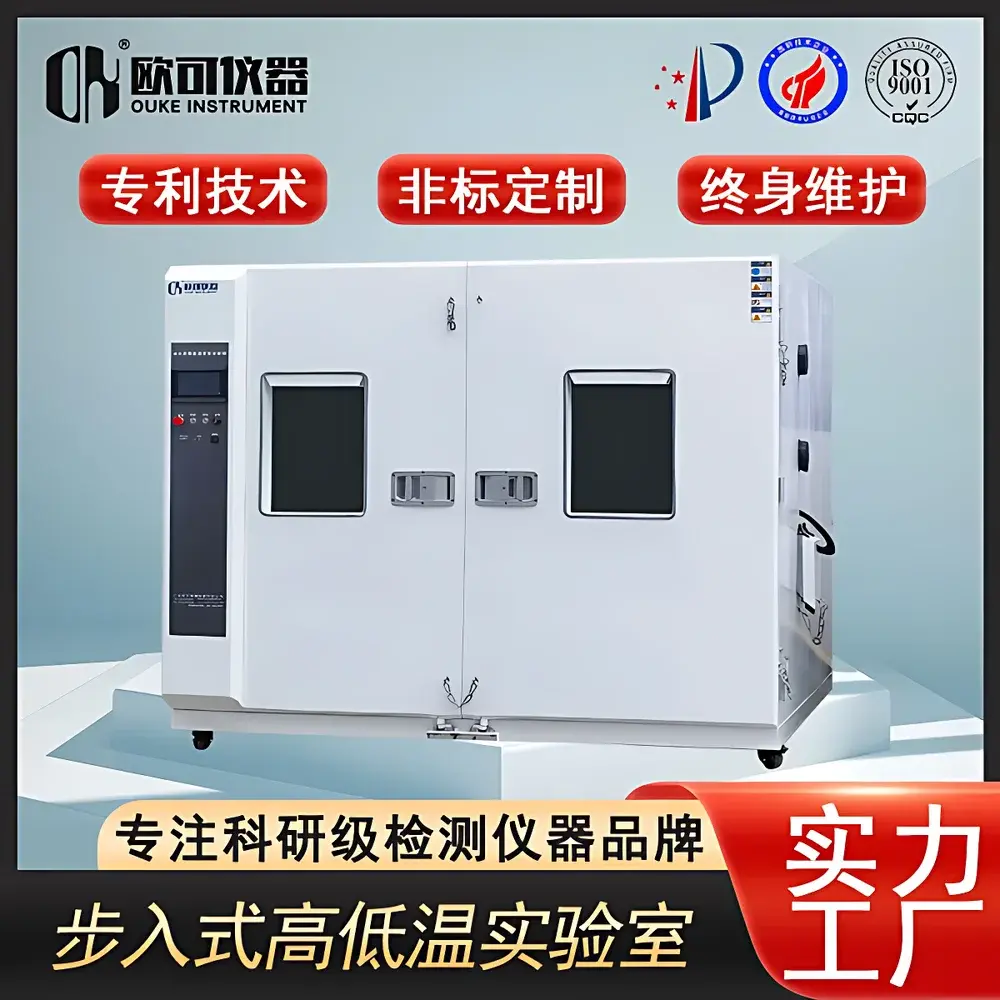
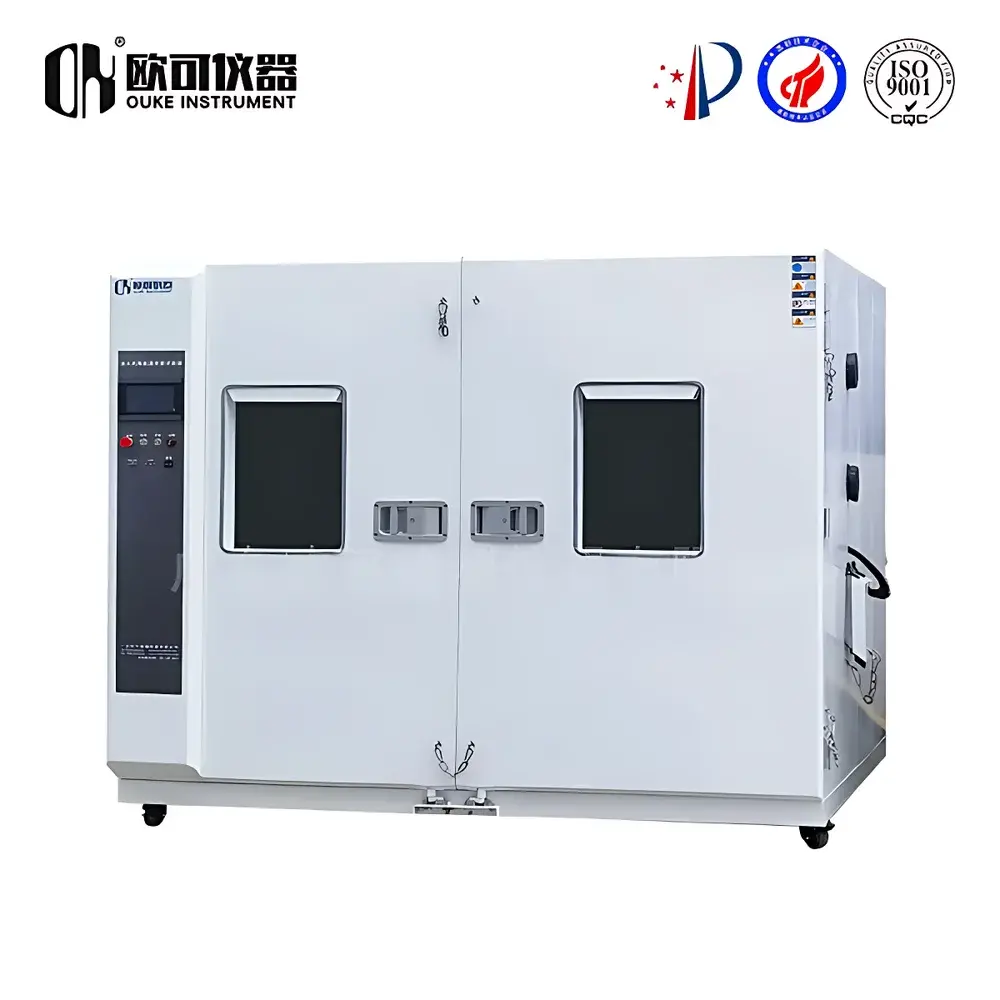
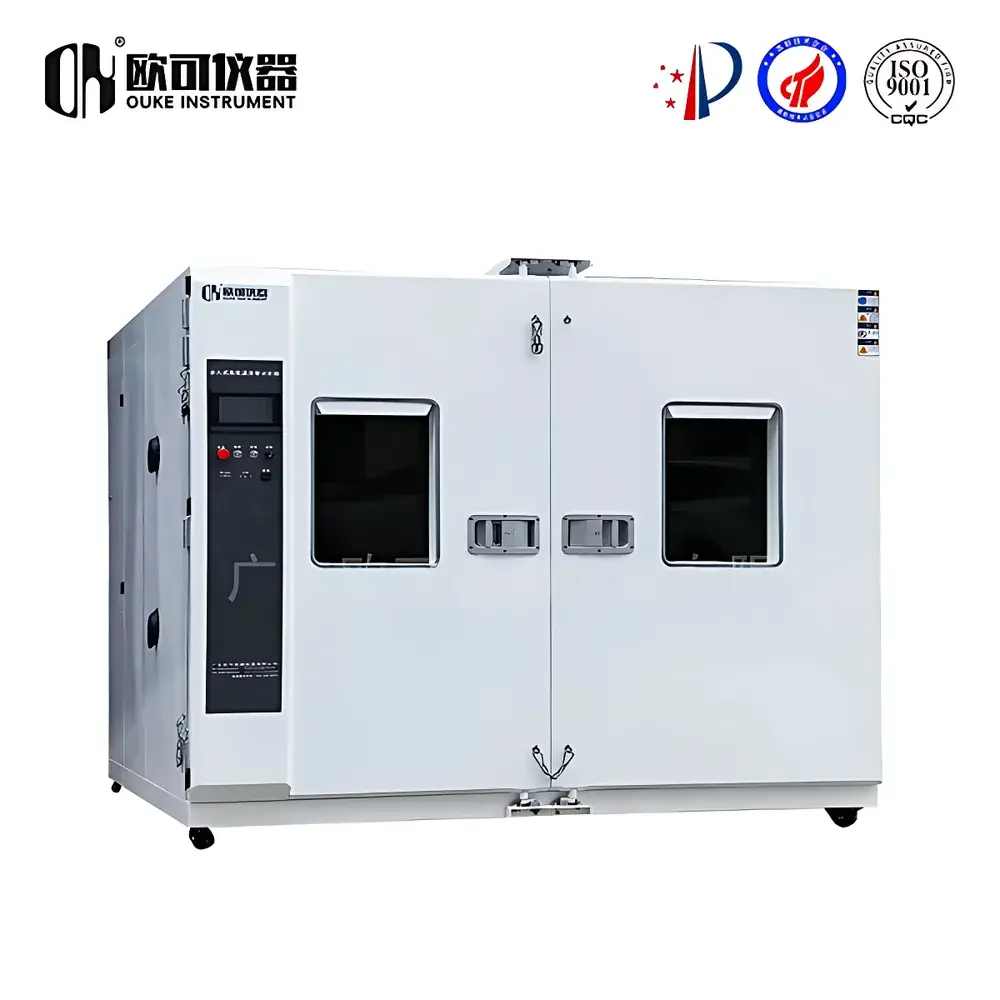
OK-STH Walk-in High-Temperature Aging Chamber
| Brand | OK Instruments |
|---|---|
| Origin | Guangdong, China |
| Manufacturer Type | Direct Manufacturer |
| Model | OK-STH-Volume 9 |
| Temperature Range Options | A: 0°C / B: −20°C / C: −40°C / D: −60°C / E: −70°C |
| Temperature Uniformity | ±3°C |
| Control Accuracy | ±1°C |
| Heating Rate | 1.0–4.0°C/min |
| Internal Dimensions | Custom-engineered per user specifications (D×W×H) |
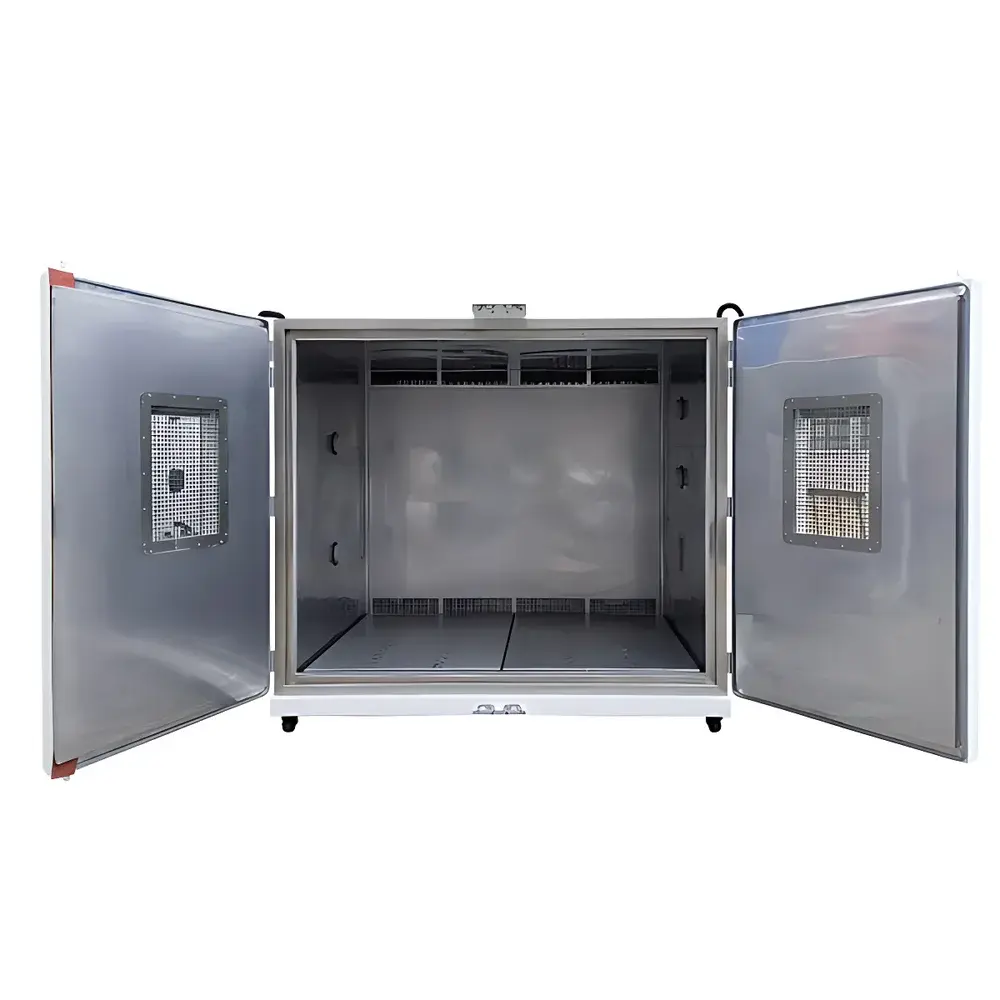
| Construction | Structural steel frame, double-skin insulated panels (PU core), reinforced walk-in door with anti-frost heating, observation window, and cable/port penetrations |
Overview
The OK-STH Walk-in High-Temperature Aging Chamber is an industrial-grade environmental test system engineered for large-scale thermal aging, burn-in, and long-term reliability validation under controlled elevated temperature conditions. Unlike benchtop or upright chambers, the OK-STH is architecturally designed as a fully accessible, room-scale enclosure—typically ranging from 1 m³ to over 100 m³ in volume—enabling direct human ingress for sample loading, instrumentation setup, real-time monitoring, and in-situ diagnostics. Its operational principle centers on precision air-to-air thermal regulation via forced convection, utilizing high-capacity electric heating elements, multi-stage refrigeration (where low-temperature variants are specified), and a robust airflow distribution network. The chamber maintains stable, uniform thermal profiles across its entire working volume—critical for validating the thermal endurance of complex assemblies where spatial temperature gradients could compromise test fidelity. It complies with foundational environmental testing frameworks including IEC 60068-2-2 (heat test), MIL-STD-810H Method 501.7 (high temperature), and supports alignment with ISO/IEC 17025-accredited laboratory practices when integrated into validated test protocols.
Key Features
- Modular structural design with load-bearing galvanized steel framework and high-density polyurethane (PU)-filled insulated panels (≥100 mm thickness), ensuring thermal resistance (U-value ≤0.25 W/m²·K) and dimensional stability under repeated thermal cycling.
- Reinforced walk-in door with dual-seal gasketing, electrically heated anti-frost glass viewport, emergency interior release, and interlocked safety cutoffs compliant with EN 61000-6-4 and EN 61000-6-2 EMC requirements.
- High-power resistive heating system (up to 60 kW configurable), capable of sustaining temperatures up to +150°C in select configurations—optimized for accelerated aging of electronic components, battery modules, and polymer-based systems.
- Intelligent air management: Multiple backward-curved centrifugal fans (total airflow ≥15,000 m³/h) coupled with symmetrical ductwork ensure temperature uniformity ≤±3°C throughout the working volume at steady state.
- PLC-based control system with 10.4″ color touchscreen HMI, supporting up to 99 programmable steps, ramp-soak profiles, real-time deviation alarms, and dual-stage over-temperature protection (mechanical + electronic).
- Standardized 4×Φ100 mm cable ports with silicone grommets, optional LN₂ injection interface (for rapid cooldown variants), and RS485/Modbus TCP connectivity for SCADA integration.
Sample Compatibility & Compliance
The OK-STH accommodates full-system and batch-level testing of physically large or thermally active units—including EV battery packs (up to 2 m × 1.5 m × 1.8 m), telecom server racks, aerospace avionics enclosures, photovoltaic inverters, and industrial control cabinets. Its open-access architecture eliminates constraints associated with chamber door apertures or internal shelf spacing. All electrical and mechanical interfaces conform to CE marking directives (2014/30/EU EMC, 2014/35/EU LVD), and thermal performance data can be documented to support GLP/GMP audit trails. While humidity control is not standard on the high-temperature aging variant, optional dehumidification modules (desiccant or refrigerant-based) may be integrated upon request to meet combined thermal-hygroscopic stress requirements per IPC-9701 or JEDEC JESD22-A108.
Software & Data Management
The embedded controller logs timestamped temperature readings from ≥6 calibrated PT100 sensors (including chamber center, corners, and load surface positions) at user-defined intervals (1 s to 60 min). Raw data exports to CSV or Excel-compatible formats; trend visualization is available via on-device graphs or remote web interface (HTTP/HTTPS). For regulated environments, optional software packages provide 21 CFR Part 11-compliant electronic signatures, role-based access control, audit trail generation, and data integrity safeguards—including write-protection, checksum verification, and automatic backup to external NAS or cloud storage (AWS S3 or Azure Blob). Calibration certificates traceable to NIM (China National Institute of Metrology) or UKAS-accredited labs are supplied with each unit.
Applications
- Automotive: End-of-line burn-in of ADAS ECUs, thermal soak testing of traction inverters, and pre-delivery aging of infotainment systems under sustained +85°C conditions.
- Energy Storage: Accelerated life-cycle screening of Li-ion BESS cabinets per UL 1973 and IEC 62619, including charge/discharge cycling at elevated ambient temperatures.
- Aerospace & Defense: Environmental stress screening (ESS) of UAV power distribution units, radar subsystems, and flight-critical wiring harnesses per RTCA DO-160G Section 4.2.
- Electronics Manufacturing: High-volume burn-in of PCBAs, ASICs, and optoelectronic transceivers in accordance with Telcordia GR-468-CORE and JEDEC J-STD-020.
- Materials Science: Long-duration thermal degradation studies of elastomers, adhesives, and composite laminates per ASTM D3045 and ISO 188.
FAQ
What is the minimum recommended clear space required around the chamber for ventilation and service access?
A minimum clearance of 800 mm on all sides and 1,200 mm above is required for heat dissipation, compressor servicing, and panel removal—per ASHRAE Guideline 33-2021.
Can the OK-STH be configured for temperature cycling between high and low extremes?
Yes—when equipped with dual-stage cascade refrigeration and extended-range heaters, the OK-STH platform supports programmable thermal cycling (e.g., −40°C ↔ +125°C) with transition rates up to 3°C/min, meeting MIL-STD-202G Method 107 and IEC 60068-2-14 requirements.
Is remote monitoring and alarm notification supported out of the box?
Standard Ethernet connectivity enables SNMP-based network monitoring; optional SMS/email alert modules trigger notifications upon deviation, power loss, or door-open events.
How is temperature uniformity verified and documented during factory acceptance testing (FAT)?
FAT includes a 12-point uniformity mapping per IEC 60068-3-5 using NIST-traceable Class A PT100 probes, with full report generation and uncertainty budgeting included in delivery documentation.
Does OK Instruments provide installation supervision and IQ/OQ protocol support?
Yes—on-site commissioning, utility connection verification, and GxP-aligned Installation Qualification (IQ) and Operational Qualification (OQ) documentation are available as value-added services, aligned with Annex 15 and ISO 13485 expectations.



