
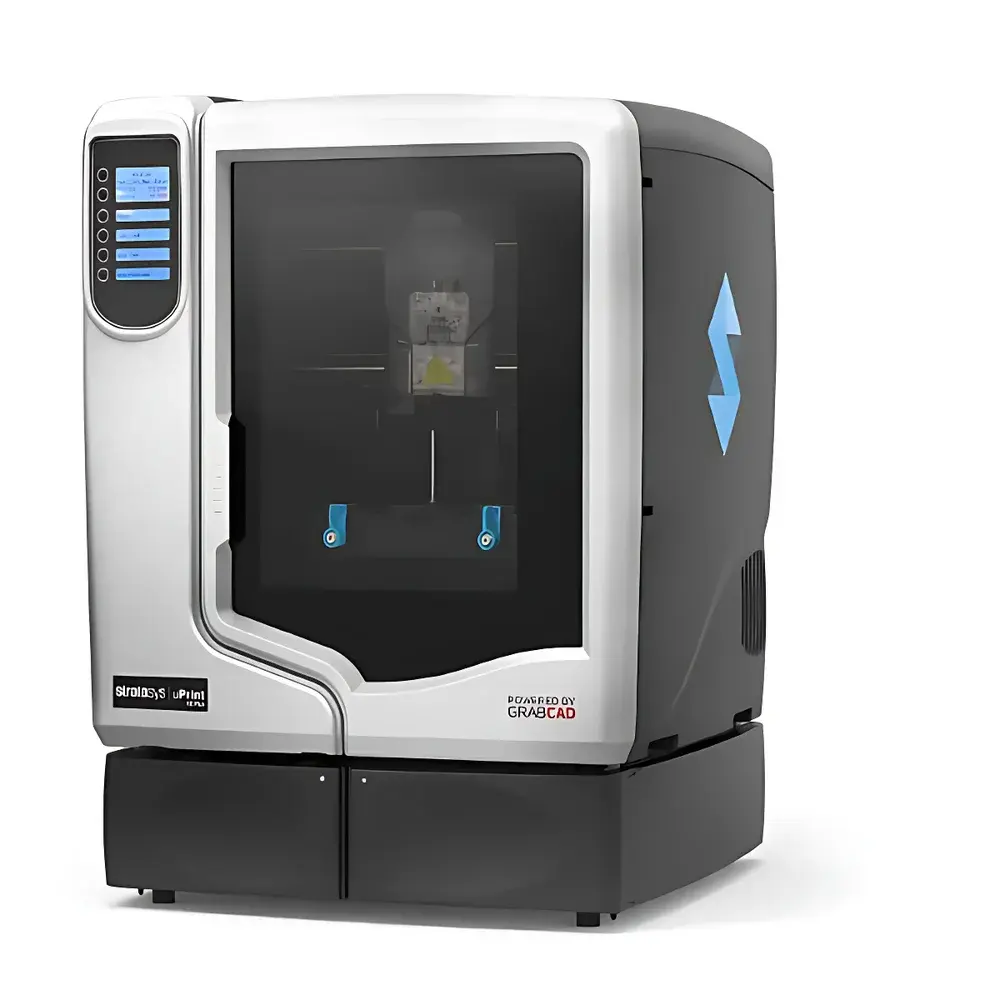
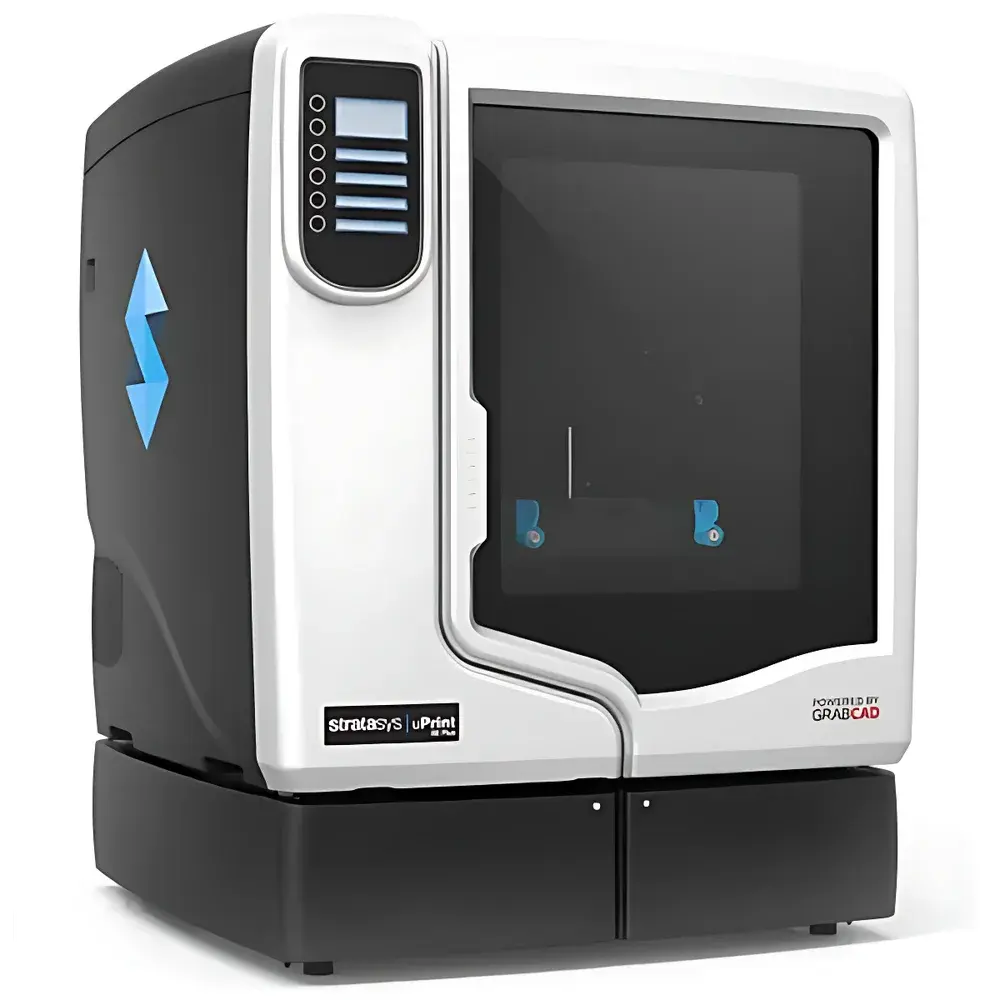
Stratasys uPrint SE Plus Fused Deposition Modeling 3D Printer
| Brand | Stratasys |
|---|---|
| Origin | Israel |
| Model | uPrint SE Plus |
| Build Volume | 203 mm × 203 mm × 152 mm |
| Layer Thickness | 0.127 mm (0.005 in), 0.178 mm (0.007 in) |
| Dimensional Accuracy | ±0.2 mm |
| Build Speed | 60 cm³/h |
| Compatible Material | ABSplus thermoplastic |
| Laser Power & Count | None (FDM uses heated extrusion, not laser) |
Overview
The Stratasys uPrint SE Plus is a production-grade fused deposition modeling (FDM®) 3D printer engineered for precision, repeatability, and workflow integration in regulated laboratory and engineering environments. Unlike stereolithography (SLA) or selective laser sintering (SLS) systems, the uPrint SE Plus employs thermoplastic extrusion—melting and precisely depositing ABSplus filament layer-by-layer under computer-controlled thermal and motion parameters. This process delivers functional parts with isotropic mechanical properties, dimensional stability across temperature and humidity variations, and inherent biocompatibility support when used with medical-grade post-processing protocols. Designed for benchtop deployment in QC labs, R&D centers, and prototyping workshops, the system features a sealed, self-contained build chamber with automated material handling, dual-cartridge consumables (model + support), and integrated build platform leveling—eliminating manual calibration drift common in open-frame desktop FDM platforms.
Key Features
- Engineered for ISO 13485-aligned workflows: All hardware components—including extruder thermal control, stepper motor resolution, and Z-axis lead screw pitch—are traceably calibrated and documented per Stratasys Factory Certification standards.
- Dual-material cartridge system: Pre-loaded ABSplus modeling material and water-soluble SR-30 support material minimize operator intervention and ensure consistent melt viscosity and interlayer adhesion across print runs.
- Automated build platform leveling: A contactless capacitive sensor array validates Z-zero position before each job, compensating for thermal expansion of the aluminum build plate during preheat cycles.
- Integrated environmental enclosure: Maintains stable chamber temperature (±1.5°C) throughout printing to prevent warping and improve interlayer fusion—critical for dimensional fidelity in orthopedic jigs and microfluidic housings.
- Onboard diagnostic logging: Real-time monitoring of extrusion pressure, nozzle temperature deviation, and motor current draw enables predictive maintenance and supports GLP/GMP audit trails.
Sample Compatibility & Compliance
The uPrint SE Plus is validated for use with Stratasys-certified ABSplus (UL 94 HB rated, RoHS-compliant), a high-impact, low-moisture-absorption thermoplastic optimized for mechanical robustness and surface finish consistency. While not a Class II medical device itself, the system meets ASTM F2792-12a (Standard Terminology for Additive Manufacturing) definitions for FDM technology and supports documentation packages required for FDA 21 CFR Part 11 compliance when deployed with Stratasys Insight™ software and networked audit-log servers. It is routinely employed in laboratories adhering to ISO 10993-5 (cytotoxicity) pre-screening workflows for custom fixture fabrication and USP <1033> performance qualification of printed tooling used in pharmaceutical packaging validation.
Software & Data Management
Operation is managed via Stratasys Insight™ slicing software (v6.2+), which provides deterministic toolpath generation, lattice structure optimization, and automated support placement based on part geometry and orientation heuristics. STL and native SolidWorks (.sldprt) files are imported directly; all build parameters—including layer thickness selection (0.127 mm or 0.178 mm), raster angle, infill density, and shell count—are configurable within predefined material-specific profiles. The software enforces digital signature verification for firmware updates and maintains immutable job logs including start/stop timestamps, material lot numbers, and thermal history curves—fully compatible with electronic lab notebook (ELN) integrations and 21 CFR Part 11–compliant e-signature workflows when hosted on validated Windows Server environments.
Applications
- Functional prototyping of surgical guides and anatomical models for preoperative planning, leveraging ABSplus’s sterilizability via ethylene oxide (EtO) and gamma irradiation.
- Manufacturing of low-volume, high-tolerance jigs and fixtures for cell culture plate alignment, microcentrifuge rotor adaptation, and spectrophotometer sample holder customization.
- Rapid iteration of microfluidic chip housings requiring leak-free sealing interfaces and precise channel registration—enabled by the system’s ±0.2 mm XY positional repeatability and controlled Z-layer stacking.
- Production of calibration artifacts for metrology labs, including gauge blocks, step wedges, and thread pitch standards—validated against NIST-traceable CMM measurements.
- Education and training modules in biomedical engineering curricula, where reproducible part geometry and material property transparency support pedagogical rigor in additive manufacturing coursework.
FAQ
Is the uPrint SE Plus suitable for printing sterile medical devices?
No—the system itself is not a sterilization device. However, ABSplus-printed parts can undergo terminal sterilization using validated EtO or gamma processes per ISO 11135 or ISO 11137, provided design-for-sterilization principles (e.g., vent path geometry, material thickness uniformity) are applied.
Does it support third-party filaments?
No. Stratasys restricts operation to certified ABSplus and SR-30 cartridges to maintain mechanical property consistency, regulatory documentation integrity, and warranty coverage.
What maintenance intervals are recommended?
Extruder nozzle cleaning every 50 hours; full build chamber wipe-down after each job; annual calibration verification by Stratasys Field Service Engineers using NIST-traceable reference artifacts.
Can it be integrated into an LIMS or MES environment?
Yes—via Insight™’s RESTful API and OPC UA-compatible data export modules, enabling bidirectional job dispatch, material consumption tracking, and quality event logging into enterprise systems.
Is remote monitoring supported?
Yes—through Stratasys Connect™ cloud service (optional subscription), providing real-time build progress alerts, thermal anomaly detection, and historical job analytics accessible via secure web dashboard.



