
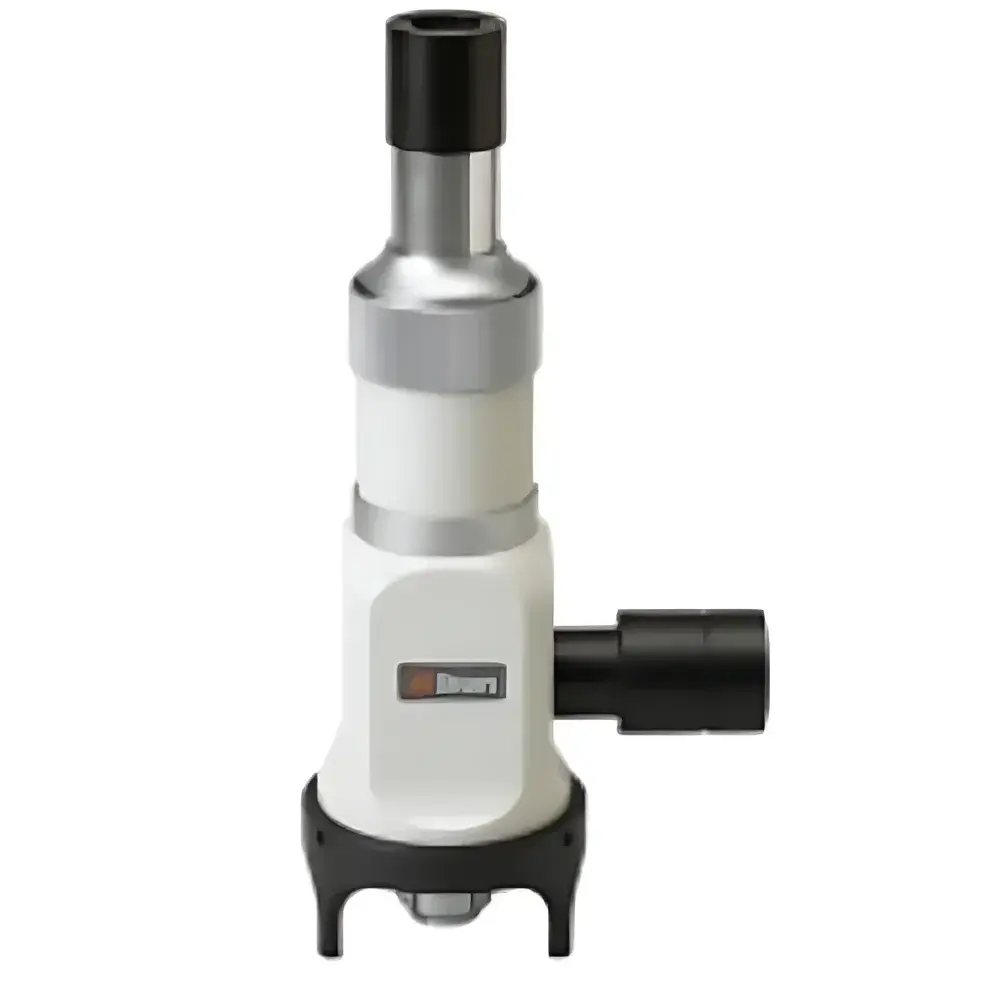
Struers PSM-5 and PSM-10 Portable Handheld Optical Microscopes
| Brand | Struers |
|---|---|
| Origin | France |
| Model | PSM-5 / PSM-10 |
| Magnification | up to 400× (PSM-5), up to 600× (PSM-10) |
| Illumination | Integrated battery-powered LED |
| Construction | Lightweight aluminum housing |
| Accessories | Digital camera adapter, eyepiece micrometer, thin-film thickness gauge, magnetic cross-stage (PSM-10 only), high tripod base (PSM-10 only) |
| Carrying case | Rugged aluminum transport case with integrated tool storage |
| Compliance | Designed for field-deployable non-destructive evaluation in accordance with aerospace surface inspection best practices |
Overview
The Struers PSM-5 and PSM-10 are precision-engineered portable handheld optical microscopes designed for rapid, on-site non-destructive surface evaluation of prepared metallographic specimens, replication samples, and in-service components. Unlike scanning acoustic microscopes (SAM) or ultrasonic C-scan systems — which rely on high-frequency sound wave propagation and time-of-flight analysis — the PSM series operates on conventional brightfield optical microscopy principles, delivering real-time, high-resolution visual assessment without sample contact or coupling media. These instruments are purpose-built for integration into Struers’ end-to-end portable preparation and inspection workflow, particularly following surface conditioning with TransPol-5 electrolytic polishers or MoviPol-5 portable grinding-polishing units. Their compact form factor, battery-powered LED illumination, and ruggedized mechanical architecture enable reliable operation in demanding environments including aircraft hangars, engine overhaul bays, and field-based quality control checkpoints across aerospace OEM and MRO facilities.
Key Features
- Lightweight ergonomic design with balanced center-of-gravity for extended handheld use without operator fatigue
- Optical magnification range: 400× maximum (PSM-5); 600× maximum (PSM-10), achieved via interchangeable objective lenses and high-clarity eyepieces
- Integrated, dimmable white LED illumination powered by standard AA batteries — no external power supply or cables required
- Modular accessory interface supporting digital imaging via industry-standard C-mount camera adapters (e.g., USB3.0 CMOS sensors)
- Optional calibrated eyepiece micrometer and thin-film thickness gauge for semi-quantitative dimensional estimation of scratches, porosity, or coating discontinuities
- PSM-10-specific magnetic cross-stage enables stable positioning on ferromagnetic curved surfaces such as turbine blades, pipe welds, and airframe skins
- High-stability tripod base (PSM-10 only) with adjustable leveling feet and fine-focus tilt mechanism for reproducible vertical alignment
- Aluminum transport case certified to IP65 ingress protection standards, containing microscope body, lens set, camera adapter, calibration tools, and spare batteries
Sample Compatibility & Compliance
The PSM-5 and PSM-10 are optimized for direct observation of flat or moderately curved metallic, ceramic, and composite surfaces prepared using standardized metallographic techniques per ASTM E3, ISO 13078, and EN 1368. They accommodate both epoxy-mounted cross-sections and silicone rubber replicas (e.g., Struers Replicaset®), enabling comparative analysis between lab-prepared reference samples and field-acquired replicates. While not a regulatory compliance instrument per se, the system supports traceable documentation workflows aligned with AS9100D clause 8.5.2 (Identification and traceability) and FAA AC 120-95B requirements for in-service inspection record retention. When paired with compliant digital cameras and timestamped image capture software, audit trails satisfy basic GLP documentation expectations for preliminary defect screening prior to formal NDT certification (e.g., PT, UT, or RT).
Software & Data Management
The PSM series does not include proprietary embedded firmware or onboard processing; instead, it functions as an optical imaging platform compatible with third-party machine vision software (e.g., Olympus Stream, ImageJ, or HALCON SDK). Digital images acquired via C-mount adapters retain EXIF metadata including lens focal length, exposure settings, and optional GPS coordinates when used with geotagged mobile devices. Struers recommends implementing secure local storage protocols and version-controlled naming conventions (e.g., “AircraftReg_SectionID_Date_Time_PSM10_400x”) to support configuration management under FAA Part 145 or EASA Part-145 maintenance documentation frameworks. No FDA 21 CFR Part 11 electronic signature capability is provided, as the device serves strictly as a visualization aid—not a diagnostic or analytical measurement instrument.
Applications
- Routine verification of surface finish roughness (Ra, Rz) after polishing on critical rotating components
- Visual assessment of microcrack initiation at stress-concentrated regions in turbine disks and compressor blades
- Replica-based monitoring of corrosion progression in aging airframe structures during depot-level inspections
- On-wing evaluation of thermal barrier coating integrity, spallation, and interfacial delamination
- Validation of EDM recast layer removal following repair welding on landing gear assemblies
- Field-side comparison of incoming raw material microstructures against approved reference standards
FAQ
Are the PSM-5 and PSM-10 classified as scanning acoustic microscopes (SAM)?
No. These are optical microscopes. Scanning acoustic microscopes utilize GHz-range ultrasound and require liquid coupling; the PSM series uses visible-light optics and requires no couplant.
Can these microscopes be used for quantitative grain size analysis?
Not autonomously. While compatible with image analysis software, they lack automated stage scanning or built-in ASTM E112-compliant grain counting algorithms. Manual point-counting per ASTM E562 is feasible with optional micrometer eyepieces.
Is the aluminum transport case certified for air transport?
Yes — the case meets IATA Packing Instruction 950 for equipment containing lithium-free alkaline batteries and is rated for checked baggage handling under ICAO Technical Instructions.
Does Struers provide calibration certificates for the PSM series?
Struers supplies factory-verified optical alignment reports and magnification verification charts traceable to NIST-traceable standards. Formal ISO/IEC 17025 calibration is performed by accredited third-party labs upon request.
What is the typical battery life under continuous LED illumination?
Approximately 8–10 hours using four fresh AA alkaline cells at medium brightness setting; runtime decreases by ~35% at maximum intensity.



