
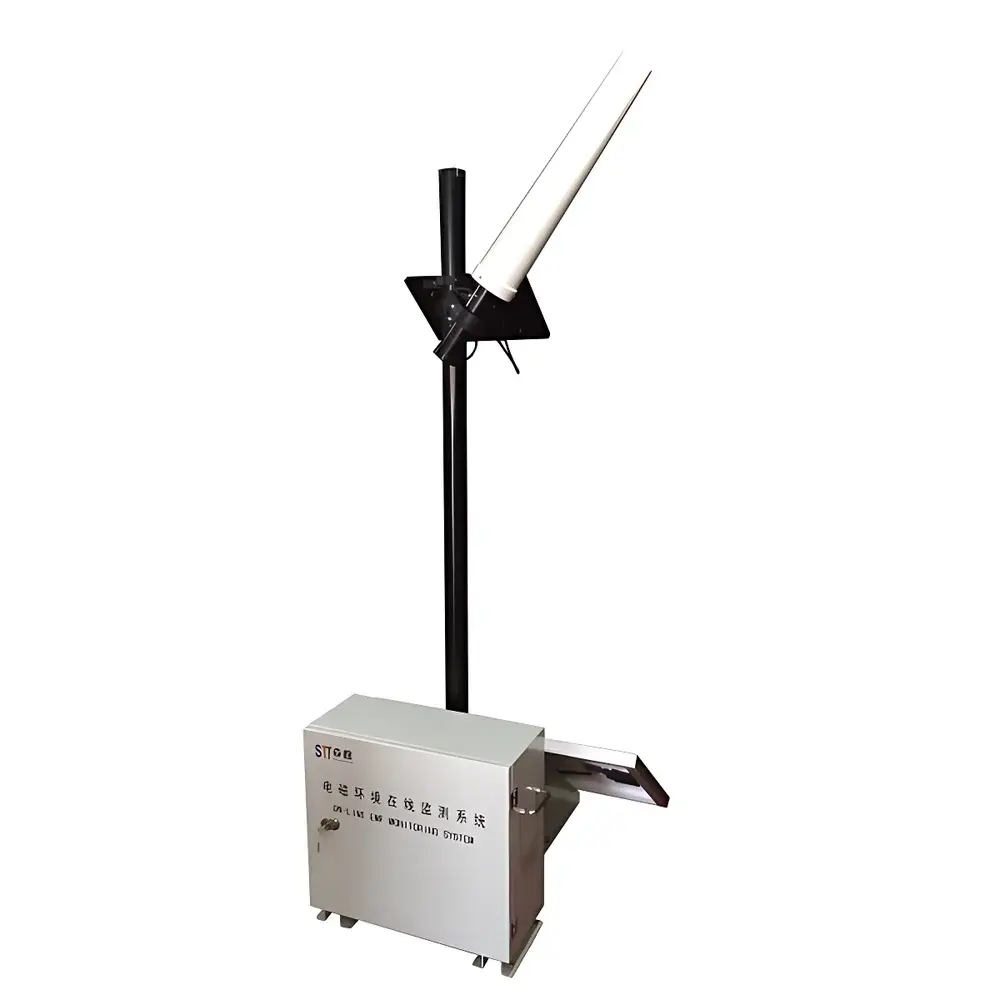
STT OS-8 Fixed Electromagnetic Environment Online Monitoring System
| Brand | STT Senfu Technology |
|---|---|
| Origin | Beijing, China |
| Manufacturer Type | OEM Manufacturer |
| Regional Origin | Domestic (China) |
| Model | OS-8 |
| Price Range | USD 7,000 – 14,000 |
| Frequency Range | 1 Hz – 60 GHz |
| Field Units | V/m, µT, A/m, mW/cm², W/m² |
| Probe Types | Triaxial Isotropic E/H-field Probes (LF & RF) |
| Data Storage | 8 GB (≥1 year at 6-min avg) |
| Power Supply | Solar + 12V/65Ah Lead-Acid (15-day autonomy) or Grid |
| Communication | GPRS/CDMA/4G, Fiber, Intranet |
| Operating Temp | −20 °C to +70 °C |
| Humidity | <95% RH |
| Compliance | YD/T 2390–2013, HJ/T 10.2–1996, Env. Prot. Notice [2007] No. 114 |
Overview
The STT OS-8 Fixed Electromagnetic Environment Online Monitoring System is a turnkey, regulatory-grade infrastructure solution engineered for continuous, unattended electromagnetic field (EMF) surveillance in sensitive urban and industrial environments. Designed in strict accordance with Chinese national standards—including YD/T 2390–2013 (Technical Requirements for EMF Online Monitoring Systems), HJ/T 10.2–1996 (Guidelines for EMF Monitoring Instruments and Methods), and the Ministry of Ecology and Environment’s [2007] No. 114 Technical Specification for Mobile Base Station EMF Monitoring—the OS-8 implements a distributed architecture comprising autonomous monitoring sub-stations and a centralized web-based command center. Each sub-station integrates triaxial isotropic broadband probes (covering 1 Hz–60 GHz), real-time signal conditioning electronics, solar-redundant power management, and dual-mode telemetry (fiber backbone + cellular fallback). The system captures electric field (E-field) and magnetic field (H-field) magnitudes simultaneously, computes statistical percentiles (E5, E50, E80, E95), and delivers traceable, time-synchronized measurements compliant with IEC 62110 and IEEE C95.3 recommendations for environmental EMF assessment.
Key Features
- Multi-band isotropic probe architecture: Separate low-frequency (20 Hz–1 kHz) and radiofrequency (100 kHz–6 GHz) triaxial sensors ensure metrological integrity across power-line harmonics, AM/FM broadcast, mobile communications (2G–5G NR), and microwave bands.
- Autonomous operation: Integrated solar charging (10 W panel + 4.2 V/18 Ah Li-ion buffer) and 12 V/65 Ah lead-acid backup enable uninterrupted 15-day operation under zero insolation—validated per IEC 62109 for off-grid reliability.
- Regulatory-grade data governance: Full audit trail including timestamped raw samples, calibration metadata, probe health diagnostics (temperature, battery voltage, sensor offset), and alarm event logs (exceedance, comms loss, low power, probe fault).
- GIS-enabled dynamic visualization: Web dashboard overlays real-time E/H-field intensity on interactive OpenStreetMap tiles, with color-coded heatmaps, historical trajectory playback, and configurable alert thresholds aligned to local exposure limits (e.g., ICNIRP 2020, GB 8702–2014).
- Public transparency interface: Outdoor-rated 55″ LCD display (2000 cd/m² brightness) renders live metrics alongside bilingual (CN/EN)科普 content—preloaded modules cover base station safety, transformer EMF behavior, household appliance emissions, and WHO/ICNIRP risk communication frameworks.
Sample Compatibility & Compliance
The OS-8 system supports long-term deployment adjacent to diverse EMF sources: cellular macro/micro base stations (including massive MIMO arrays), 50/60 Hz high-voltage transmission corridors (110 kV–1000 kV), FM/AM/DAB broadcast towers, and medium-wave AM transmitters. All probe calibrations are traceable to NIM (National Institute of Metrology, China) via accredited third-party laboratories. Measurement uncertainty budgets adhere to ISO/IEC 17025:2017 requirements for field instrumentation. The platform satisfies GLP-aligned data integrity criteria: immutable storage (write-once filesystem), electronic signatures for configuration changes, and role-based access control (RBAC) for audit logging—facilitating readiness for environmental regulatory inspections or public inquiry proceedings.
Software & Data Management
The central monitoring platform runs on a ThinkStation E31 workstation-class server, hosting a hardened Linux container stack with PostgreSQL-backed time-series database (InfluxDB-compatible schema). Web interface complies with WCAG 2.1 AA accessibility standards and supports TLS 1.3 encryption. Data export functions generate ISO 8601-compliant CSV/JSON bundles with embedded metadata (probe serial, calibration expiry, site coordinates, measurement epoch). Automated report generation includes daily/weekly/monthly compliance summaries (max/min/avg/6-min mean, % of reference level), trend analysis (linear regression over 30/90/365 days), and anomaly detection (Grubbs’ test for outliers). Remote firmware updates and parameter reconfiguration occur via signed OTA packages, preserving cryptographic chain-of-custody.
Applications
- Regulatory compliance monitoring for telecom operators deploying 5G infrastructure near schools, hospitals, and residential zones.
- Environmental impact verification for HVDC converter stations and ultra-high-voltage (UHV) AC substations during commissioning and operational phases.
- Public transparency programs mandated by municipal governments under “Right-to-Know” ordinances—displaying live data on community portals and roadside digital signage.
- Scientific research on diurnal/seasonal EMF variability, correlation with meteorological parameters (via optional integrated weather station), and baseline establishment for epidemiological cohort studies.
- Post-incident forensic analysis following public complaints: Time-synchronized playback of field magnitude, spectral snapshot exports, and geotagged photo documentation from onboard IP cameras (optional add-on).
FAQ
Does the OS-8 system meet international EMF exposure standards such as ICNIRP or IEEE C95.1?
Yes—the measurement methodology, probe isotropy, and statistical processing (E95, 6-minute averaging) align with ICNIRP 2020 guidelines and IEEE Std C95.3–2019 for environmental surveys. Local limit comparisons are user-configurable within the software.
Can the system integrate with existing SCADA or EMS platforms used by power utilities?
Yes—OPC UA and Modbus TCP gateways are available as optional modules, enabling bidirectional data exchange with utility-wide energy management systems without compromising cybersecurity segmentation.
How is data authenticity assured against tampering or unauthorized modification?
All measurements are cryptographically signed at acquisition (SHA-256 hash per 60-second block), stored in write-once memory partitions, and logged with hardware-enforced timestamps synchronized via GPS PPS. Audit trails record every configuration change with operator ID and IP address.
Is remote calibration validation possible without physical probe retrieval?
Field verification is supported using STT’s traceable RF reference source (OS-8 CALKIT), allowing periodic end-to-end system checks via automated self-test routines executed from the central server.
What is the recommended maintenance interval for long-term deployments?
Probe recalibration is advised every 24 months; battery replacement every 36 months; solar panel cleaning quarterly. The system logs all consumables usage and triggers preventive maintenance alerts based on runtime hours and environmental exposure metrics.
Related Products







