
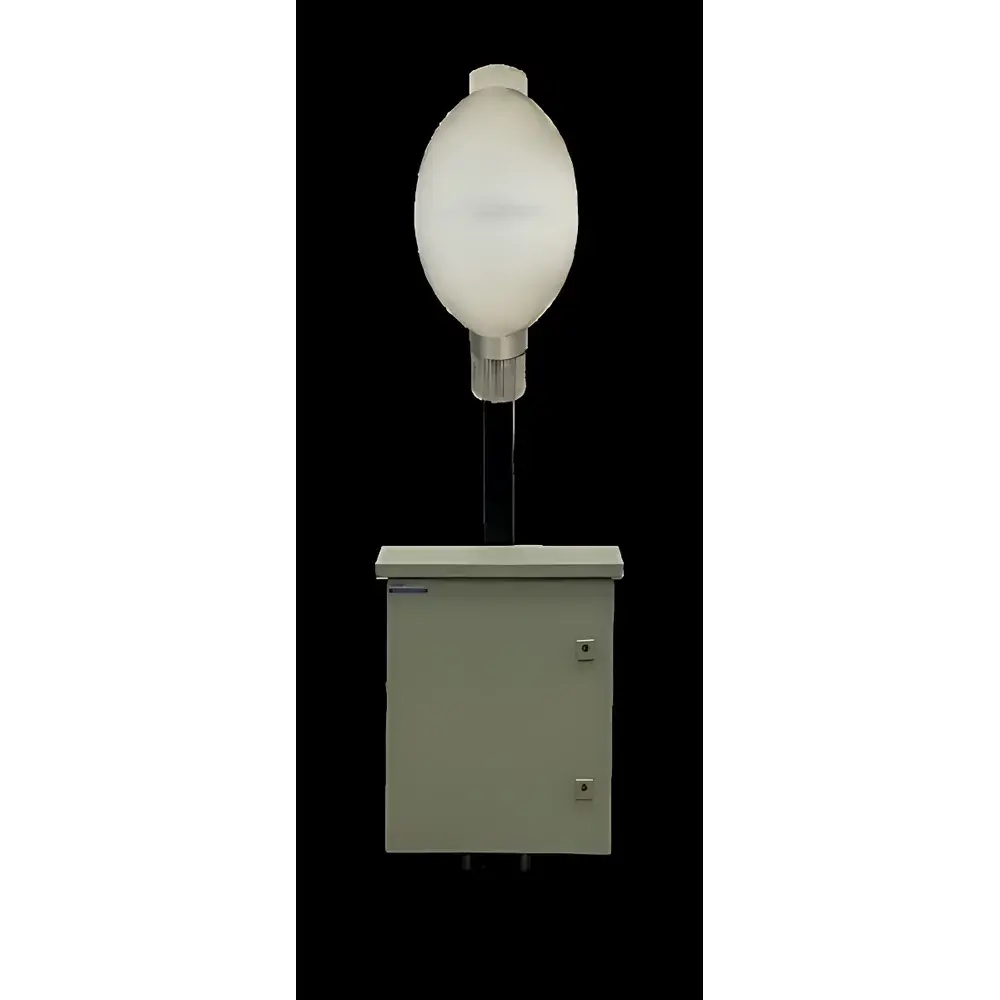
STT-OS-8 Power Frequency Electromagnetic Environment Online Monitoring System
| Brand | STT |
|---|---|
| Origin | Beijing, China |
| Manufacturer | STT Senfu Technology |
| Product Type | Online Electromagnetic Field Monitor |
| Instrument Category | Spectrum Analyzer |
| Detector Type | Triaxial Isotropic Probe |
| Measurement Scope | Electromagnetic Radiation Sources & Ambient EM Environment Quality |
| Frequency Range | 20 Hz – 100 kHz |
| Electric Field Sensitivity | 0.1 V/m |
| Physical Footprint | 450 mm × 450 mm |
| Power Supply | Patented Interference-Free Probe Powering Technology |
| Data Integrity | Automatic Offline Data Resumption & Re-transmission |
| Calibration Method | Full-System Integrated Calibration in Traceable EMC Chamber |
| Compliance Context | Designed for compliance with GB 8702–2014, ICNIRP 2010 Guidelines, and IEC 62110:2019 |
| Deployment Scale | >280 Operational Stations Nationwide (Substations, AM/FM Broadcast Sites, Telecom Base Stations, TV Transmitters) |
Overview
The STT-OS-8 Power Frequency Electromagnetic Environment Online Monitoring System is an engineered solution for continuous, high-fidelity assessment of low-frequency electromagnetic fields (EMF) in the 20 Hz to 100 kHz band—primarily covering power frequency (50 Hz) harmonics, industrial equipment emissions, and legacy broadcast infrastructure. Unlike conventional spot-check instruments, the OS-8 employs a triaxial isotropic electric field probe coupled with a fully integrated signal conditioning and data acquisition architecture. Its measurement principle is based on broadband capacitive coupling with vector-summed orthogonal field components, enabling true RMS field strength quantification without directional bias. The system is explicitly designed for unattended, long-term deployment in regulatory monitoring networks, utility asset management programs, and public exposure assessment frameworks where traceability, spatial fidelity, and temporal continuity are non-negotiable.
Key Features
- Patented interference-free probe powering architecture: Eliminates conductive coupling artifacts and preserves native field distribution at the sensing volume—critical for metrological integrity in near-field environments.
- Full-system integrated calibration: Performed in accredited electromagnetic compatibility (EMC) chambers per IEC 61000-4-3 and ISO/IEC 17025 requirements; calibration certificates include uncertainty budgets for the complete probe–cable–electronics chain.
- Robust environmental resilience: IP65-rated enclosure; operational across −25 °C to +60 °C; immune to solar irradiance, rain, and humidity-induced drift due to thermally stabilized front-end amplifiers and shielded analog pathways.
- Autonomous data continuity: Embedded dual-SIM LTE module with local 32 GB industrial-grade SD storage; automatically resumes transmission upon network recovery and backfills time-stamped records with sequence-verified integrity checks.
- Compact footprint (450 mm × 450 mm): Enables rapid installation on existing infrastructure (e.g., substation gantries, broadcast tower platforms, rooftop telecom shelters) without structural reinforcement.
Sample Compatibility & Compliance
The OS-8 is validated for ambient electromagnetic environment monitoring in accordance with national and international exposure limit frameworks. It supports conformance verification against GB 8702–2014 (China’s Regulation on Electromagnetic Environment Control), ICNIRP 2010 reference levels for general public exposure, and IEEE C95.1–2019 limits. Its triaxial isotropic response ensures accurate field vector reconstruction regardless of incident wave polarization—essential for heterogeneous emission sources such as three-phase transformers or asymmetrical antenna arrays. All firmware and data logging routines comply with GLP-aligned audit trail requirements, including immutable timestamping, user-access logs, and configuration change history.
Software & Data Management
The system integrates with STT’s EMNet™ Central Monitoring Platform—a web-based SCADA interface supporting role-based access control (RBAC), real-time GIS-mapped visualization, automated alerting (SMS/email/webhook), and configurable reporting templates aligned with provincial environmental protection bureau submission formats. Raw binary data streams are archived in HDF5 format with embedded metadata (probe serial, calibration expiration, GPS coordinates, temperature/humidity logs). Export modules support CSV, NetCDF, and XML schemas compliant with China’s National Environmental Monitoring Center (NEMC) data ingestion protocols. Optional FDA 21 CFR Part 11-compliant electronic signature and audit trail packages are available for regulated utility clients.
Applications
- Continuous compliance monitoring at ±500 kV and ±800 kV ultra-high-voltage (UHV) substations and converter stations.
- Spatial EMF mapping around medium-wave (MW) and short-wave (SW) broadcast transmitters operating below 3 MHz, where harmonic content extends into the monitored band.
- Baseline characterization and post-construction verification for 5G macro-site co-location projects involving legacy 2G/3G/LTE infrastructure.
- Long-term trend analysis of background electromagnetic noise in ecologically sensitive zones adjacent to HVDC corridors.
- Supporting epidemiological studies requiring temporally resolved, georeferenced EMF exposure metrics over multi-year intervals.
FAQ
Does the OS-8 require periodic recalibration? Why is full-system calibration necessary?
Yes—recalibration is recommended every 24 months under standard operating conditions. Full-system calibration is mandatory because parasitic coupling between the probe, coaxial cable, and chassis alters effective aperture response; standalone probe calibration cannot account for installation-specific field distortion.
Can the OS-8 measure magnetic fields in addition to electric fields?
No—the OS-8 is optimized exclusively for electric field (E-field) measurement in the power frequency range. Magnetic field (H-field) monitoring requires a separate triaxial induction coil sensor and is supported via optional modular expansion.
Is the system compatible with third-party SCADA or IoT platforms?
Yes—EMNet™ provides RESTful API endpoints and Modbus TCP gateway functionality for integration with Siemens Desigo, Schneider EcoStruxure, or custom cloud-based telemetry stacks.
What is the uncertainty budget for the 0.1 V/m sensitivity specification?
At 50 Hz, expanded uncertainty (k=2) is ±4.2% of reading, derived from probe linearity, thermal drift compensation, ADC quantization, and calibration reference standard uncertainty per ISO/IEC 17025 Annex A.3.
How is data authenticity ensured during offline operation?
Each data packet includes SHA-256 hash signatures, monotonic sequence counters, and NTP-synchronized timestamps verified against onboard RTC with battery backup—preventing replay or tampering during extended disconnection events.
Related Products







