
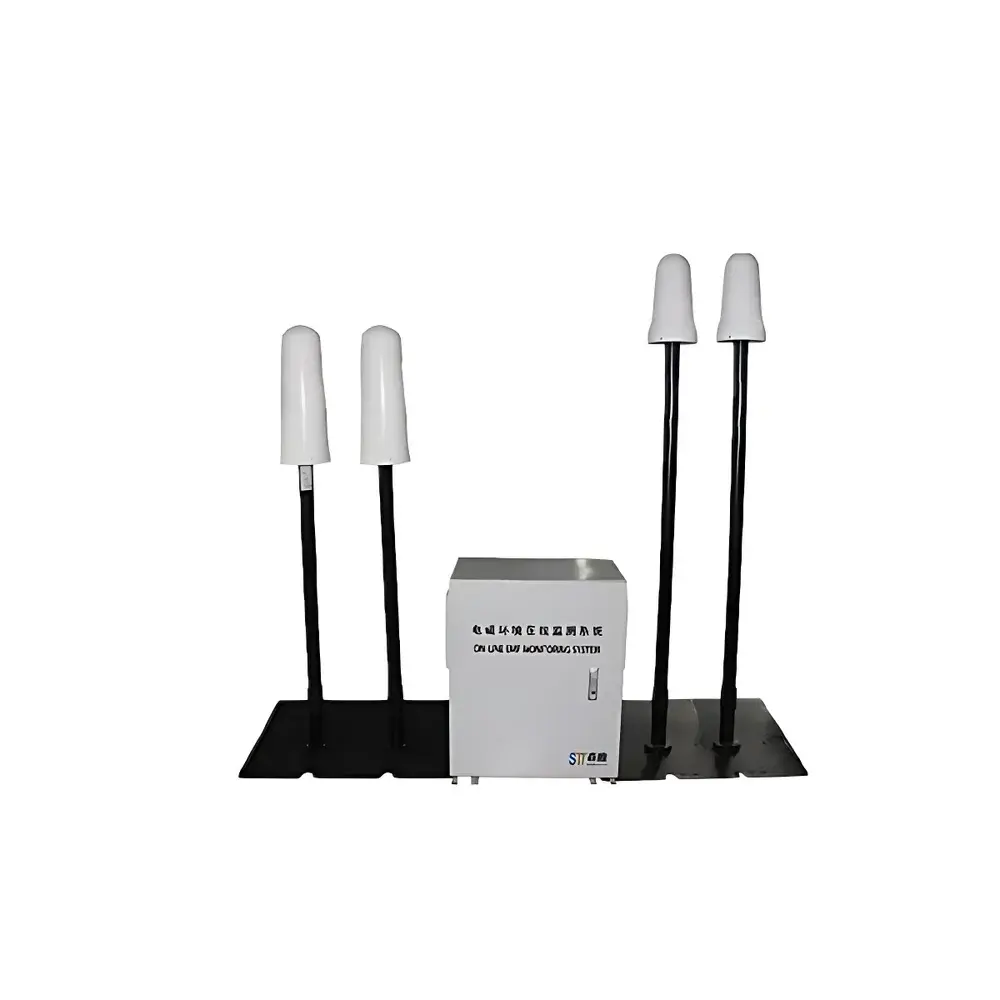
STT-OS-8S Selective-Frequency Electromagnetic Environment Online Monitoring System
| Brand | STT |
|---|---|
| Origin | Beijing, China |
| Manufacturer Type | Manufacturer |
| Country of Origin | China |
| Model | OS-8S |
| Price | Upon Request |
| Frequency Range | 100 kHz – 6 GHz |
| Measurement Accuracy | ≤ ±3 dB |
| Electric Field Range | 1 mV/m – 300 V/m |
Overview
The STT-OS-8S Selective-Frequency Electromagnetic Environment Online Monitoring System is an engineered solution for continuous, high-fidelity electromagnetic field (EMF) surveillance across a broad spectral range—from 5 Hz to 6 GHz. Based on selective-frequency (narrowband) measurement architecture—distinct from broadband RMS detection—the system resolves individual emission sources by frequency bin, enabling quantitative attribution of field contributions from discrete emitters (e.g., power lines, AM/FM broadcast transmitters, cellular base stations, radar installations, and digital TV towers). Its core principle relies on real-time fast Fourier transform (FFT)-based spectral analysis coupled with calibrated, triaxial isotropic sensors, ensuring traceable, interference-resilient measurements compliant with international EMF assessment frameworks including ICNIRP guidelines, IEEE C95.3, and national environmental monitoring standards (e.g., HJ 972–2018 in China). Designed for unattended long-term deployment, the OS-8S integrates GPS-based geotagging and precise time synchronization (±100 ns), supporting regulatory-grade data integrity for environmental impact assessments and compliance verification.
Key Features
- Full-spectrum selective-frequency monitoring: 5 Hz – 6 GHz coverage via modular sensor configuration (electric and magnetic fields measured independently)
- Multi-band triaxial isotropic sensing: Simultaneous E-field and H-field acquisition across six defined frequency sub-bands—enabling source-specific contribution analysis (e.g., 50/60 Hz power harmonics, 530–1710 kHz AM broadcast, 87.5–108 MHz FM, 470–862 MHz DTV, 700 MHz–3.8 GHz mobile networks, and radar bands up to 6 GHz)
- Integrated meteorological parameter logging: Temperature, relative humidity, atmospheric pressure, wind speed/direction, and rainfall—correlated with EMF data for environmental context
- High temporal resolution: Field strength sampling at 3-second intervals; full-spectrum FFT acquisition every 3 minutes (configurable)
- Robust hardware architecture: IP65-rated enclosure, industrial-grade temperature tolerance (−25 °C to +60 °C), and dual-redundant data transmission (4G LTE + optional Ethernet/WiFi)
- GPS-based georeferencing and PPS time stamping: Ensures spatial accuracy < 5 m and temporal alignment across distributed sensor nodes
Sample Compatibility & Compliance
The OS-8S supports interchangeable, NIST-traceable probes and antennas—including SLF-04 (5 Hz–400 kHz, low-frequency E/H-field), SLF-30 (30 kHz–30 MHz, medium-wave E/H-field), SRF-01 (100 kHz–138 MHz, broadcast H-field loop antenna), and SRF-06 (30 MHz–6 GHz, RF E-field dipole array). All transducers are calibrated per ISO/IEC 17025 requirements and characterized for isotropy (< ±0.5 dB deviation over 360° azimuth/elevation). The system meets electromagnetic compatibility (EMC) Class B per EN 61326-1 and fulfills technical specifications outlined in China’s “Technical Specification for Electromagnetic Environment Monitoring of Power Transmission and Transformation Projects” (HJ 681–2013) and “Environmental Radiation Monitoring Standards for Broadcasting and Television Facilities” (HJ 972–2018). Data records include full audit trails, sensor calibration IDs, and uncertainty budgets—supporting GLP/GMP-aligned reporting and regulatory submissions.
Software & Data Management
The OS-8S operates with the dedicated STT-OS-8S Radiation Environment Online Monitoring Platform—a secure, role-based web application supporting TLS 1.2 encryption and optional 21 CFR Part 11-compliant electronic signatures. The platform provides real-time spectral waterfall displays, time-series trend charts, source-specific contribution heatmaps, and automated exceedance alerts (customizable per ICNIRP/IEEE reference levels). Raw I/Q data and processed spectral files (IEEE 1547-compliant .sdf format) are archived with SHA-256 hashing for data integrity verification. Export options include CSV, PDF reports (with embedded metadata), and RESTful API integration with enterprise GIS or environmental management systems (EMS). Audit logs capture all user actions, configuration changes, and firmware updates—retained for ≥18 months per standard operating procedures.
Applications
- Regulatory environmental EMF monitoring around high-voltage substations, HVDC corridors, and railway electrification infrastructure
- Compliance verification for broadcast transmitter sites (AM/FM/DTV) and telecom base station clusters (2G–5G NR)
- Baseline surveys and post-construction EMF impact assessments for urban development projects
- Scientific research on long-term EMF exposure trends and correlation with local meteorological variables
- Mobile monitoring campaigns using vehicle-mounted or portable configurations for hotspot identification and forensic signal characterization
- Support for national electromagnetic environment quality reporting under Ministry of Ecology and Environment (MEE) mandates
FAQ
What distinguishes selective-frequency monitoring from broadband measurement?
Selective-frequency systems resolve amplitude per discrete frequency bin (e.g., 1 kHz resolution), eliminating intermodulation distortion and harmonic coupling artifacts common in broadband detectors—particularly critical near AM broadcast bands or switching power supplies.
Can the OS-8S identify unknown or intermittent emitters?
Yes. Its real-time FFT engine captures transient signals ≥100 ms duration, with time-stamped spectral snapshots enabling retrospective root-cause analysis of sporadic interference events.
Is remote firmware update supported?
Yes. Secure OTA (over-the-air) updates are performed via signed packages validated against embedded public-key certificates.
How is measurement uncertainty quantified and reported?
Each data packet includes expanded uncertainty (k=2) derived from probe calibration coefficients, temperature drift models, and ADC noise floor—automatically embedded in exported datasets.
Does the system support multi-node synchronized measurements?
Yes. GPS-disciplined oscillators ensure phase-coherent sampling across geographically dispersed units—enabling interferometric source localization when deployed in arrays.







