
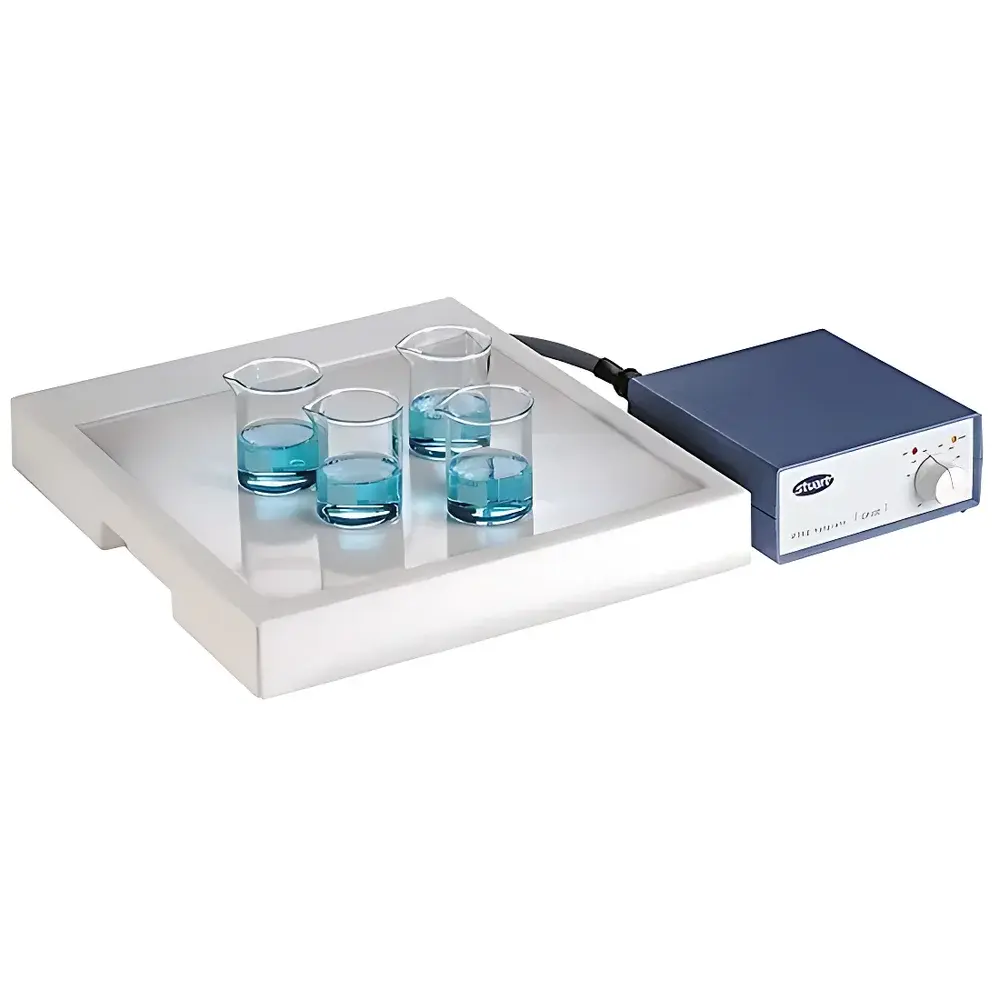
Stuart CP300 PTFE-Coated Acid-Resistant Ceramic Hotplate
| Brand | Stuart |
|---|---|
| Origin | United Kingdom |
| Model | CP300 |
| Heating Surface Material | Glass-Ceramic |
| Heating Element Encapsulation | PTFE |
| Heating Area | 200 × 200 mm (400 cm²) |
| Max Operating Temperature | 400 °C |
| Power Rating | 900 W |
| Dimensions (Hotplate) | 320 × 360 × 60 mm (W×D×H) |
| Dimensions (Controller) | 150 × 160 × 65 mm (W×D×H) |
| Weight | 11 kg |
| Electrical Supply | 230 V, 50–60 Hz |
| Safety Indicator | LED “HOT” warning light activated at surface temperature >50 °C |
| Connection | PTFE-insulated cable between hotplate and remote controller |
Overview
The Stuart CP300 PTFE-Coated Acid-Resistant Ceramic Hotplate is an engineered solution for laboratories requiring reliable, contamination-free heating in aggressive chemical environments—particularly those involving mineral acid digestion, trace metal analysis, and hydrolysis protocols. Unlike conventional stainless-steel or aluminum hotplates, the CP300 integrates a fully inert glass-ceramic top plate combined with PTFE-encapsulated heating elements and housing surfaces. This dual-material architecture eliminates metallic leaching, prevents corrosion from HNO₃, HCl, HF, and mixed-acid vapors, and ensures long-term dimensional stability under sustained thermal cycling. The device operates on resistive heating principles, delivering uniform thermal distribution across its 200 × 200 mm active zone without magnetic interference—making it compatible with both glassware and non-magnetic reaction vessels. Its design adheres to core laboratory safety and integrity requirements, including ISO/IEC 17025-compliant sample preparation workflows and EPA Method 3050B/3052 digestion protocols.
Key Features
- Chemically inert glass-ceramic work surface rated for continuous exposure to concentrated nitric, hydrochloric, and hydrofluoric acids—cleanable with ≥70% HNO₃ without degradation.
- PTFE-coated heating elements and structural components provide complete resistance to acid mists, fumes, and condensates typical in open-vessel digestion systems.
- Remotely mounted digital controller connected via PTFE-insulated cable (rated to 200 °C), enabling safe placement of the hotplate inside fume hoods while keeping controls outside—reducing operator exposure and improving ergonomics.
- Dual-status thermal safety system: a dedicated “HOT” LED indicator flashes continuously whenever the ceramic surface exceeds 50 °C, regardless of power state—complying with IEC 61000-4-2 ESD immunity and EN 60598-1 thermal hazard labeling conventions.
- Robust mechanical construction with reinforced edge sealing and IP20-rated enclosure; suitable for Class II biosafety cabinets and GLP-regulated cleanroom-adjacent preparation areas.
Sample Compatibility & Compliance
The CP300 supports standard borosilicate glassware (e.g., Kjeldahl flasks, digestion tubes, beakers up to 2 L), quartz vessels, and PFA-lined containers. It is routinely deployed in accredited environmental testing labs performing EPA 3050B (acid digestion of sediments and soils) and ASTM D5172 (determination of trace metals in petroleum products). Its non-reactive surface meets USP requirements for extractables testing and satisfies key clauses of ISO 15190:2020 (laboratory safety) regarding equipment material compatibility with hazardous reagents. No metallic components contact heated samples, eliminating risk of Fe, Cr, Ni, or Cu contamination—critical for ICP-MS and GF-AAS trace quantification.
Software & Data Management
The CP300 operates as a standalone analog/digital hybrid instrument with no embedded firmware or network interface. Temperature control is achieved via precision potentiometer-based regulation with ±2 °C accuracy over 0–400 °C range. While it does not support data logging or PC connectivity natively, its stable thermal output and repeatable setpoint response enable integration into validated workflows compliant with FDA 21 CFR Part 11 when paired with external calibrated thermocouple validation systems (e.g., Fluke 1524 with NIST-traceable probes). Audit trails for calibration and operational checks are maintained manually per GLP Annex 11 guidance.
Applications
- Acid digestion of environmental matrices (soils, sludges, plant tissues) prior to elemental analysis by ICP-OES or ICP-MS.
- Controlled hydrolysis of polymers and biological macromolecules under acidic conditions.
- Pre-concentration steps in radiochemical analysis where stainless-steel contamination must be excluded.
- Heating of PFA or quartz digestion vessels during EPA Method 3052 microwave-assisted pre-heating cycles.
- Trace-metal-clean benchtop heating in ISO/IEC 17025-accredited metallurgical testing laboratories.
FAQ
Is the CP300 compatible with perchloric acid digestion?
No. Perchloric acid requires specialized explosion-proof hotplates with integrated scrubbing and ventilation interlocks. The CP300 is rated for HNO₃, HCl, HF, and H₂SO₄ only.
Can the controller be wall-mounted?
Yes—the controller features two M4 threaded inserts on the rear panel for secure bracket mounting per DIN 41612 standards.
Does the unit include a calibration certificate?
Not supplied as standard; however, Stuart provides optional UKAS-accredited calibration services traceable to NPL standards upon request.
What maintenance is required?
Annual inspection of PTFE cable insulation integrity and verification of HOT indicator function against a calibrated IR thermometer are recommended per manufacturer’s service bulletin SB-CP300-Rev.4.
Is the hotplate suitable for use in inert atmosphere gloveboxes?
Yes—its non-magnetic, spark-free operation and absence of internal electronics make it compatible with argon- or nitrogen-filled enclosures when installed with appropriate feedthroughs.



