
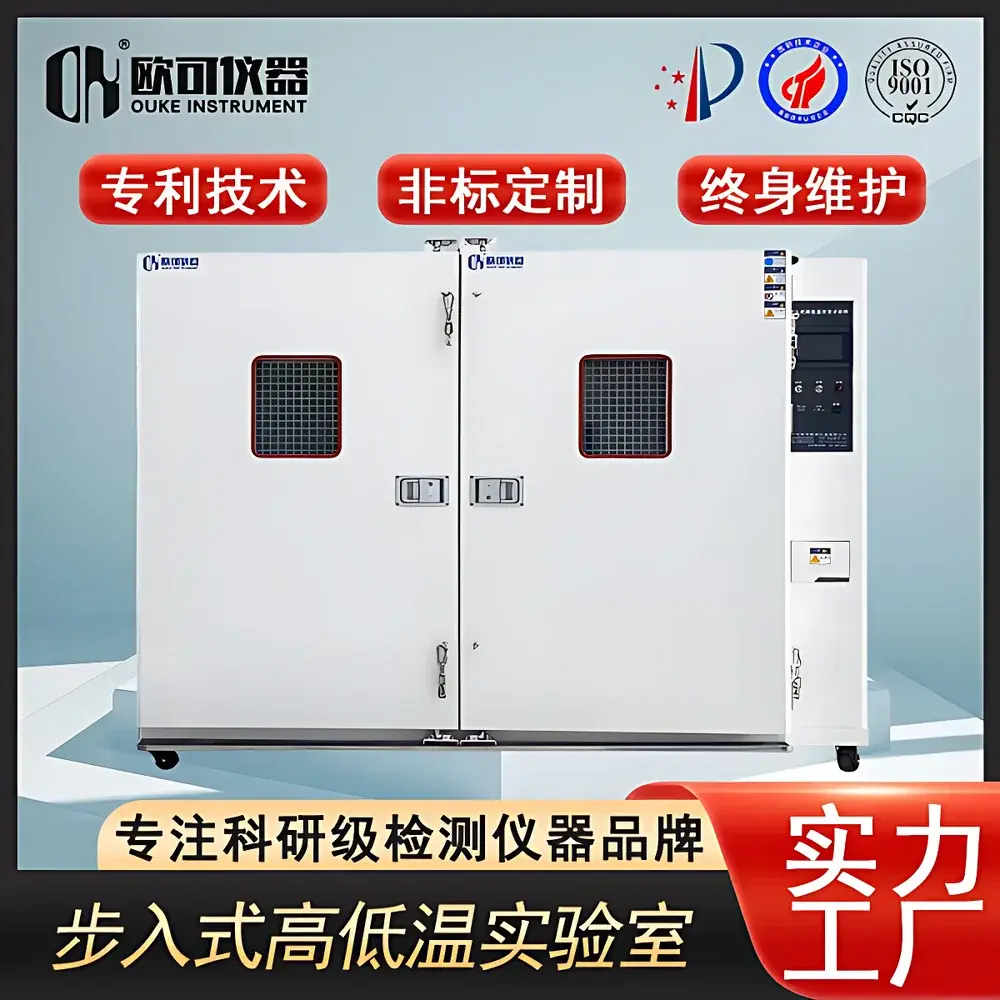
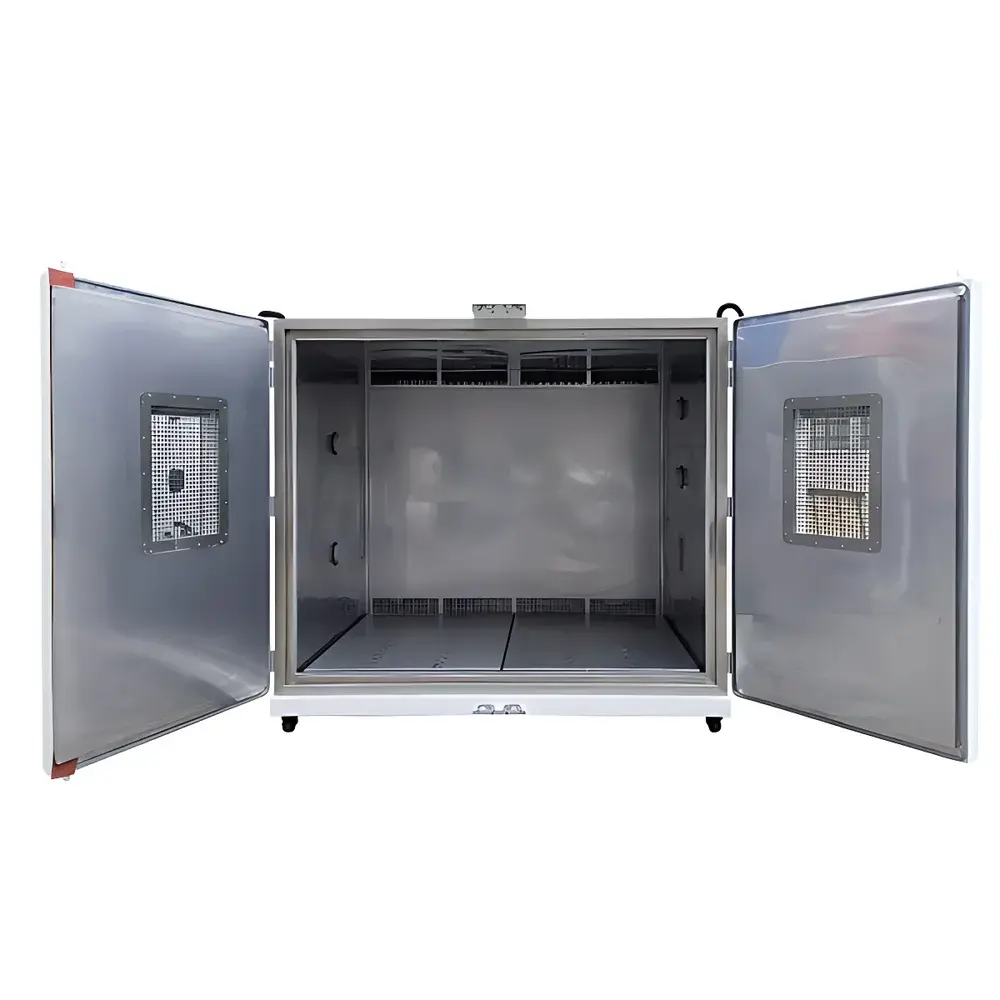
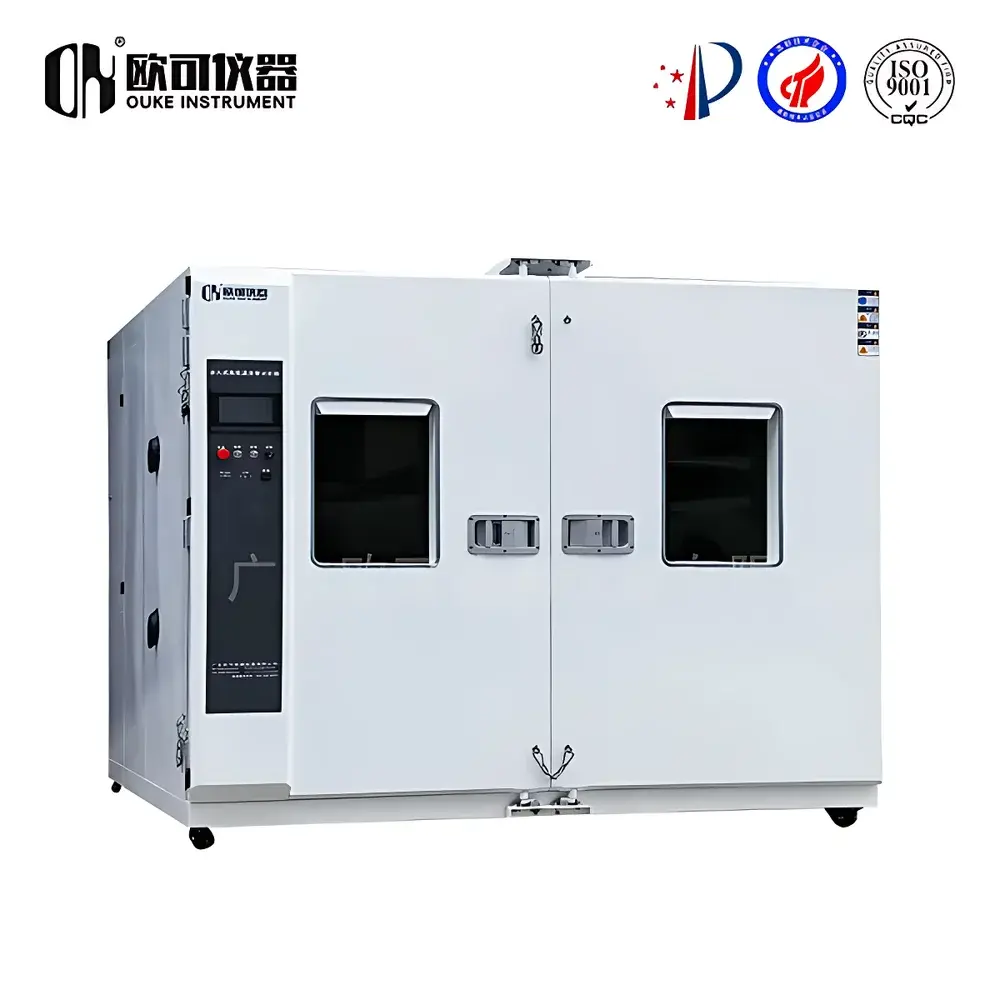
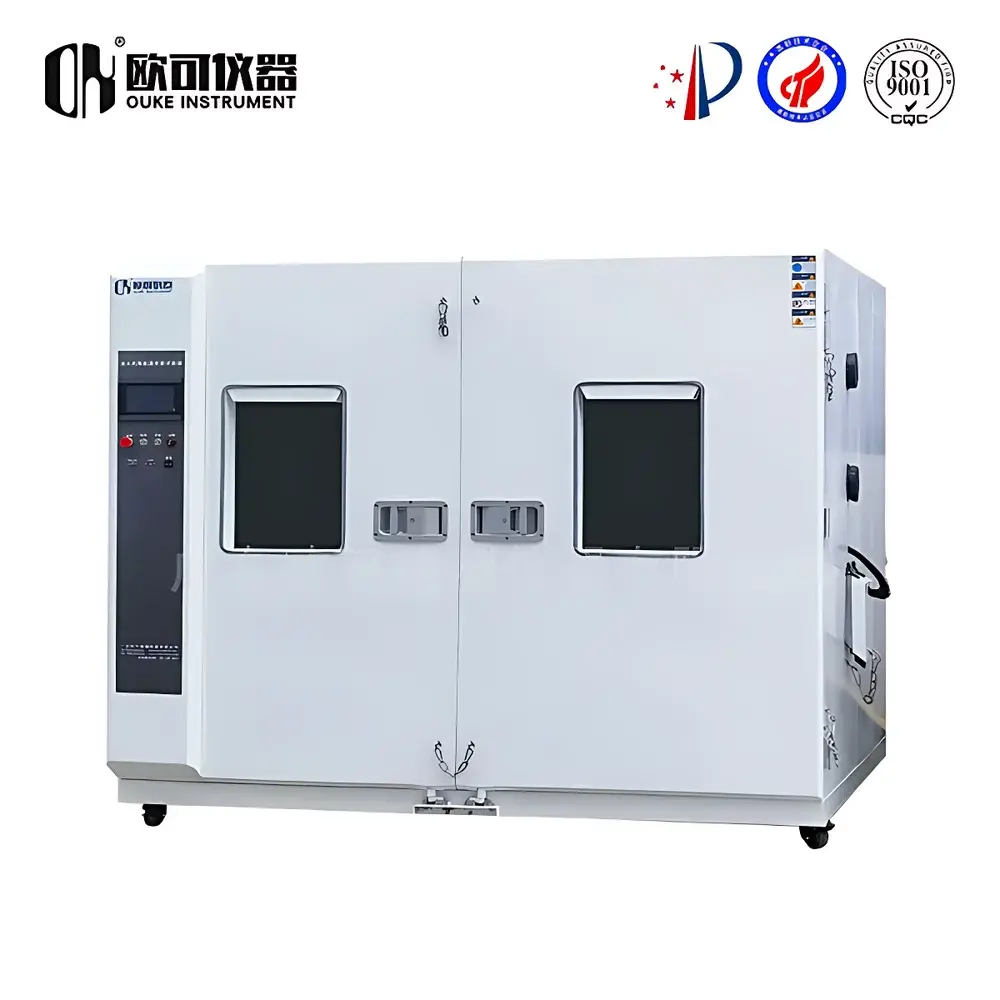
OK STW-8.2 Walk-in Temperature & Humidity Environmental Test Chamber
| Brand | OK Instruments |
|---|---|
| Origin | Guangdong, China |
| Manufacturer Type | Direct Manufacturer |
| Country of Origin | China |
| Model | OK-STH-8.2m² |
| Internal Dimensions (D×W×H) | 2000 × 2000 × 2000 mm |
| Temperature Range Options | A: 0°C / B: −20°C / C: −40°C / D: −60°C / E: −70°C |
| Temperature Uniformity | ±3°C |
| Temperature Control Accuracy | ±1°C |
| Heating Rate | 1.0–4.0°C/min |
| Humidity Range | 20–98% RH (optional configuration) |
| Humidity Control Accuracy | ±3% RH (at 25°C) |
| Construction | Double-skin steel panels with high-density polyurethane (PU) insulation |
| Door | Electrically heated observation door with safety interlock |
| Refrigeration | Cascade refrigeration system (dual-stage compressors) |
| Air Circulation | High-capacity centrifugal fans with optimized ductwork |
| Control System | Industrial PLC-based controller with touch interface, programmable profiles, data logging, and Ethernet remote monitoring |
Overview
The OK STW-8.2 Walk-in Temperature & Humidity Environmental Test Chamber is an industrial-grade, room-scale environmental simulation system engineered for system-level reliability validation under controlled thermal and hygrothermal conditions. Designed according to the fundamental principles of convective heat transfer and psychrometric control, it enables precise, stable, and spatially uniform regulation of temperature (from −70°C to +150°C, configurable) and relative humidity (20–98% RH). Its 8.2 m³ internal volume (2000 × 2000 × 2000 mm) supports full-access operator entry—facilitating installation, cabling, real-time instrumentation, and functional verification of large-format test articles. Unlike benchtop or upright chambers, the STW-8.2 functions as a structural test environment: a sealed, insulated chamber with reinforced steel framing, integrated safety interlocks, and HVAC-grade airflow management. It serves as critical infrastructure for validating thermal resilience, condensation resistance, material dimensional stability, and electronic functionality across automotive powertrains, aerospace avionics racks, utility-scale battery energy storage systems (BESS), and telecom server cabinets.
Key Features
- Modular double-wall construction using 150 mm thick PU-insulated steel panels (thermal conductivity ≤ 0.022 W/m·K), ensuring low heat leakage and long-term structural integrity.
- Cascade refrigeration architecture with independent high-temperature and low-temperature compressor stages—enabling stable operation down to −70°C without liquid nitrogen dependency.
- Electrically heated, multi-point sealed observation door with anti-frost heating element and emergency egress release compliant with ISO 13857 safety clearance standards.
- High-volume air distribution system featuring three 3 kW centrifugal fans and symmetrical duct geometry—achieving ≤ ±3°C temperature uniformity across the full working volume per IEC 60068-3-5.
- Programmable PLC controller with 10.1″ capacitive touchscreen, supporting up to 999-step temperature/humidity profiles, ramp/soak logic, and alarm-triggered email/SMS notifications via Modbus TCP or SNMP.
- Dedicated test port array (6 × Φ100 mm, IP65-rated) with silicone gasket sealing for uninterrupted signal/power feedthrough during continuous operation.
Sample Compatibility & Compliance
The STW-8.2 accommodates physically integrated systems—including electric vehicles (EVs), aircraft landing gear assemblies, photovoltaic inverters, and 19″ rack-mounted data center hardware—without disassembly. Its open-floor layout and 900 mm wide access door support forklift-assisted loading. The chamber meets mechanical and electrical safety requirements per EN 61000-6-2 (immunity) and EN 61000-6-4 (emissions), and its control software architecture supports audit-ready data integrity per FDA 21 CFR Part 11 when equipped with optional electronic signature and user-role modules. Humidity control subsystems are calibrated traceably to NIST-traceable hygrometers, and temperature sensors (PT100 Class A) are distributed at nine standardized locations (per IEC 60068-3-5 Annex B) for uniformity verification reports.
Software & Data Management
The embedded OK-EnviroControl™ platform provides real-time visualization of all sensor channels (temperature, humidity, dew point, airflow velocity), with configurable sampling intervals from 1 s to 60 min. All measurement data—including timestamps, setpoints, deviations, and alarm events—are stored locally on a redundant 128 GB industrial SSD and simultaneously mirrored to a secure FTP/SFTP server or cloud-hosted time-series database (e.g., InfluxDB). Export formats include CSV, PDF test reports (with digital signature), and XML for LIMS integration. Optional GLP/GMP-compliant mode enforces electronic audit trails, user authentication (LDAP/Active Directory), and immutable record retention—fully aligned with ISO/IEC 17025 clause 7.7 and ASTM E2500-13 section 7.3.
Applications
- Automotive: Cold-start validation of EV battery management systems (BMS) at −40°C; HVAC performance mapping across 20–95% RH; thermal shock cycling of ADAS sensor housings.
- Aerospace: Environmental stress screening (ESS) of flight-critical avionics enclosures per MIL-STD-810H Method 502.7; moisture ingress testing of composite wing sections.
- Energy Storage: Calendar life assessment of 480 V BESS cabinets under combined high-humidity (85% RH) and elevated temperature (40°C) conditions per UL 9540A.
- Telecommunications: Thermal derating analysis of 5G baseband units operating at 55°C ambient with 90% RH; convection-cooled chassis airflow optimization.
- Industrial Electronics: Burn-in qualification of industrial PLCs per JEDEC JESD22-A108F; accelerated moisture sensitivity level (MSL) pre-conditioning for SMT assembly lines.
FAQ
What is the standard lead time for factory acceptance testing (FAT) and site commissioning?
Typical FAT duration is 10 working days following mechanical completion; on-site commissioning—including installation verification, sensor calibration, uniformity mapping, and operational training—requires 5–7 days depending on customer facility readiness.
Can the chamber be upgraded to support rapid temperature transition (RTT) profiles?
Yes—retrofit options include supplementary LN₂ injection nozzles, enhanced compressor staging logic, and high-velocity air diffusers, enabling linear ramp rates up to 10°C/min within the −40°C to +85°C range.
Is remote diagnostics and preventive maintenance supported?
All units ship with embedded MQTT-enabled telemetry; OK’s ServiceLink™ portal provides predictive alerts for refrigerant pressure drift, fan motor current variance, and heater coil resistance degradation—triggering automated service ticket generation.
How is humidity generated and controlled without condensation on test specimens?
Steam humidification via stainless-steel immersion heaters ensures particle-free vapor delivery; dynamic dew point modulation and wall-surface temperature monitoring prevent localized condensation, especially during low-temperature high-RH transitions.
Does OK provide validation documentation compliant with ISO 17025 or GxP?
Upon request, OK delivers IQ/OQ documentation packages—including equipment specifications, calibration certificates (NIST-traceable), uniformity test reports, and software verification protocols—prepared in accordance with ISO/IEC 17025:2017 and Annex 11 of EU GMP Guidelines.



