
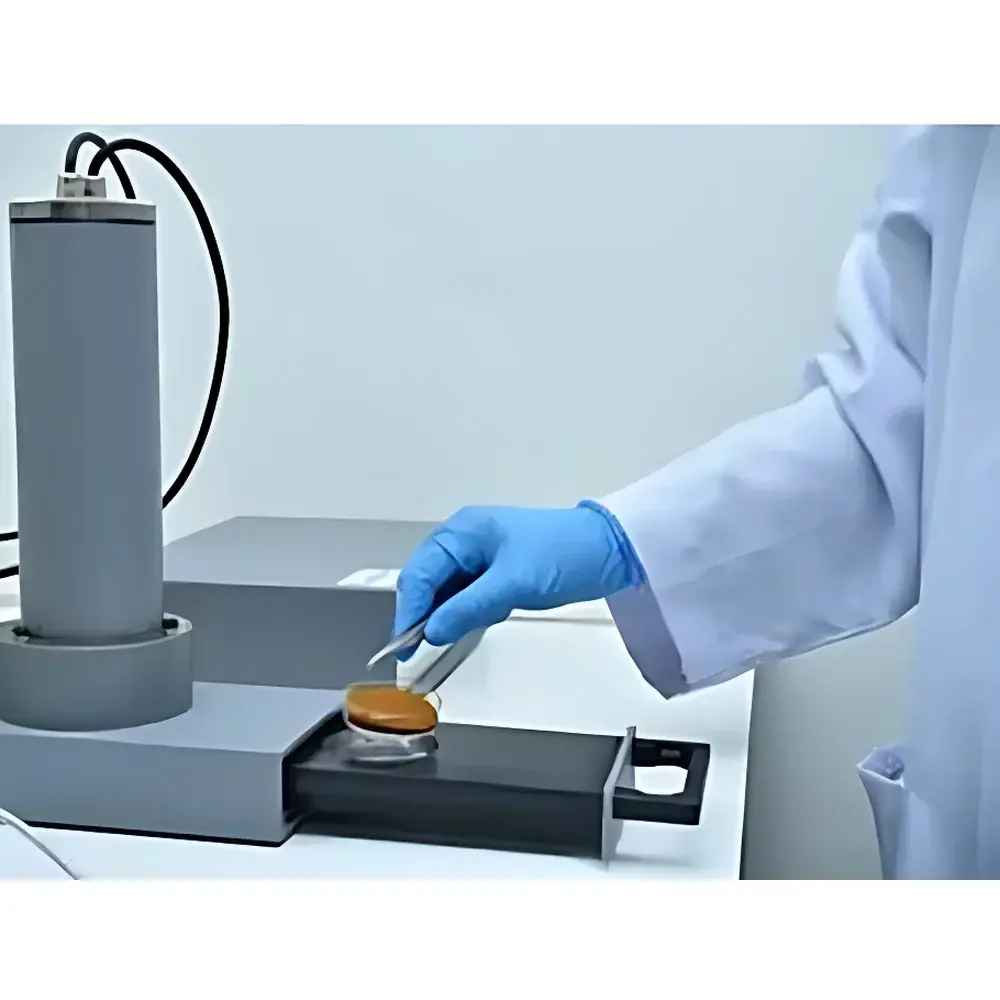
SUERC PPSL-2 Portable Photostimulated Luminescence (PSL) Irradiated Food Screening System
| Brand | SUSS (Germany) |
|---|---|
| Model | PPSL-2 |
| Origin | China (Beijing-manufactured under SUSS technical supervision) |
| Detection Principle | Photostimulated Luminescence (PSL) |
| Compliance | EN 13751:2002, ISO/IEC 17025-aligned operation |
| Sample Throughput | ≤60 samples/hour |
| Detection Time | 15 s (standalone mode), 60 s (PC-connected mode) |
| Sample Form | Solid powders, granules, dried herbs, spices, shellfish fragments, bone-in meat matrices |
| Sensitivity | Capable of detecting irradiation doses ≥0.1 kGy in silicate-containing materials (e.g., mineral debris in herbs/spices) |
| Dimensions | 420 × 320 × 280 mm |
| Weight | 12.5 kg |
| Power Supply | 100–240 V AC, 50/60 Hz |
Overview
The SUERC PPSL-2 Portable Photostimulated Luminescence (PSL) Irradiated Food Screening System is an engineered solution for rapid, non-destructive identification of ionizing radiation treatment in food and herbal products. It operates on the photostimulated luminescence principle: when mineral contaminants—such as silicates, feldspars, or calcium phosphates—present in food matrices (e.g., soil residues on herbs, shell fragments in seafood, or bone particles in meat) are exposed to ionizing radiation, they trap electrons in crystal lattice defects. Upon subsequent stimulation with pulsed visible light (typically 520–580 nm), these trapped charges recombine and emit characteristic luminescence photons detectable by a high-gain photomultiplier tube (PMT). The intensity and temporal profile of this emission correlate directly with prior irradiation history. Unlike thermoluminescence (TL), which requires post-sampling annealing and re-irradiation for calibration, PSL enables direct, single-step analysis without secondary irradiation—making it ideal for routine screening in quality control laboratories, regulatory testing facilities, and field-deployable inspection units.
Key Features
- Portable benchtop design (12.5 kg, compact footprint) enabling both laboratory and on-site deployment
- Pulsed LED excitation source with precise spectral output (545 ± 10 nm) optimized for silicate-based PSL signal generation
- Ultra-low-noise PMT detector coupled with patented UK photon-counting electronics (UK Patent No. 2291707) for sub-picowatt-level signal resolution
- No chemical reagents, solvents, or sample digestion required—minimizing consumables and operator exposure risk
- Direct measurement capability for dry powders, ground spices, dehydrated vegetables, crushed shellfish, and bone-in meat composites
- Two operational modes: standalone (15-second qualitative screening with LED status indicators) and PC-controlled (60-second quantitative PSL intensity integration with spectral baseline correction)
- Robust mechanical shutter and light-tight sample chamber ensuring zero ambient light interference during acquisition
Sample Compatibility & Compliance
The PPSL-2 is validated for use across diverse food categories containing naturally occurring crystalline minerals—including but not limited to: dried herbs and botanicals (e.g., oregano, turmeric, ginseng), ground spices (e.g., black pepper, paprika), dehydrated fruits and vegetables, crustacean shells (shrimp, crab), mollusk fragments, and mechanically separated meat with bone particulates. Its analytical performance aligns with EN 13751:2002 (“Foodstuffs — Detection of Irradiated Food Using Photostimulated Luminescence”), the harmonized European standard for PSL-based irradiation detection. While not a certified reference method per ISO/IEC 17025 accreditation out-of-the-box, the system supports full traceability through instrument log files, user-defined test protocols, and audit-ready metadata export—facilitating internal validation per GLP and GMP requirements. It is routinely employed in laboratories undergoing FDA or EFSA audits where documented irradiation status is mandated for import clearance or labeling compliance.
Software & Data Management
The optional PC-integrated software provides comprehensive data acquisition, visualization, and reporting functionality. Each measurement generates timestamped PSL decay curves, integrated photon counts, background-subtracted net signals, and pass/fail classification based on pre-configured threshold algorithms (adjustable per matrix type). Raw data files are saved in vendor-neutral CSV format with embedded metadata (operator ID, sample ID, date/time, instrument serial number, gain settings). Audit trail features include user login tracking, parameter change logs, and electronic signature support compatible with FDA 21 CFR Part 11 readiness when deployed on validated Windows environments. Export modules enable direct integration into LIMS platforms via ODBC or RESTful API endpoints.
Applications
- Routine screening of imported spices and dried botanicals for undeclared irradiation—a critical control point under EU Regulation (EC) No 1999/1999 and U.S. FDA 21 CFR §179.26
- Verification of irradiation claims on organic-certified products where irradiation is prohibited
- Supply chain due diligence for retailers requiring irradiation status documentation prior to shelf placement
- Research applications in food stability studies assessing radiolytic compound formation in irradiated matrices
- Regulatory enforcement testing at border inspection posts using portable configuration for real-time triage
- Internal QC in irradiation service providers to confirm dosimetric uniformity and process validation
FAQ
What types of food can be tested without sample preparation?
Dry, free-flowing powders and fine granules—such as ground cinnamon, dried thyme, or powdered garlic—can be measured directly in a Petri dish with no pretreatment.
Is PSL suitable for liquid or high-moisture foods?
No. The method relies on mineral inclusions; homogenized liquids, fresh produce, or pastes require lyophilization and mineral residue enrichment prior to analysis.
How does PSL differ from thermoluminescence (TL) testing?
PSL uses optical stimulation and yields results in seconds without re-irradiation; TL requires heating cycles, reference material irradiation, and longer analysis times (typically >30 minutes per sample).
Does the system require annual recalibration?
While no scheduled recalibration is mandated, users must perform daily background checks and weekly reference sample verification using provided quartz sand standards to maintain measurement integrity.
Can results be used in legal or regulatory proceedings?
Yes—when operated under documented SOPs, with maintained instrument logs and trained personnel, PSL data meet evidentiary thresholds for import rejection or labeling disputes in jurisdictions recognizing EN 13751.






