
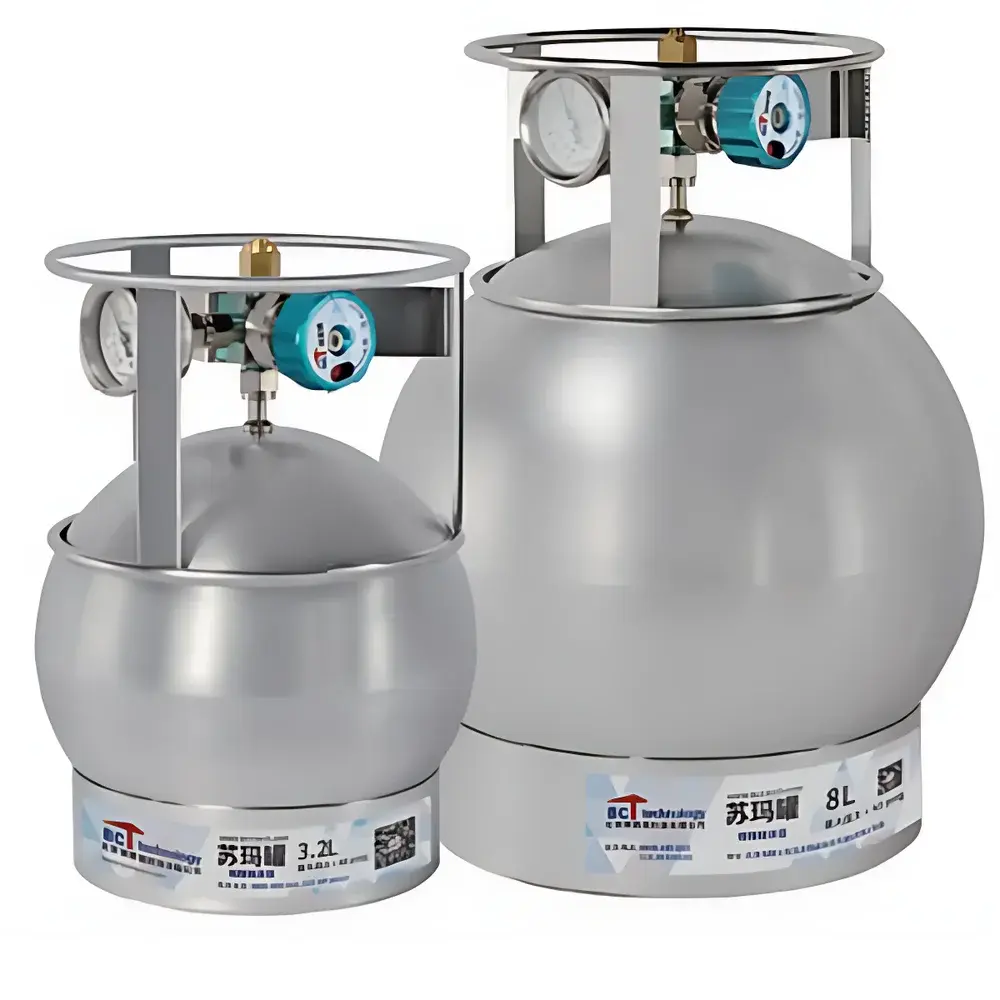
Summa Canister (BCT Model)
| Brand | BCT |
|---|---|
| Origin | Beijing, China |
| Manufacturer Type | Manufacturer |
| Product Origin | Domestic (China) |
| Model | Summa Canister |
| Pricing | Available Upon Request |
Overview
The BCT Summa Canister is a high-performance, electropolished stainless-steel air sampling vessel engineered for quantitative, non-powered collection and storage of volatile organic compounds (VOCs) and reactive inorganic gases from ambient or indoor air matrices. Based on the standardized design originally developed by the U.S. Environmental Protection Agency (EPA) and refined under EPA Method TO-14A and TO-15, this canister operates on the principle of whole-air proportional sampling—enabling passive, flow-independent capture when paired with an integrated critical-orifice flow controller (e.g., an EPA-approved constant-flow sampler). Its core function is to preserve sample integrity over extended holding times (up to 30 days at 4 °C, per EPA guidelines), making it indispensable for regulatory monitoring, source apportionment studies, and laboratory-based GC–MS or GC–FID analysis of trace-level atmospheric analytes.
Key Features
- Inert Internal Surface: Each canister undergoes fused-silica inert coating via chemical vapor deposition (CVD), followed by rigorous passivation and helium leak testing. A certified inertness validation report—including dynamic blank testing for C2–C12 hydrocarbons, carbonyls, sulfur species (e.g., H2S, CS2), nitrogen oxides, and polar VOCs—is supplied with every unit.
- Ultra-Low Adsorption Valve System: Equipped with a proprietary diaphragm-seal valve featuring zero internal springs, metal-on-metal sealing surfaces, and minimal wetted area. This architecture significantly reduces analyte adsorption/desorption hysteresis, especially for aldehydes (e.g., formaldehyde, acetaldehyde), alcohols, ketones, and acidic gases.
- Valve Position Indicator: Integrated mechanical position marker provides unambiguous visual confirmation of open/closed status, preventing misalignment during pressurization, evacuation, or analytical transfer—critical for maintaining quantitative recovery and audit readiness.
- Robust Mechanical Architecture: Constructed from 316L stainless steel with electrochemical polishing (Ra ≤ 0.4 µm), rated for service pressures up to 30 psig, and validated for ≥1,000 pressurization cycles without performance degradation.
- Trace-Level Sensitivity Support: Validated for quantitative recovery across a dynamic concentration range of 0.01–100 ppb for >120 target VOCs per EPA TO-15, including labile species such as methyl mercaptan, hydrogen sulfide, and vinyl chloride.
Sample Compatibility & Compliance
The BCT Summa Canister is compatible with standard EPA-compliant analytical workflows, including automated thermal desorption (ATD) coupled to gas chromatography–mass spectrometry (GC–MS) and GC–flame ionization detection (GC–FID). It meets material compatibility requirements for ISO 16000-6 (indoor air VOC sampling), ASTM D5466 (standard practice for whole-air sampling), and supports GLP/GMP-aligned data integrity protocols. When used with documented chain-of-custody procedures and calibrated flow controllers, data generated satisfies reporting criteria under U.S. EPA 40 CFR Part 60, Part 63, and EU Directive 2008/50/EC. All units are manufactured under ISO 9001-certified quality management systems.
Software & Data Management
While the Summa Canister itself is a passive sampling device, its integration into modern environmental laboratories relies on complementary digital infrastructure. BCT provides optional barcode-labeled canisters compatible with LIMS platforms (e.g., Thermo Fisher SampleManager, LabWare LIMS) for full traceability—from field deployment and vacuum verification logs to lab receipt, analysis scheduling, and raw data linkage. Each inertness certificate includes a unique serial number, test date, and analyte-specific recovery percentages (n = 3 replicates), supporting 21 CFR Part 11–compliant electronic record retention when scanned and archived.
Applications
- Ambient air quality monitoring networks (e.g., NCore, CASTNet)
- Indoor air quality assessments in commercial buildings and schools (per ASHRAE Standard 62.1)
- Emission source testing at industrial facilities (fugitive emissions, stack testing support)
- Toxic air contaminant (TAC) investigations and health risk assessments
- Method validation and reference standard gas storage (certified calibration mixtures up to 10,000 ppm)
- Research on atmospheric chemistry kinetics and oxidation product formation
FAQ
What is the maximum recommended storage time for a filled Summa canister before analysis?
Per EPA Method TO-15, samples should be analyzed within 30 days if stored at 4 °C; for highly reactive compounds (e.g., C2H4, H2S), analysis within 72 hours is advised.
Can the canister be reused, and how many cycles are validated?
Yes—each canister is validated for ≥1,000 cleaning cycles using EPA-recommended protocols (ultrasonic cleaning, heated purge, and vacuum bake-out at 150 °C for 2 hours), with post-cleaning blank verification required before reuse.
Is the inertness certification performed per unit or batch?
Inertness testing is conducted on a per-unit basis; each canister ships with its own Certificate of Analysis (CoA) listing recovery rates for ≥15 priority compounds.
Does the valve require lubrication or periodic replacement?
No—the diaphragm-seal valve contains no elastomers or greases and requires no maintenance; seal integrity is verified during every evacuation cycle via pressure decay testing.
How is vacuum integrity verified prior to field deployment?
Users perform a standardized leak check using a calibrated pressure transducer; acceptable decay rate is ≤0.1 psi/hour over a 2-hour period at ambient temperature.



