
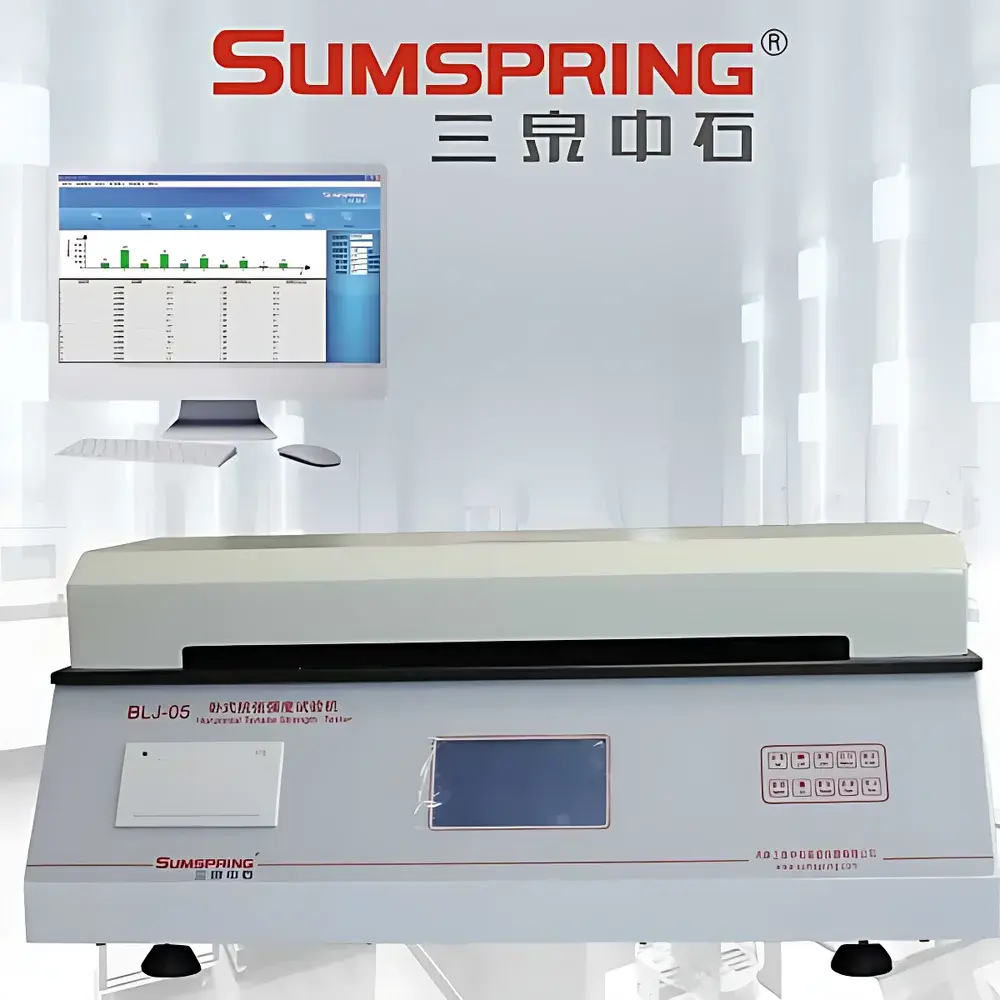
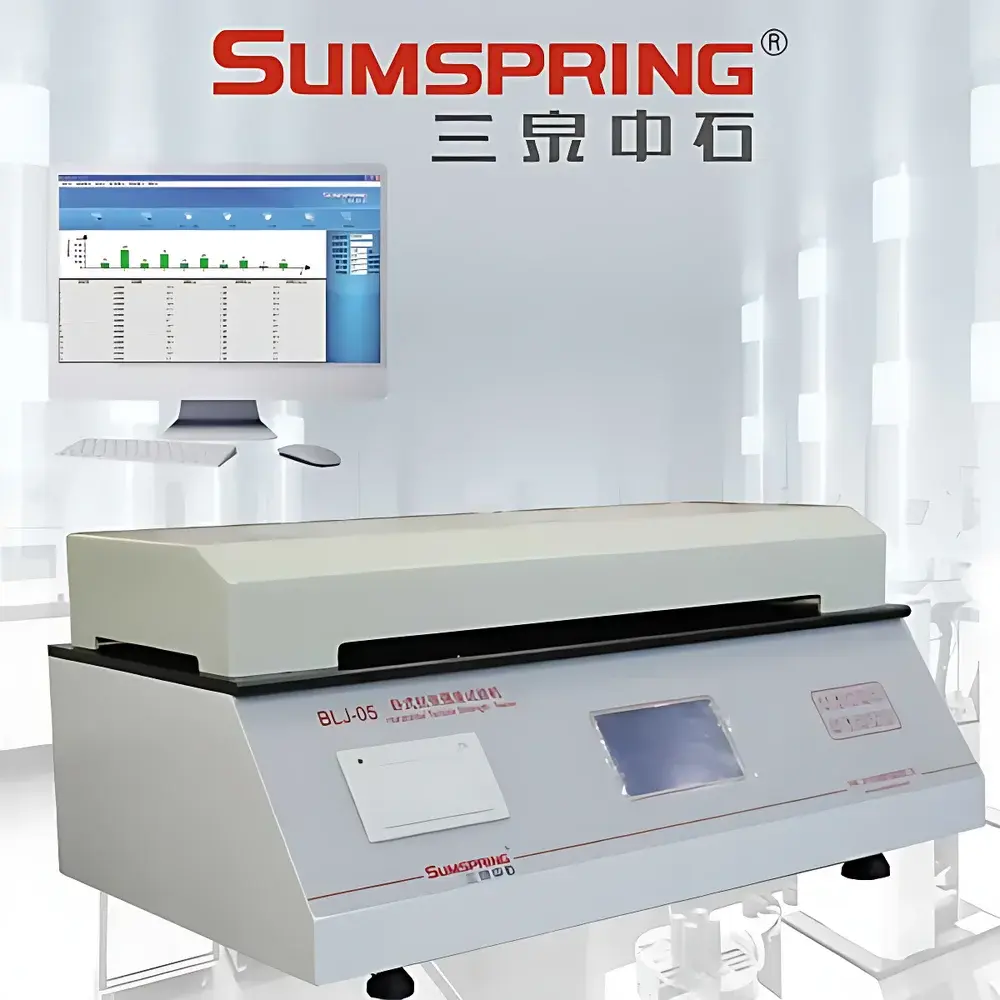
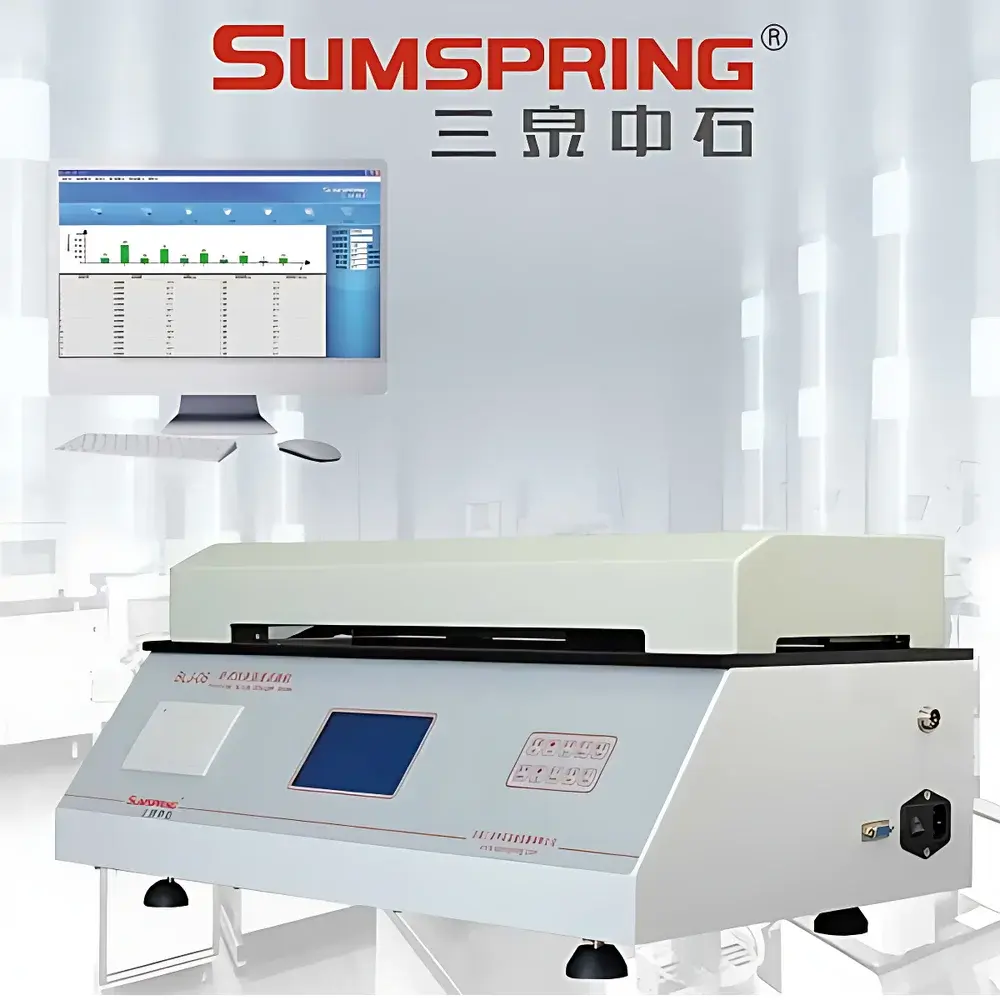
SumSpring BLC-05 Horizontal Tensile Strength Tester for Tissue Paper and Thin Sheet Materials
| Brand | SumSpring |
|---|---|
| Model | BLC-05 |
| Origin | Shandong, China |
| Manufacturer Type | Direct Manufacturer |
| Country of Origin | China |
| Maximum Test Force | 30 N |
| Force Range | 2–100% FS |
| Force Resolution | 0.001 N |
| Displacement Resolution | 0.01 mm |
| Accuracy Class | Class 1 (per ISO 7500-1) |
| Speed Range | 1–500 mm/min, infinitely variable |
| Gauge Length | 180 mm ±1 mm (adjustable) |
| Sample Width | ≤50 mm |
| Dimensions (L×W×H) | 550×370×240 mm |
| Weight | 30 kg |
| Operating Temperature | 15–50 °C |
| Relative Humidity | ≤80% RH, non-condensing |
| Power Supply | 220 V, 50 Hz |
| Compliant Standards | GB/T 20808, GB/T 12914, GB/T 465.2 |
Overview
The SumSpring BLC-05 Horizontal Tensile Strength Tester is an engineered solution for the precise mechanical characterization of low-strength, high-elongation thin-sheet materials—primarily tissue paper, facial tissues, toilet paper, and related hygiene products. Designed in strict accordance with international tensile testing principles and national standard methodologies, the instrument operates on a uniaxial tensile loading principle: a controlled, constant-rate displacement is applied to a conditioned specimen clamped between two parallel grips, while real-time force and displacement data are captured via a high-stability load cell and precision encoder system. The horizontal architecture eliminates gravitational interference on sensor calibration—ensuring consistent baseline integrity across repeated wet and dry tests. Unlike vertical testers, this configuration maintains optimal alignment under low-force regimes (<30 N), minimizing bending moments and slippage artifacts common in soft, fibrous substrates. Its primary metrological outputs include tensile strength (kPa or N/m), elongation at break (%), and tensile energy absorption (J/m²)—all traceable to SI units and validated against reference standards.
Key Features
- Microprocessor-controlled operation with large LCD display and intuitive PVC membrane keypad interface
- Horizontal dual-grip configuration ensures zero-load offset from fixture mass—critical for sub-5 N measurements
- Infinitely variable crosshead speed (1–500 mm/min), programmable in 0.1 mm/min increments to meet diverse test protocols (e.g., GB/T 20808 specifies 20 ±5 mm/min for tissue)
- Force-hold function enables manual inspection of peak load values prior to automatic reset
- Integrated thermal-printer module provides immediate hardcopy output of test ID, max force, elongation, and date/time stamp—supporting GLP-compliant record retention
- RS232 serial interface (standard) enables bidirectional communication with external PCs for automated data logging and batch reporting
- Robust aluminum alloy frame with anti-vibration base plate minimizes ambient transmission during low-force dynamic testing
Sample Compatibility & Compliance
The BLC-05 accommodates specimens up to 50 mm wide and 180 mm gauge length—optimized for standardized strips cut from rolled or folded tissue products per GB/T 12914 (equivalent to ISO 1924-2). Optional water immersion trough enables wet-tensile evaluation under controlled humidity and temperature conditions, supporting compliance with GB/T 20808 for “wet tensile strength” specifications in premium hygiene paper grades. All mechanical and software functions conform to ISO 7500-1 (static calibration of force-measuring instruments), ISO 527-1 (plastics tensile testing framework), and ASTM D828 (tensile properties of paper and paperboard). The system supports audit-ready documentation when paired with optional compliant software—meeting requirements for internal QA, third-party certification, and regulatory submissions under ISO/IEC 17025-accredited laboratories.
Software & Data Management
The optional PC-based analysis software (sold separately) provides full test method configuration, multi-curve overlay, statistical summary (mean, SD, CV%, min/max), and export to CSV, Excel, or PDF formats. Each test record includes embedded metadata: operator ID, environmental conditions (if logged externally), sample lot number, and calibration certificate traceability. Audit trail functionality complies with FDA 21 CFR Part 11 requirements—including electronic signatures, user access levels, and immutable change logs. Raw force-displacement datasets are stored in ASCII format for post-hoc reanalysis using MATLAB, Python, or industry-standard rheology packages.
Applications
- Quality control of tissue paper manufacturing lines—monitoring fiber bonding efficiency and refining process consistency
- R&D evaluation of wet-strength resins, creping adhesives, and enzymatic treatments
- Comparative assessment of recycled vs. virgin pulp formulations under standardized dry/wet conditions
- Supplier qualification testing per contractual tensile performance thresholds (e.g., ≥1.2 N for 2-ply toilet paper per GB/T 20808)
- Stability studies tracking tensile degradation during accelerated aging or humidity cycling
- Supporting ISO 9001:2015 clause 8.5.1 (control of production and service provision) through documented measurement capability
FAQ
What is the minimum measurable force resolution?
The system resolves forces down to 0.001 N across its full 30 N range, with linearity verified per ISO 7500-1 Class 1 criteria.
Can the instrument perform wet tensile tests out-of-the-box?
Yes—the standard configuration includes a stainless-steel immersion trough; users must supply distilled water and conditioning chamber (optional accessory).
Is calibration verification supported?
Yes—built-in zero-balance and span-check routines allow daily verification; certified deadweight sets (traceable to NIM) are recommended for periodic recalibration.
Does the system meet regulatory requirements for pharmaceutical packaging testing?
While designed for hygiene paper, its mechanical accuracy and data integrity features align with USP <1043> and ISO 11607-1 for tensile validation of medical-grade paper-based packaging—subject to lab-specific risk assessment and SOP validation.
How is specimen failure within 10 mm of the jaw addressed?
The instrument firmware flags such events automatically; results are excluded from statistical reports per GB/T 465.2 clause 7.3—and the operator is prompted to discard the reading without manual intervention.





