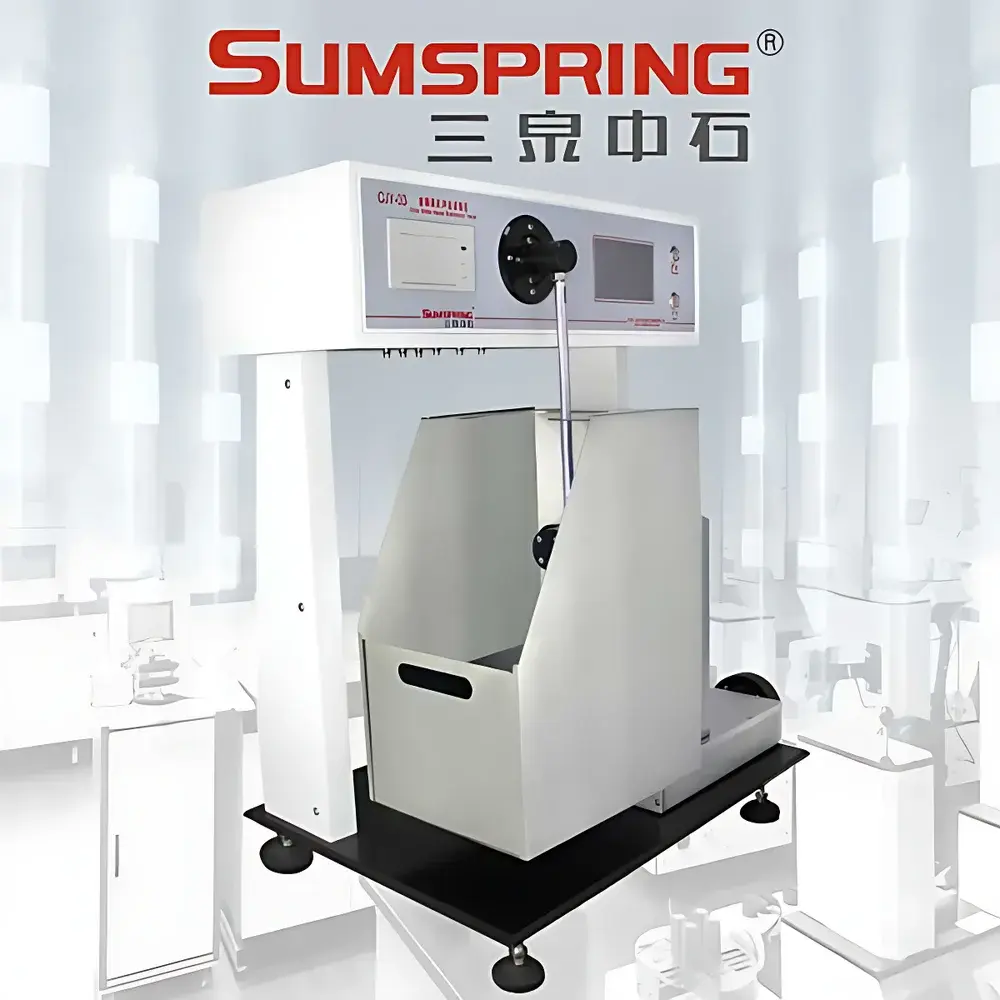
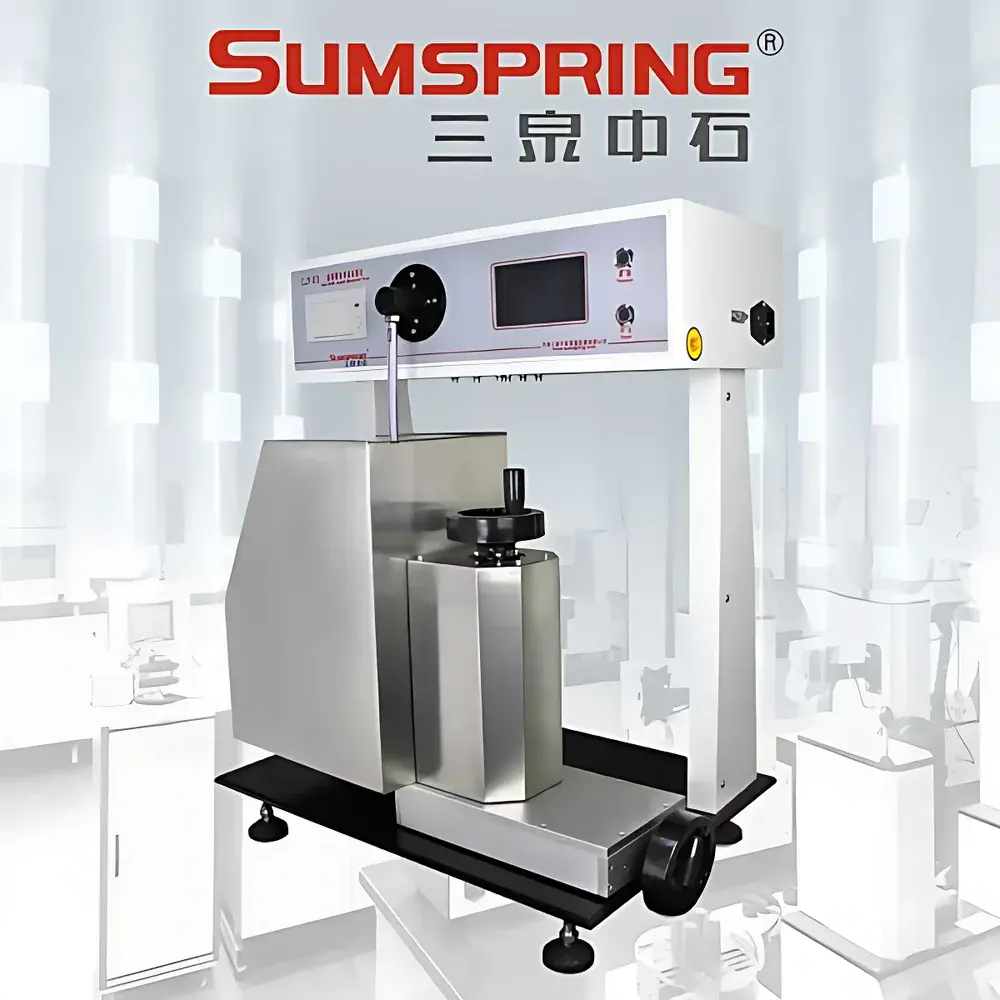
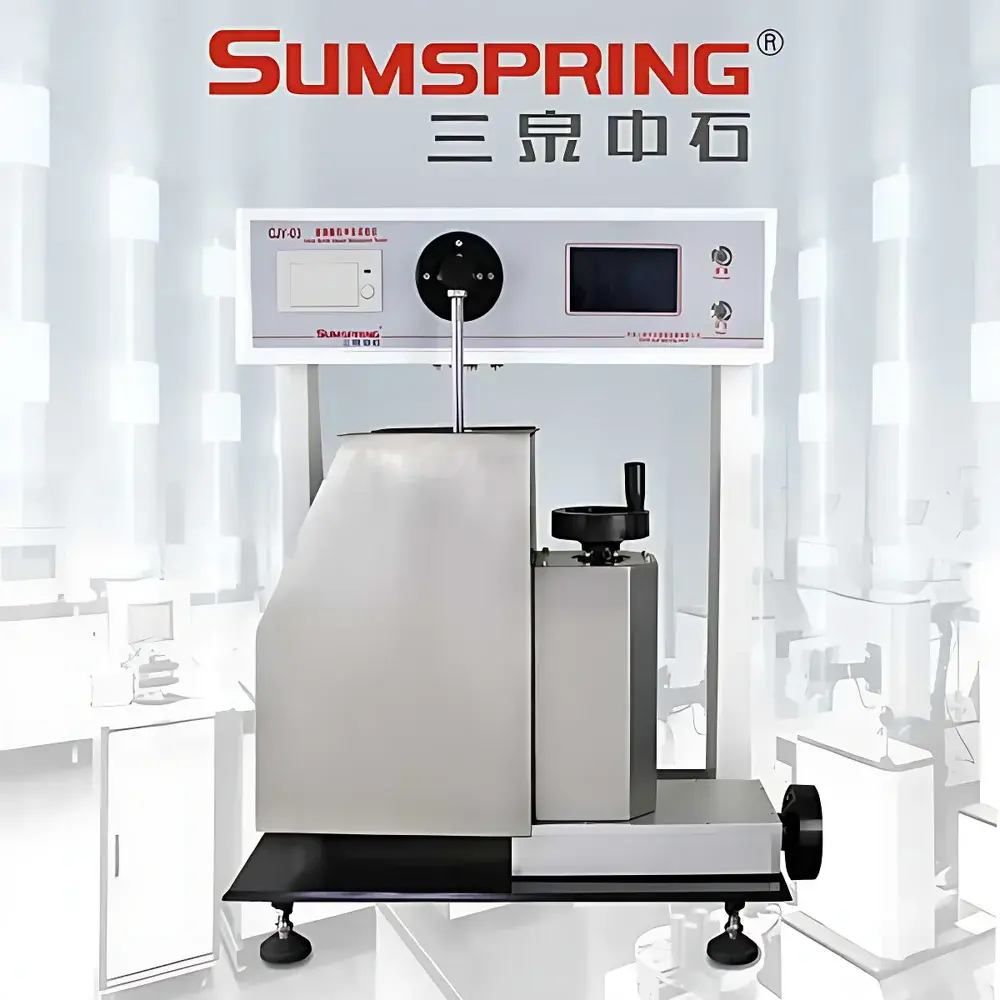
SumSpring CJY-03 Glass Bottle Impact Tester
| Brand | SumSpring |
|---|---|
| Origin | Shandong, China |
| Manufacturer Type | Direct Manufacturer |
| Country of Origin | China |
| Model | CJY-03 Glass Bottle Impact Tester |
| Price | Upon Request |
| Sample Diameter Range | φ20–160 mm |
| Sample Height Adjustment | 20–190 mm |
| Impact Energy Range | 0–2.5 N·m |
| Impact Energy Resolution | 0.01 N·m |
| Dimensions (L×W×H) | 420 × 330 × 500 mm |
| Weight | 28 kg |
| Operating Temperature | 15–50 °C |
| Relative Humidity | ≤80% RH (non-condensing) |
| Power Supply | AC 220 V, 50 Hz |
| Compliant Standards | GB/T 6552–1986, GB/T 6552–2015 |
Overview
The SumSpring CJY-03 Glass Bottle Impact Tester is a precision-engineered horizontal impact testing instrument designed specifically for evaluating the mechanical resistance of glass containers to dynamic mechanical shock. It operates on the principle of controlled pendulum impact—where a calibrated mass is released from a defined height to deliver a reproducible kinetic energy impulse to the lateral surface of a vertically positioned glass bottle or jar. This method simulates real-world handling stresses encountered during filling, capping, palletizing, transportation, and retail distribution. Unlike quasi-static compression or drop tests, the CJY-03 replicates transient loading conditions governed by Newtonian impact mechanics, enabling quantification of fracture initiation thresholds under localized stress concentration. The system is engineered for high repeatability in regulated packaging quality assurance environments, particularly where regulatory compliance with national standards (e.g., GB/T 6552) is mandatory for food, beverage, and pharmaceutical primary packaging.
Key Features
- Pendulum-based impact mechanism with digitally adjustable release height and calibrated impact mass—ensuring traceable energy delivery within 0–2.5 N·m range at 0.01 N·m resolution.
- Motorized vertical sample positioning stage (20–190 mm travel), accommodating bottles from narrow-neck vials (φ20 mm) to wide-mouth jars (φ160 mm) without manual reconfiguration.
- Integrated high-sensitivity load cell and real-time data acquisition module synchronized with impact event timing—capturing peak force, time-to-failure, and energy absorption characteristics.
- 7-inch capacitive touch LCD interface with embedded firmware for test parameter setup, result visualization, and pass/fail threshold configuration per batch or product SKU.
- Onboard thermal management and humidity-resistant enclosure design—validated for stable operation across ambient conditions from 15 °C to 50 °C and ≤80% RH (non-condensing).
- Compact footprint (420 × 330 × 500 mm) and modular construction—optimized for integration into QC laboratories, packaging R&D centers, and production line validation stations.
Sample Compatibility & Compliance
The CJY-03 accommodates cylindrical and oval-section glass containers—including flint, amber, and green soda-lime and borosilicate bottles—regardless of base geometry or shoulder contour, provided outer diameter falls within the specified φ20–160 mm range. Its adjustable sample height platform ensures consistent impact point alignment at mid-body regions, minimizing variability due to curvature-induced stress dispersion. The instrument complies fully with GB/T 6552–2015 (“Glass Containers — Resistance to Thermal Shock and Mechanical Shock”), which supersedes GB/T 6552–1986 and aligns with international best practices for container integrity verification. While not certified to ISO 7458 or ASTM D4332 directly, its test methodology is technically harmonized with those frameworks for comparative mechanical shock assessment. Data outputs support GLP-compliant documentation requirements when paired with external audit-ready reporting tools.
Software & Data Management
The CJY-03 operates via embedded real-time firmware—not PC-dependent software—minimizing cybersecurity exposure and ensuring deterministic response latency (<10 ms) during impact capture. All test records—including date/time stamp, sample ID, impact energy, peak force (N), time-to-fracture (ms), and pass/fail status—are stored internally and exported via USB to CSV format. A built-in thermal mini-printer provides immediate hard-copy output for shift logs or audit trails. For enterprise integration, optional RS-232 or Ethernet modules enable connection to LIMS or MES platforms, supporting structured data ingestion and automated report generation. Audit trail functionality meets baseline requirements for FDA 21 CFR Part 11–aligned workflows when combined with user-access controls and electronic signature protocols implemented at the facility level.
Applications
- Pre-release validation of new bottle designs against mechanical shock specifications prior to scale-up manufacturing.
- Routine incoming inspection of glass container lots from suppliers—verifying consistency in annealing quality and wall thickness uniformity.
- Root-cause analysis of field failures (e.g., in-transit breakage) by correlating impact energy thresholds with thermal treatment history or mold-line variations.
- Supporting packaging optimization studies—evaluating trade-offs between weight reduction, material substitution (e.g., lightweighted soda-lime vs. standard), and impact resilience.
- Training and qualification of packaging engineers and QA technicians in standardized mechanical testing methodologies per Chinese national standards.
FAQ
What standards does the CJY-03 comply with?
It is fully compliant with GB/T 6552–2015, the current Chinese national standard for mechanical shock resistance testing of glass containers.
Can the CJY-03 test non-cylindrical bottles (e.g., square or oval jars)?
Yes—provided the maximum cross-sectional dimension falls within the φ20–160 mm envelope and the test surface presents sufficient planar contact area for repeatable pendulum impact registration.
Is calibration certification included with shipment?
The unit ships with factory calibration verification documentation; accredited third-party calibration services are available upon request for ISO/IEC 17025 traceability.
Does the system support automated pass/fail decision logic?
Yes—users may define custom energy or force thresholds per product code; the system flags deviations in real time and logs them with timestamped metadata.
What maintenance is required for long-term accuracy?
Annual verification of pendulum arm inertia, impact mass tolerance, and sensor linearity is recommended; no routine consumables are required beyond standard electrical safety checks.