
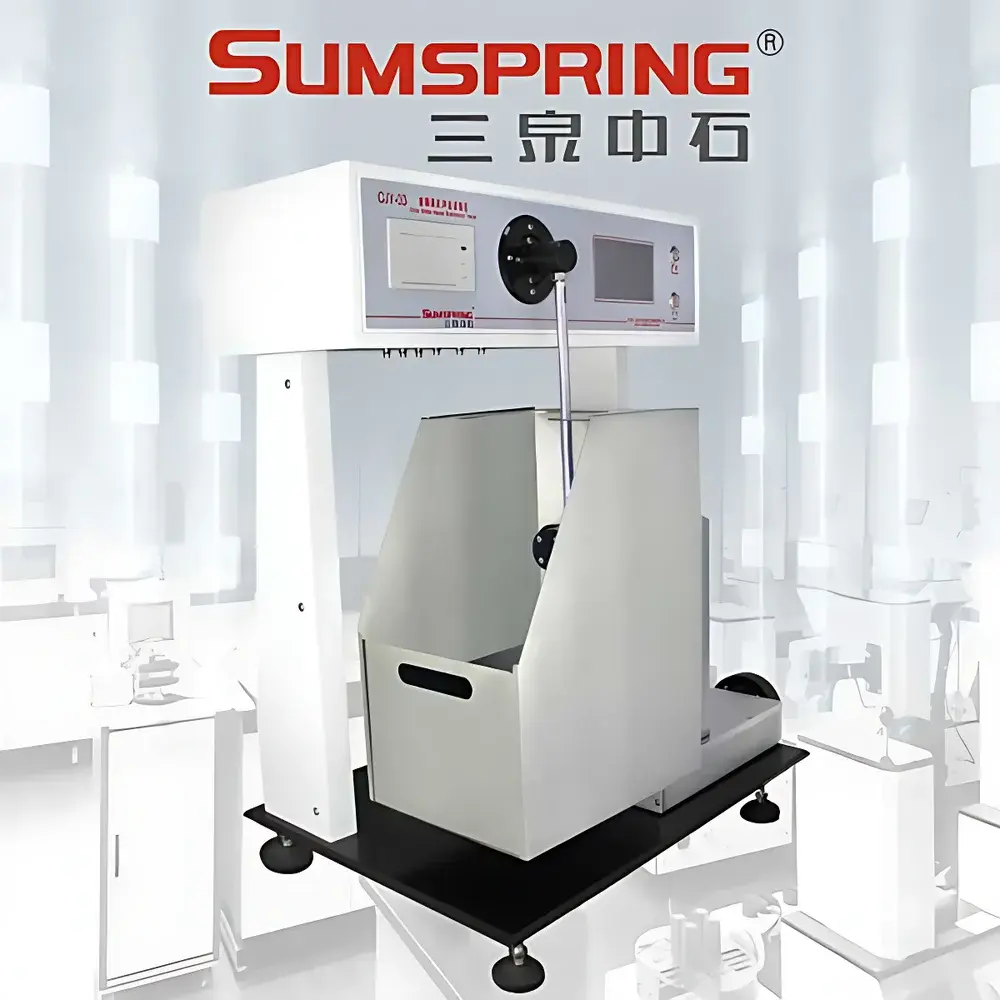
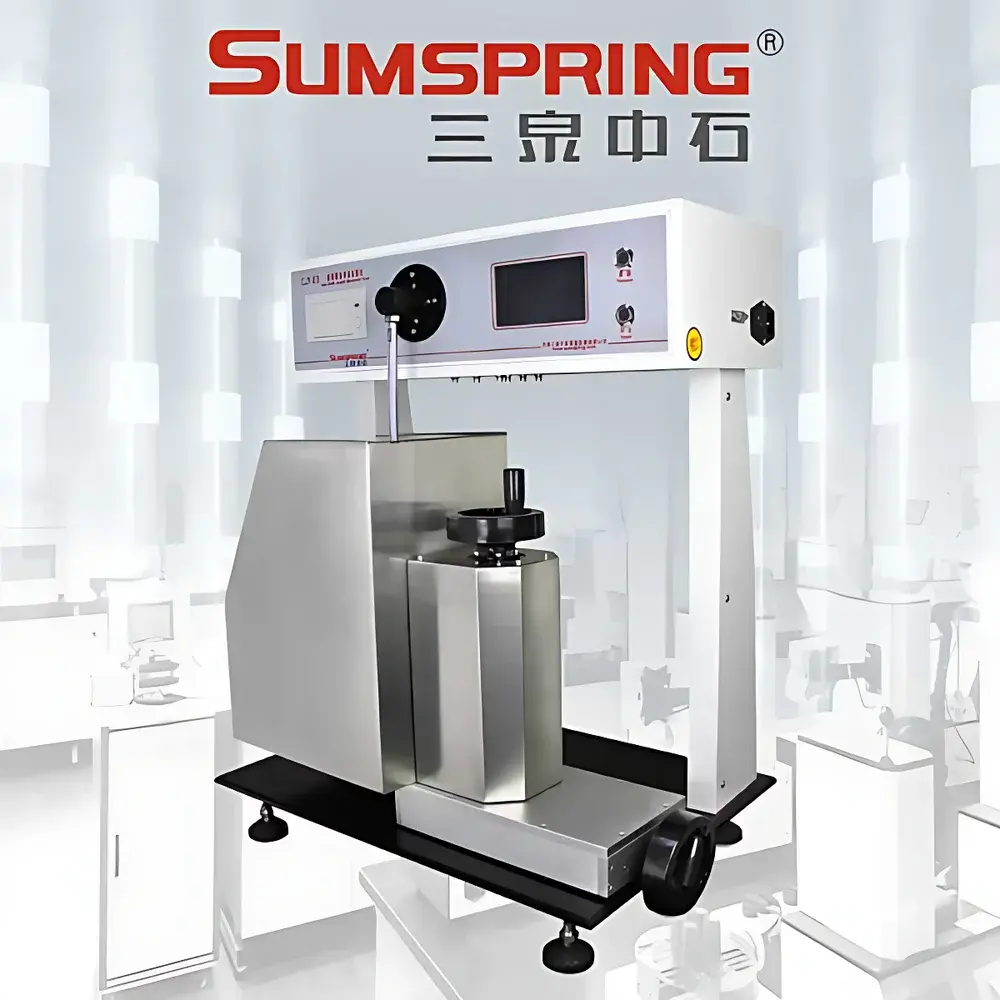
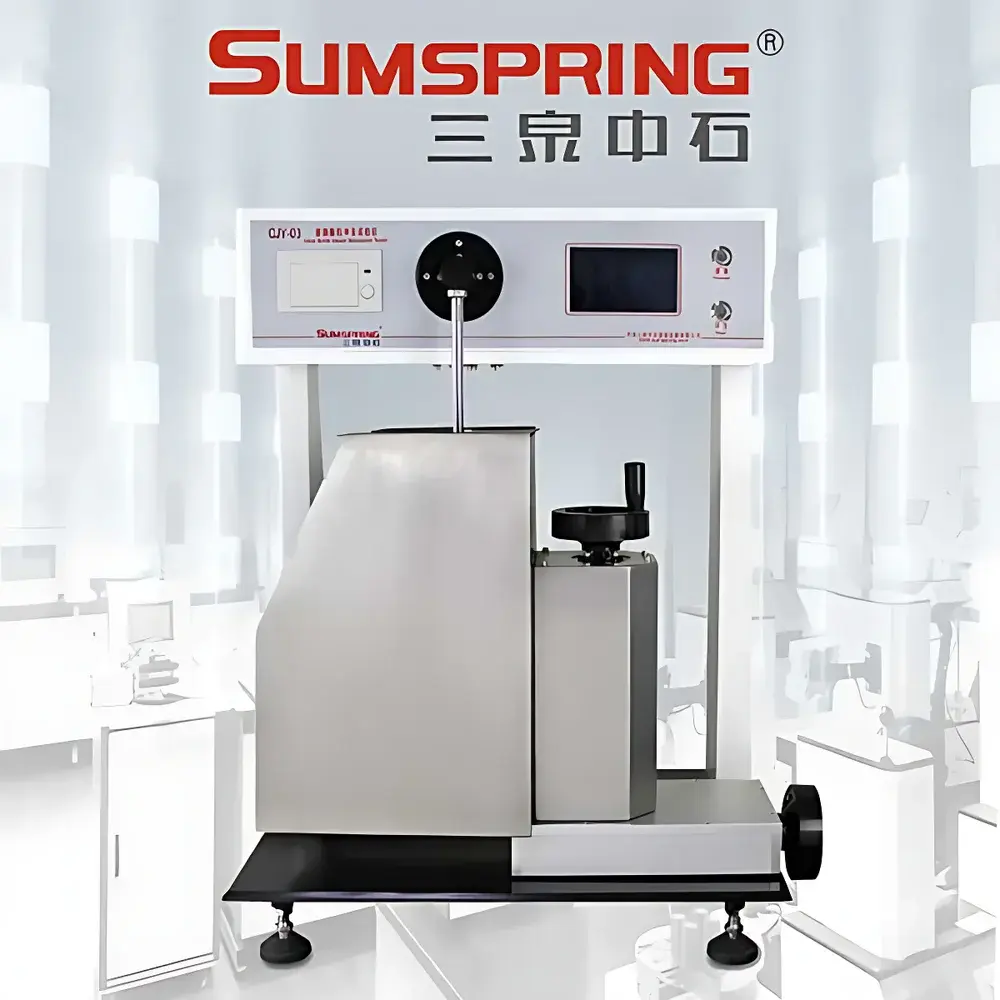
SumSpring CJY-03 Horizontal Impact Tester for IV Bottles
| Brand | SumSpring |
|---|---|
| Origin | Shandong, China |
| Manufacturer Type | OEM/ODM Producer |
| Country of Origin | China |
| Model | CJY-03 |
| Quotation | Upon Request |
| Sample Diameter Range | φ20–160 mm |
| Specimen Height Adjustment | 20–190 mm |
| Impact Energy Range | 0–2.5 N·m |
| Impact Energy Resolution | 0.01 N·m |
| Dimensions (L×W×H) | 420 × 330 × 500 mm |
| Weight | 28 kg |
| Operating Temperature | 15–50 °C |
| Relative Humidity | ≤80% RH (non-condensing) |
| Power Supply | AC 220 V, 50 Hz |
| Compliant Standards | GB/T 6552–1986, GB/T 6652–2015 |
Overview
The SumSpring CJY-03 Horizontal Impact Tester for IV Bottles is a precision-engineered mechanical testing instrument designed to evaluate the mechanical robustness of glass pharmaceutical containers—specifically intravenous (IV) bottles—under controlled horizontal impact conditions. It operates on the principle of pendulum-based impact energy delivery, where a calibrated arm with a defined mass strikes the specimen at a predetermined angular displacement, generating a repeatable kinetic energy impulse (0–2.5 N·m) normal to the bottle’s sidewall or base. This methodology directly simulates real-world mechanical stresses encountered during secondary packaging handling, palletized transport, and warehouse stacking—critical failure modes that may compromise container integrity and, consequently, sterility assurance. Unlike drop testers or vertical impact systems, the CJY-03 replicates lateral inertial loads typical of conveyor belt transitions, fork-lift jolts, or sudden deceleration events. Its design adheres strictly to the physical test protocols outlined in GB/T 6552–1986 (determination of thermal shock resistance of glass containers) and GB/T 6652–2015 (impact resistance testing methods for pharmaceutical glass packaging), ensuring metrological traceability and regulatory alignment for domestic Chinese pharmaceutical manufacturers operating under NMPA GMP requirements.
Key Features
- Pendulum impact mechanism with adjustable release angle and calibrated energy output (0.01 N·m resolution), enabling precise incremental energy escalation per test cycle.
- Motorized height-adjustable specimen support stage (20–190 mm range), accommodating diverse IV bottle geometries—from small 50 mL ampoule-style vials to large 2 L polyolefin-coated glass containers—without manual repositioning.
- Integrated 7-inch capacitive touch LCD interface with embedded firmware for test parameter configuration (impact energy, repetition count, dwell time), real-time force feedback visualization, and pass/fail threshold setting.
- Onboard thermal-stabilized micro-printer (included) generates time-stamped, audit-ready hardcopy reports containing specimen ID, energy level, impact count, observed failure mode (crack initiation, radial fracture, delamination), and operator signature field.
- Rigid aluminum alloy frame with vibration-damping rubber feet ensures mechanical stability during high-energy impacts, minimizing environmental coupling and improving measurement repeatability (RSD < 2.3% across 10 repeated tests at 1.8 N·m).
- Compliance-ready architecture supports optional CSV export via USB port and configurable data logging intervals for integration into laboratory information management systems (LIMS) or electronic batch records (EBR).
Sample Compatibility & Compliance
The CJY-03 accepts cylindrical and oval-section glass containers with outer diameters between 20 mm and 160 mm, including borosilicate Type I, soda-lime Type III, and coated aluminosilicate variants commonly used in parenteral drug packaging. It accommodates both empty and filled specimens (liquid fill level ≥ 80% recommended for hydrodynamic load simulation). The device fulfills essential verification requirements under China’s Good Manufacturing Practice (GMP) Annex for Sterile Products and aligns with ISO 8536-1:2020 (Infusion bottles — Part 1: Glass bottles) clause 6.4 on mechanical strength validation. While not certified to ASTM D4169 or ISTA 3A out-of-the-box, its impact energy profile is quantitatively correlatable to those standards’ “distribution simulation” severity levels when validated against reference materials. Routine calibration is performed using NIST-traceable torque wrenches and angular displacement sensors; annual third-party verification is recommended per ISO/IEC 17025:2017 guidelines.
Software & Data Management
The embedded control software provides deterministic test sequencing with no external PC dependency. All test parameters—including energy setpoint, number of impacts per location, and positional indexing—are stored in non-volatile memory with timestamped audit trails. Data export supports UTF-8 encoded CSV files containing: Test ID, Date/Time, Operator Code, Bottle Lot Number, Measured Impact Energy (N·m), Observed Damage Classification (per GB/T 6652–2015 Annex B visual grading scale), and Pass/Fail Status. Optional firmware upgrade enables GLP-compliant user access control (3-tier role permissions), electronic signatures (21 CFR Part 11 compliant when deployed with network-authenticated domain login), and automated report generation with embedded digital signatures. Raw sensor logs (pendulum angular velocity, contact duration, rebound coefficient) are retained for root-cause analysis of borderline failures.
Applications
- Pre-release quality gate testing of Type I borosilicate IV bottles prior to sterilization and filling.
- Comparative evaluation of coating durability (e.g., SiO₂ nanolayer adhesion) under mechanical stress.
- Validation of new bottle designs undergoing Design Transfer from R&D to manufacturing.
- Supplier qualification audits for glass container vendors supplying to API manufacturers.
- Root cause investigation of field complaints related to container breakage during cold-chain logistics.
- Cross-industry adaptation for cosmetic glass ampoules, diagnostic reagent vials, and food-grade glass jars requiring impact resilience certification.
FAQ
What standards does the CJY-03 directly reference in its test methodology?
It implements the procedural framework and acceptance criteria defined in GB/T 6552–1986 and GB/T 6652–2015, both national standards issued by SAC (Standardization Administration of China) specifically for pharmaceutical glass packaging mechanical testing.
Can the CJY-03 test plastic IV containers such as PET or polyolefin bottles?
Yes—though its primary calibration and validation are optimized for glass. For polymeric containers, users must establish empirical correlation curves between observed deformation thresholds and material-specific yield strain values, as energy absorption mechanisms differ fundamentally.
Is periodic recalibration required, and what documentation is provided?
Yes. A factory calibration certificate (traceable to CNAS-accredited metrology labs) is supplied with each unit. Annual recalibration is advised; SumSpring offers on-site service with full uncertainty budget reporting per ISO/IEC 17025.
Does the system support multi-location impact testing on a single bottle?
Yes—the height-adjustable stage and rotational indexing capability (manual 90° detent positions) allow systematic impact application at four cardinal points (0°, 90°, 180°, 270°) without specimen removal.
How is operator safety ensured during high-energy impact cycles?
The unit features interlocked transparent polycarbonate shielding (impact-rated to 3.0 N·m), automatic pendulum arrest upon door opening, and dual-channel emergency stop circuitry compliant with GB/T 5226.1–2019 (Electrical equipment of machines).




