
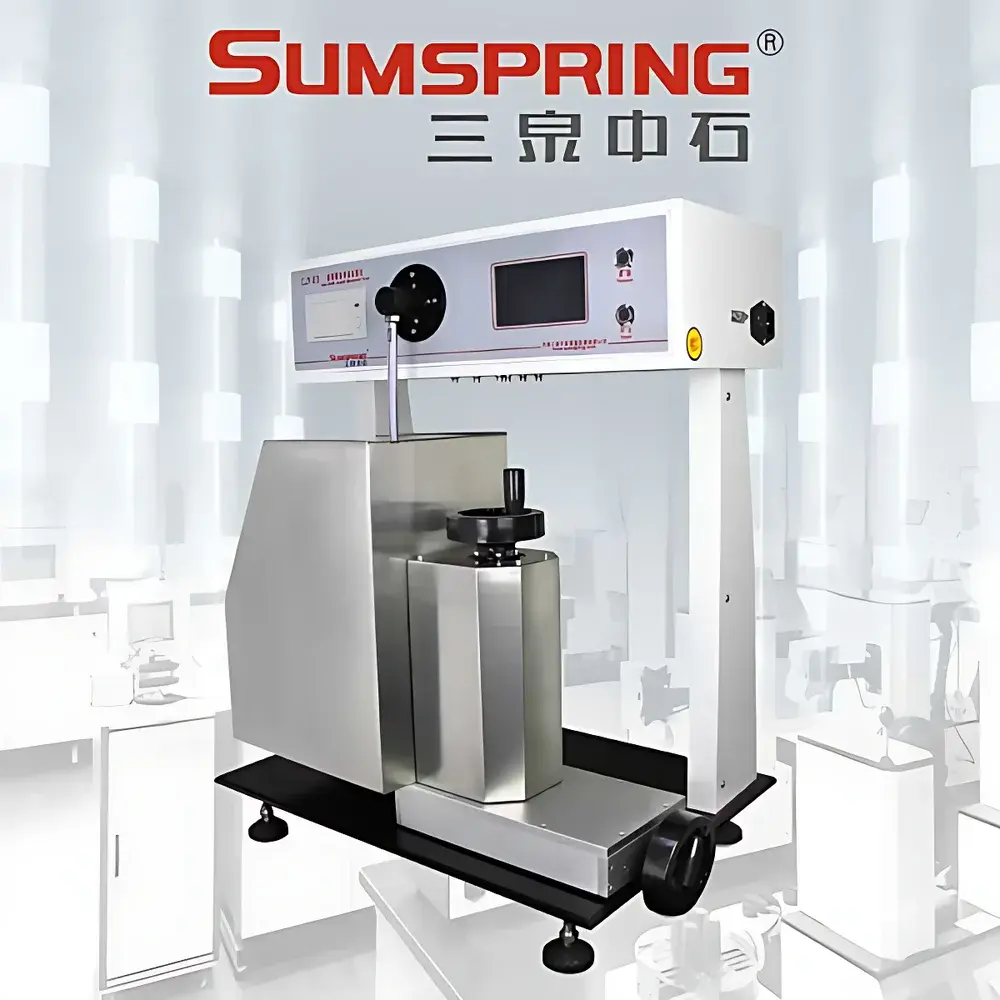
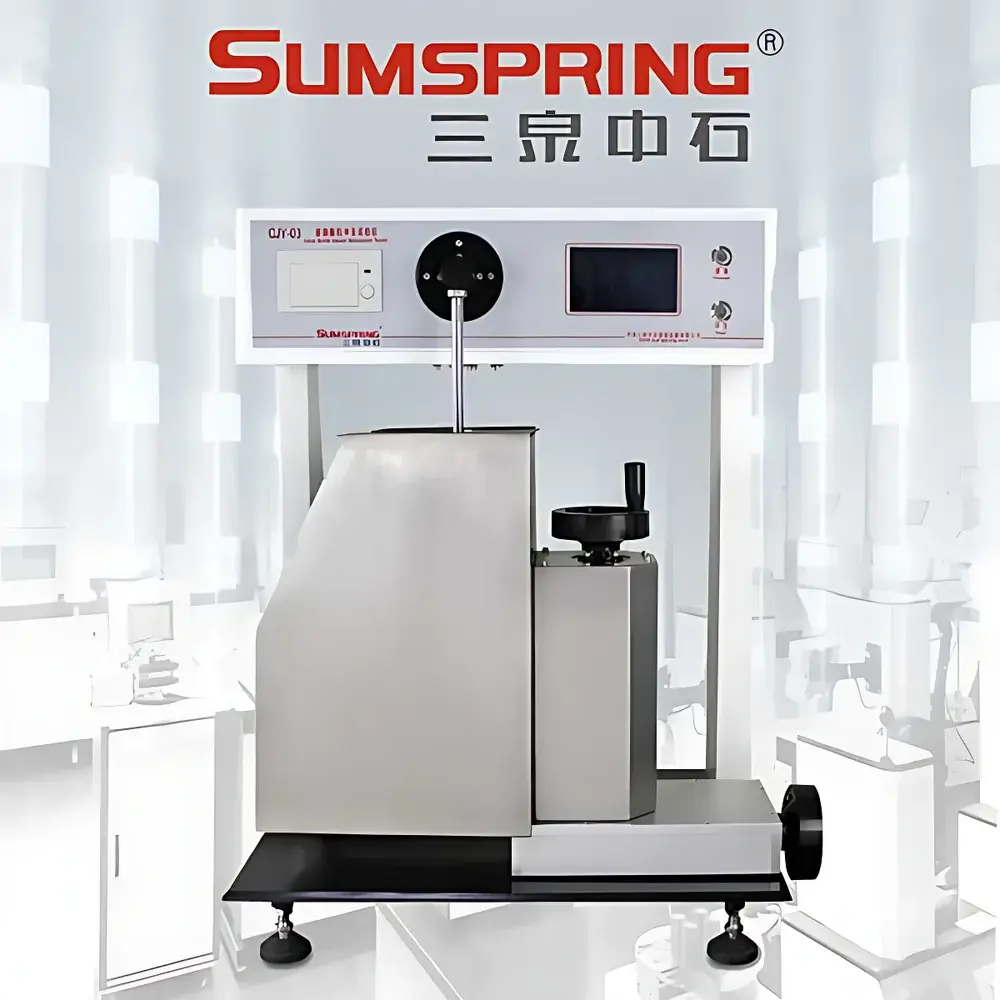
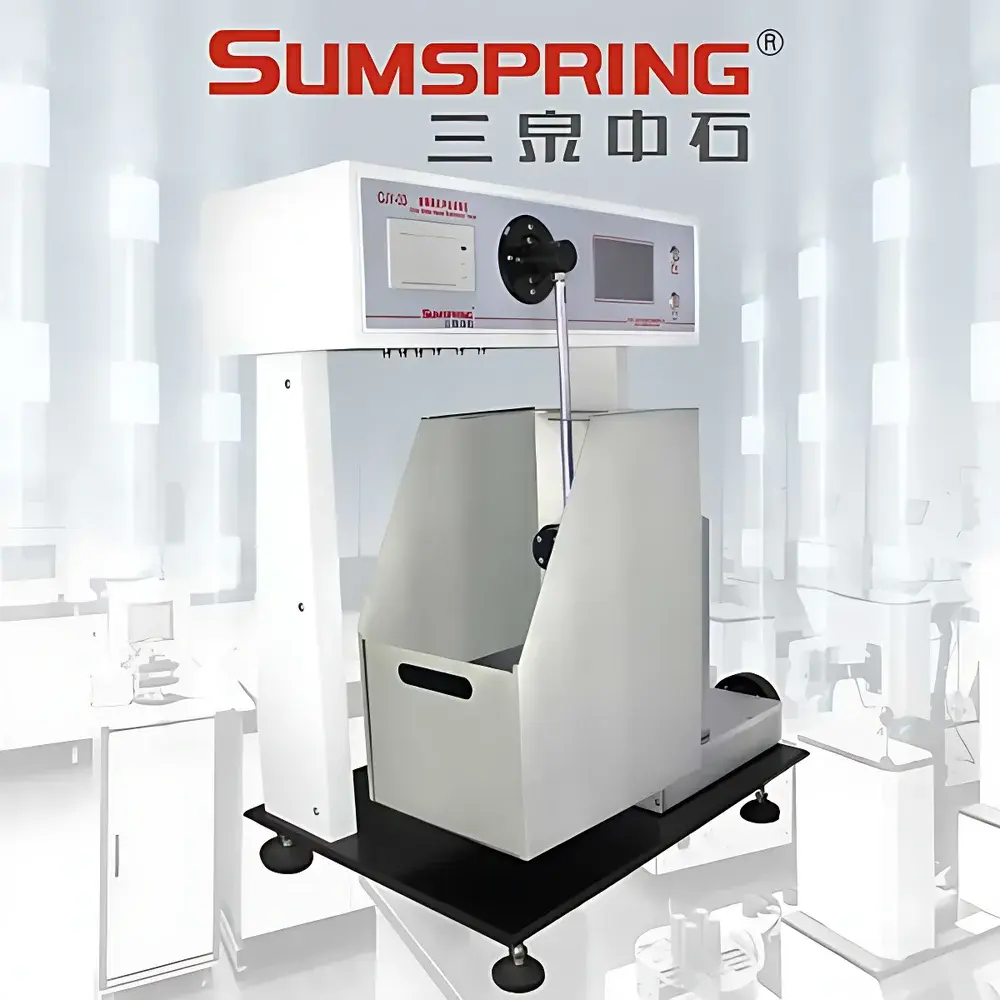
SumSpring CJY-03 Horizontal Impact Tester for Pharmaceutical Glass Containers
| Brand | SumSpring |
|---|---|
| Origin | Shandong, China |
| Manufacturer Type | Direct Manufacturer |
| Country of Origin | China |
| Model | CJY-03 |
| Quotation | Upon Request |
| Sample Diameter Range | φ20–160 mm |
| Sample Height Adjustment | 20–190 mm |
| Impact Energy Range | 0–2.5 N·m |
| Impact Energy Resolution | 0.01 N·m |
| Dimensions (L×W×H) | 420 × 330 × 500 mm |
| Weight | 28 kg |
| Operating Temperature | 15–50 °C |
| Relative Humidity | ≤80% RH (non-condensing) |
| Power Supply | AC 220 V, 50 Hz |
| Compliant Standards | GB/T 6552–1986, GB/T 6552–2015 |
Overview
The SumSpring CJY-03 Horizontal Impact Tester is a precision-engineered instrument designed specifically for evaluating the mechanical resistance of pharmaceutical glass containers—primarily infusion bottles and ampoules—to controlled horizontal impact forces. It operates on the principle of pendulum-based impact energy delivery, where a calibrated swinging arm with a standardized impact head strikes the sample at a defined height and angle, simulating real-world mechanical stresses encountered during secondary packaging, palletized transport, warehouse handling, and distribution logistics. Unlike drop testers or vertical impact systems, the CJY-03 replicates lateral inertial loads that may arise from conveyor belt collisions, carton compression, or abrupt deceleration in transit—conditions known to induce radial stress fractures in thin-walled borosilicate or soda-lime glass containers. Its design adheres strictly to the mechanical test protocols outlined in GB/T 6552, the Chinese national standard equivalent to ISO 7243 and harmonized with key aspects of USP <660> and Ph. Eur. 3.2.1 regarding container integrity verification.
Key Features
- Pendulum-type impact mechanism with adjustable release angle and calibrated energy transfer (0–2.5 N·m, resolution ±0.01 N·m), enabling repeatable, traceable force application per test cycle.
- Motorized height-adjustable sample stage (20–190 mm vertical range) accommodating diverse container geometries—from 20 mm-diameter vials to 160 mm-diameter large-volume infusion bottles—without manual repositioning or fixture changes.
- Integrated 7-inch capacitive touch LCD interface with intuitive icon-driven navigation, real-time impact energy display, and on-device parameter logging (impact count, energy setting, pass/fail status).
- Onboard thermal printer for immediate hard-copy documentation of test results, including date/time stamp, operator ID (if configured), sample ID, applied energy, and visual assessment notes.
- Rigid steel frame construction with vibration-damping base and anti-slip rubber feet ensures mechanical stability during repeated high-energy impacts, minimizing measurement drift and supporting GLP-compliant operation.
- Compliance-ready architecture: All test parameters are non-volatile; system logs retain configuration history and user actions—facilitating audit readiness under GMP Annex 11 and FDA 21 CFR Part 11 when paired with appropriate access controls and electronic signature protocols.
Sample Compatibility & Compliance
The CJY-03 supports cylindrical and oval-section glass containers commonly used across pharmaceutical primary packaging, including Type I (borosilicate), Type II (treated soda-lime), and Type III (soda-lime) glass per USP classification. It accommodates both empty and filled samples (with validated liquid fill levels), provided internal pressure remains ambient and no volatile or hazardous contents are present during testing. The device meets the dimensional and procedural requirements of GB/T 6552–2015 (“Glass containers — Resistance to thermal shock and mechanical shock”), which references ISO 7243:1984 (Glass containers — Resistance to mechanical shock) and aligns with the mechanical integrity verification clauses in ICH Q5C and WHO Technical Report Series No. 961, Annex 6. It is routinely deployed in QC laboratories for batch release testing, supplier qualification, and stability protocol support.
Software & Data Management
While the CJY-03 operates as a standalone instrument with embedded firmware, its data export capability (via USB port) enables integration into laboratory information management systems (LIMS) or enterprise quality management systems (QMS). Test records—including timestamped energy values, operator inputs, and pass/fail determinations—are saved in CSV format for traceability and statistical process control (SPC) analysis. Optional PC-based software (available separately) provides advanced reporting features: automated Pass/Fail threshold assignment per container type, trend charting of impact resistance over time, and PDF report generation compliant with ALCOA+ principles (Attributable, Legible, Contemporaneous, Original, Accurate, Complete, Consistent, Enduring, Available).
Applications
- Pre-release mechanical integrity screening of sterile glass infusion bottles prior to lyophilization or liquid filling.
- Evaluation of container redesigns—e.g., wall thickness reduction or shape optimization—for impact robustness trade-offs.
- Supplier qualification testing for incoming glass components under ASTM D4169–22 Distribution Cycle protocols.
- Root cause analysis of field failures linked to transportation damage, correlating lab impact thresholds with real-world incident data.
- Supporting regulatory submissions requiring evidence of container protection performance (e.g., CMC sections of NDAs/MAAs).
- Cross-industry adaptation for cosmetic glass packaging, food-grade jars, and laboratory glassware quality assurance.
FAQ
Does the CJY-03 comply with international pharmacopoeial standards?
Yes—it implements test conditions aligned with GB/T 6552–2015, which is technically equivalent to ISO 7243 and referenced in Ph. Eur. 3.2.1 and USP <660> for mechanical shock evaluation of glass containers.
Can the instrument test filled containers?
Yes, provided the fill level is stabilized and the container is sealed under ambient pressure; however, volatile or pressurized contents are excluded due to safety and measurement consistency requirements.
Is calibration certification included with shipment?
Each unit ships with a factory calibration certificate traceable to CNAS-accredited metrology institutes; annual recalibration is recommended per ISO/IEC 17025 guidelines.
What maintenance is required for long-term accuracy?
Routine inspection of pendulum bearing clearance, impact head wear, and touchscreen responsiveness is advised quarterly; full mechanical verification is performed during scheduled recalibration.
How is operator training delivered?
SumSpring provides remote video-based SOP training, bilingual (English/Chinese) user manuals, and optional on-site commissioning support for qualified laboratory personnel.





