
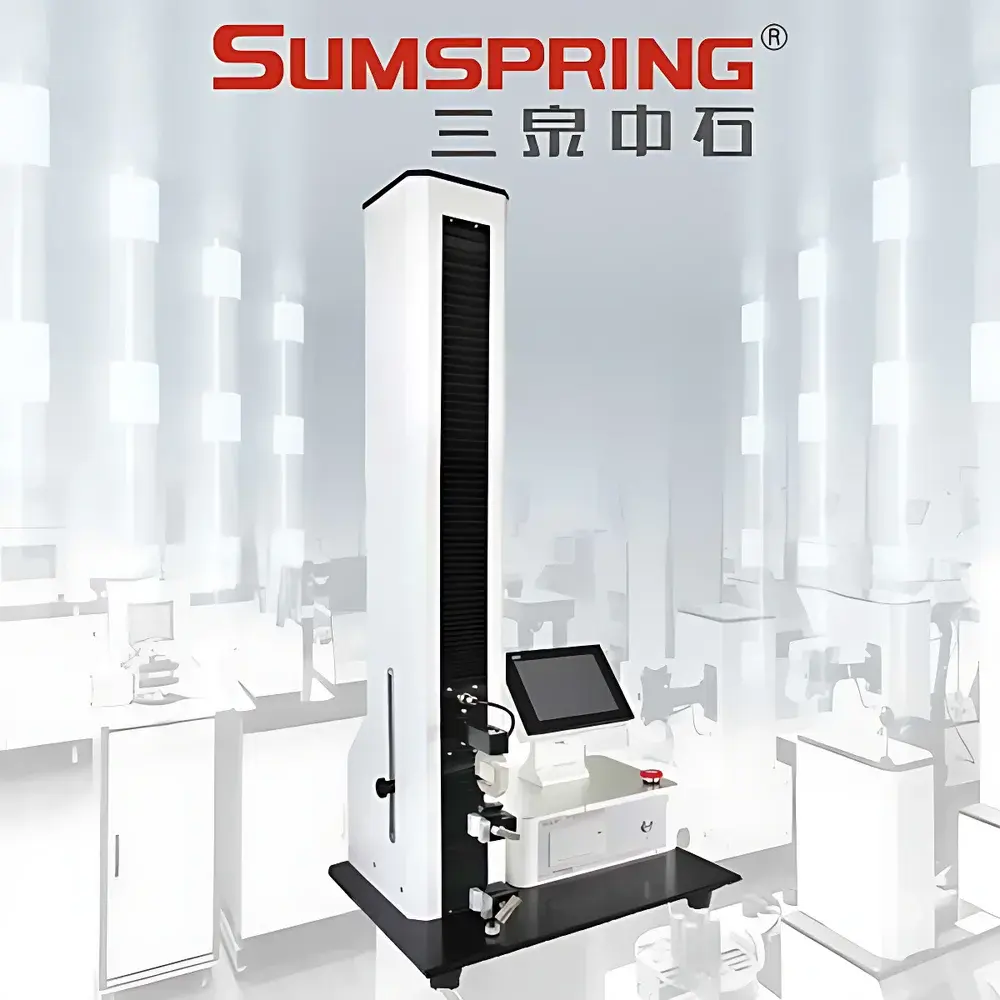
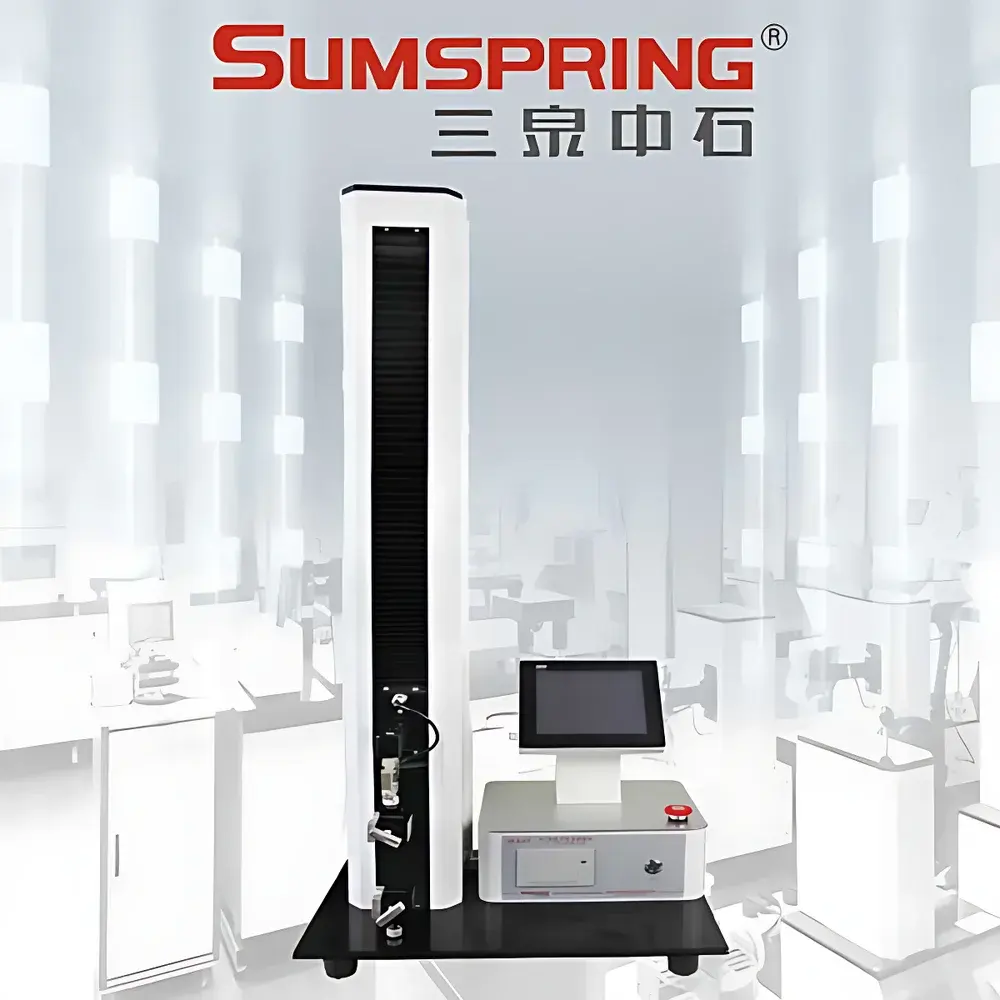
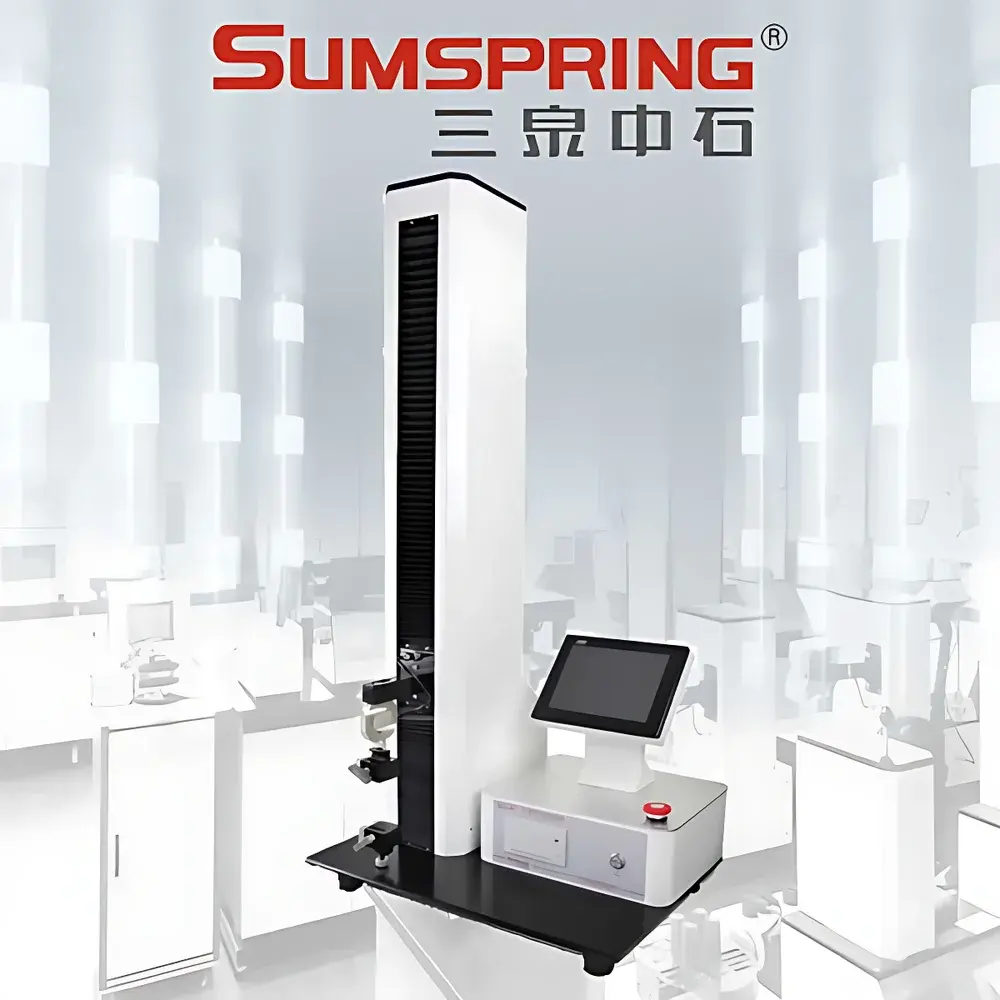
SumSpring DLS-07 Series Electronic Tensile Testing Machine for Plastic Films
| Brand | SumSpring |
|---|---|
| Origin | Shandong, China |
| Manufacturer Type | Direct Manufacturer |
| Instrument Type | Electronic Tensile Testing Machine |
| Load Capacity Options | 50 N, 500 N, 1500 N, 2000 N (selectable) |
| Accuracy Class | Class 1 (per ISO 7500-1 / ASTM E4) |
| Test Speed Range | 1–500 mm/min, infinitely variable |
| Displacement Accuracy | ±2% |
| Test Width | 50 mm (custom fixtures available) |
| Maximum Travel | 650 mm |
| Dimensions (L×W×H) | 450 × 300 × 1350 mm |
| Weight | 78 kg |
| Operating Environment | 23 ± 2 °C, ≤80% RH (non-condensing) |
| Power Supply | 220 V, 50 Hz |
Overview
The SumSpring DLS-07 Series Electronic Tensile Testing Machine is a precision-engineered mechanical testing system designed specifically for the quantitative evaluation of tensile properties in thin polymeric films, laminates, and flexible packaging materials. Built upon a robust dual-column frame architecture and driven by a servo-controlled electromechanical actuation system, this instrument operates according to the fundamental principles of uniaxial tensile testing as defined in ISO 527-3, ASTM D882, and GB/T 1040.3. It applies controlled, linear displacement to standardized specimens clamped between two high-grip-force pneumatic or mechanical fixtures, while simultaneously capturing real-time load (via calibrated S-type or load cell transducers) and axial displacement data at sampling rates up to 100 Hz. The resulting force–displacement curves are mathematically converted into stress–strain behavior, enabling direct derivation of key mechanical parameters including tensile strength at break, elongation at break, Young’s modulus (initial slope), yield point (where applicable), and energy to break. Its modular design supports both static monotonic loading and quasi-static cyclic protocols—making it suitable not only for routine QC verification but also for R&D-level material characterization under controlled environmental conditions.
Key Features
- Class 1 accuracy certified load measurement per ISO 7500-1 and ASTM E4, ensuring traceable compliance with international calibration standards.
- Infinitely variable crosshead speed from 1 to 500 mm/min, programmable in 0.1 mm/min increments—enabling precise replication of test conditions specified in ISO 527, ASTM D882, and FDA-relevant packaging validation protocols.
- Integrated displacement feedback system with ±2% linearity error over full stroke (650 mm), supporting accurate strain calculation even for low-modulus, highly extensible films.
- Dual-mode gripping options: standard 50 mm wide parallel jaw fixtures optimized for ASTM D882 specimen geometry; optional custom fixtures (e.g., pneumatic, rubber-coated, or serrated) available for fragile, slippery, or multi-layered substrates.
- Stainless-steel load frame with vibration-dampened base and rigid column alignment—engineered to minimize parasitic bending moments and ensure high reproducibility across repeated tests.
- Compliance-ready architecture: supports audit trails, user access levels, electronic signatures, and raw data export in CSV/Excel formats—facilitating adherence to GLP, GMP, and 21 CFR Part 11 requirements when paired with validated software modules.
Sample Compatibility & Compliance
The DLS-07 accommodates standard Type I, II, and V specimens per ASTM D882 and ISO 527-3, with nominal widths of 10, 15, or 20 mm and gauge lengths of 50 or 100 mm. It is routinely deployed for testing biaxially oriented polypropylene (BOPP), polyethylene terephthalate (PET), low-density polyethylene (LDPE), metallized films, co-extruded laminates, and heat-sealed pouch interfaces. All test methods implemented on this platform align with regulatory expectations for packaging integrity assessment under USP <661.2>, ISO 11607-1, and EU Directive 90/128/EEC for food-contact materials. Calibration certificates are issued with NIST-traceable reference standards, and annual verification procedures conform to ISO/IEC 17025-accredited laboratory practices.
Software & Data Management
The system operates with SumSpring’s proprietary TensilePro v3.x software suite—a Windows-based application offering real-time curve visualization, automated parameter extraction (tensile strength, % elongation, modulus), statistical reporting (mean, SD, CV%), and batch-wise comparison tools. Raw force/displacement time-series data are stored in encrypted binary format with timestamped metadata (operator ID, sample ID, test date/time, environmental log). Export functions include CSV, PDF reports (with configurable headers and footers), and XML for LIMS integration. Optional add-ons enable IQ/OQ documentation packages, electronic signature workflows, and deviation logging—supporting full lifecycle data integrity in regulated environments.
Applications
- Quality control of incoming plastic film rolls prior to converting or printing operations.
- Validation of heat seal integrity in medical device pouches and pharmaceutical blister lidding.
- Comparative analysis of polymer formulations during new material development.
- Accelerated aging studies assessing mechanical degradation after thermal, UV, or humidity exposure.
- Root cause analysis of film tearing or delamination failures in packaging lines.
- Supporting technical documentation for ISO 13485 and IATF 16949-certified manufacturing processes.
FAQ
What standards does the DLS-07 comply with for plastic film testing?
It supports execution of ASTM D882, ISO 527-3, GB/T 1040.3, and JIS K 7127, with hardware and software configurations validated against these methods.
Can the machine perform peel or tear tests in addition to tensile testing?
Yes—when equipped with optional fixtures (e.g., 180° peel grips or Elmendorf tear testers), the DLS-07 platform can be reconfigured for complementary mechanical assessments without requiring separate instrumentation.
Is third-party calibration and certification available?
SumSpring provides factory calibration with ISO/IEC 17025-accredited certificates; on-site verification and annual recalibration services are offered globally through authorized service partners.
How is data security and user accountability maintained?
Role-based login, password policies, session timeouts, and immutable audit logs meet baseline requirements for 21 CFR Part 11 compliance; full electronic signature functionality requires optional validation package.
What maintenance is required to sustain measurement accuracy?
Routine verification using certified reference load cells and dimensional standards is recommended quarterly; annual full-system recalibration is advised, especially after relocation or mechanical impact events.



