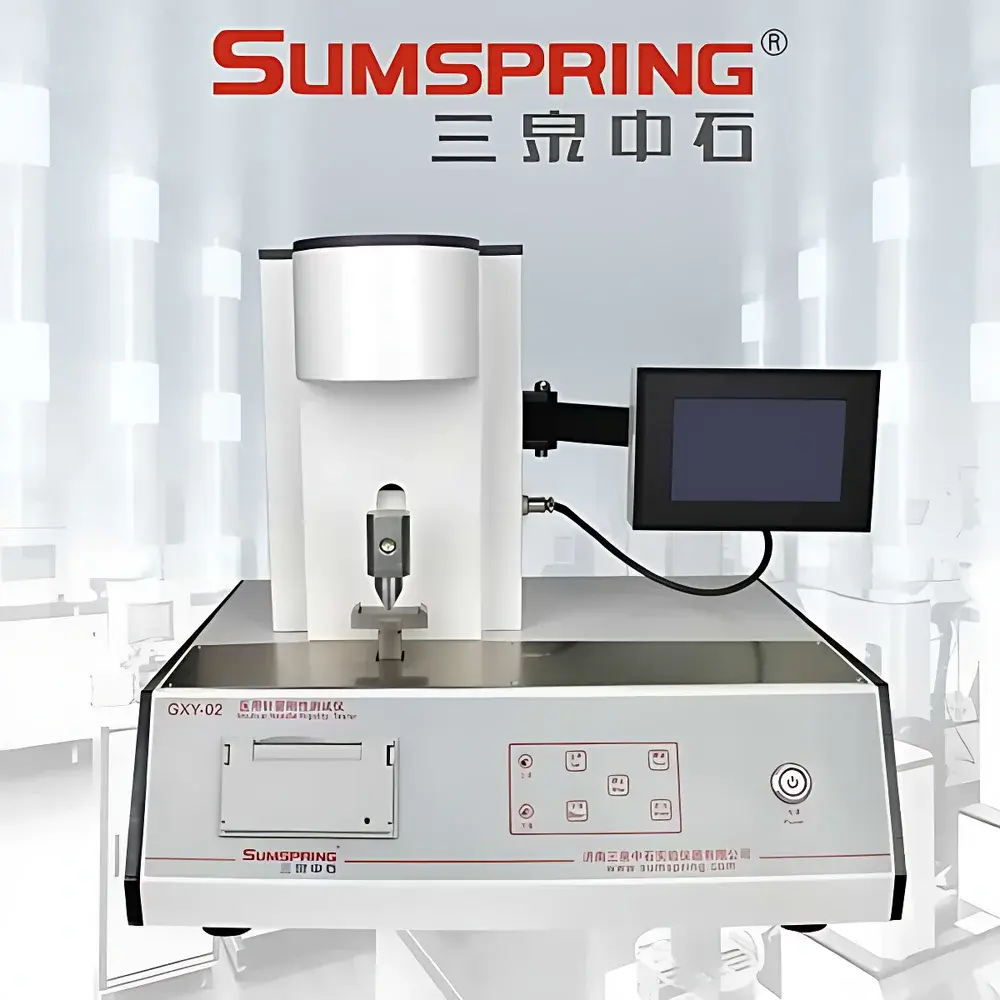


SumSpring GXY-02 Medical Needle Rigidity Tester
| Brand | SumSpring |
|---|---|
| Model | GXY-02 |
| Measurement Principle | Controlled bending force application with high-resolution deflection sensing |
| Deflection Range | 0–5 mm (±0.01 mm accuracy) |
| Load Range | 1–60 N (±0.1 N accuracy) |
| Needle Diameter Compatibility | 0.3–3.4 mm (standard, thin-wall, and ultra-thin-wall tubing) |
| Support Span Adjustment | 0–55 mm (±0.5 mm accuracy) |
| Loading Speed | 1 mm/min (±0.1 mm/min) |
| Dimensions | 460 × 340 × 400 mm |
| Weight | 25 kg |
| Power Supply | 220 V ± 10 %, 50 Hz ± 2 % |
| Operating Environment | 5–40 °C, RH 45–80 % (non-condensing) |
| Compliance Standards | GB 15811, GB 18457, YBB00092004–2015 |
Overview
The SumSpring GXY-02 Medical Needle Rigidity Tester is a precision-engineered mechanical testing instrument designed to quantify the flexural rigidity of hollow metallic and polymer-based medical needles in accordance with internationally recognized regulatory standards. It operates on the principle of controlled three-point bending: a defined load is applied vertically at the midpoint of a needle specimen supported at two fixed points, while high-resolution displacement transducers measure the resulting deflection. The rigidity value—expressed as the ratio of applied load to measured deflection (N/mm)—serves as a direct indicator of structural resistance to bending deformation under clinical handling conditions. This parameter is critical for ensuring needle integrity during insertion, minimizing buckling risk, and maintaining directional control in diagnostic and therapeutic procedures.
Key Features
- Microprocessor-controlled loading system with closed-loop feedback ensures consistent 1 mm/min crosshead speed (±0.1 mm/min), eliminating manual variability and enabling repeatable test execution.
- High-precision dual-sensor architecture: integrated load cell (1–60 N, ±0.1 N) and linear variable differential transformer (LVDT)-based deflection sensor (0–5 mm, ±0.01 mm) deliver traceable, low-noise measurement data.
- Adjustable support span (0–55 mm, ±0.5 mm resolution) accommodates diverse needle lengths per ISO 11040-4 and GB 15811 requirements, including short biopsy needles and long spinal anesthesia cannulas.
- Touchscreen HMI with embedded test protocol library supports pre-configured methods for standard wall, thin-wall, and ultra-thin-wall tubing (0.3–3.4 mm OD), aligned with YBB00092004–2015 dimensional classifications.
- Onboard thermal printer provides immediate hard-copy output of test reports—including peak load, deflection at load, calculated rigidity, pass/fail status, and timestamp—supporting GLP-compliant documentation workflows.
- Robust aluminum alloy frame and vibration-damped base minimize environmental interference, ensuring measurement stability across laboratory environments (5–40 °C, 45–80 % RH).
Sample Compatibility & Compliance
The GXY-02 is validated for testing stainless steel, nitinol, and polymer-coated hypodermic needles used in injection, blood collection, biopsy, aspiration, and spinal puncture applications. Its mechanical design conforms to the physical constraints specified in GB 15811 (hypodermic needles), GB 18457 (stainless steel needle tubing), and YBB00092004–2015 (pharmaceutical packaging and container standards). While not a certified ISO/IEC 17025 calibration device, its measurement uncertainty budget aligns with typical Class II metrological requirements for QC laboratories performing routine needle release testing. All test parameters—including support span, load rate, and deflection threshold—are programmable to reflect manufacturer-specific specifications or internal quality agreements.
Software & Data Management
The instrument’s embedded firmware supports audit-trail-enabled operation: each test record stores operator ID, date/time stamp, sample ID, configuration settings, raw sensor data, and final rigidity calculation. Data export via USB interface enables integration with LIMS or statistical process control (SPC) platforms. Though no external PC software is bundled, CSV-formatted outputs are structured for direct import into Excel, Minitab, or JMP for capability analysis (e.g., Cp/Cpk evaluation against AQL limits). For regulated environments, the system supports 21 CFR Part 11–compliant electronic signatures when deployed with third-party validation packages and networked authentication servers.
Applications
- Final release testing of sterile packaged needles prior to distribution, verifying conformance to mechanical specifications in product dossiers.
- In-process quality checks during tube drawing or needle grinding stages to detect material inconsistencies or heat-treatment deviations.
- Comparative evaluation of alternative alloys (e.g., 304 vs. 316L SS) or coating technologies (e.g., silicone vs. PTFE) for rigidity–flexibility trade-off optimization.
- Root cause analysis of field complaints related to needle bending or tip deflection during use.
- Supporting design verification per ISO 14971 risk management files, where rigidity directly influences “loss of structural integrity” hazard scenarios.
FAQ
What standards does the GXY-02 comply with?
It is configured to execute test protocols aligned with GB 15811, GB 18457, and YBB00092004–2015. Users may adapt parameters to meet ASTM F2182 or ISO 11040-4 requirements with documented method validation.
Can the GXY-02 test needles with non-circular cross-sections?
No—it is calibrated and validated exclusively for cylindrical hollow tubes. Non-round profiles (e.g., beveled, flattened, or polygonal) require custom fixturing and independent uncertainty assessment.
Is calibration certification included with purchase?
A factory calibration report (traceable to CNAS-accredited standards) is provided. Annual recalibration using NIST-traceable weights and gauge blocks is recommended for continued compliance.
Does the system support automated pass/fail decision logic?
Yes—users define upper/lower rigidity limits per product code; the instrument displays real-time pass/fail status and logs deviations automatically.
What maintenance is required?
Monthly visual inspection of load train components, biannual lubrication of lead screws, and annual verification of sensor linearity and zero drift using reference loads.