
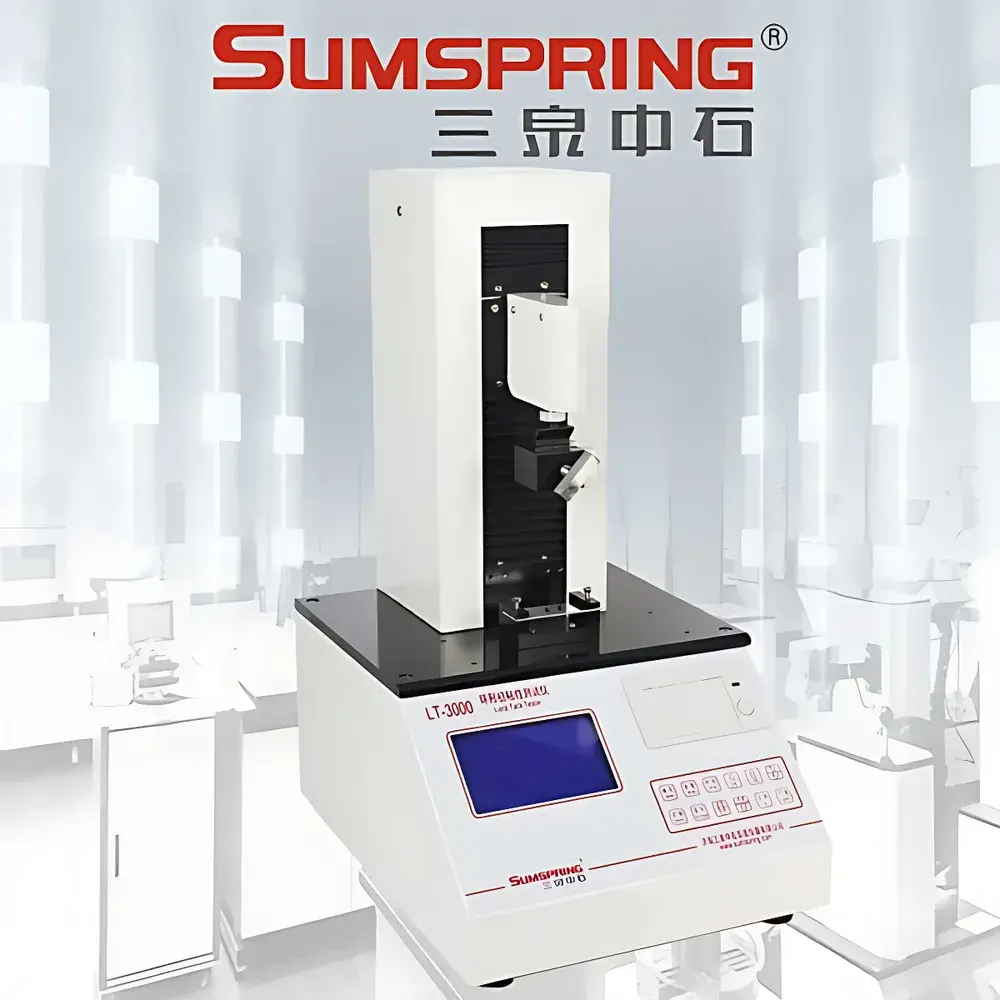
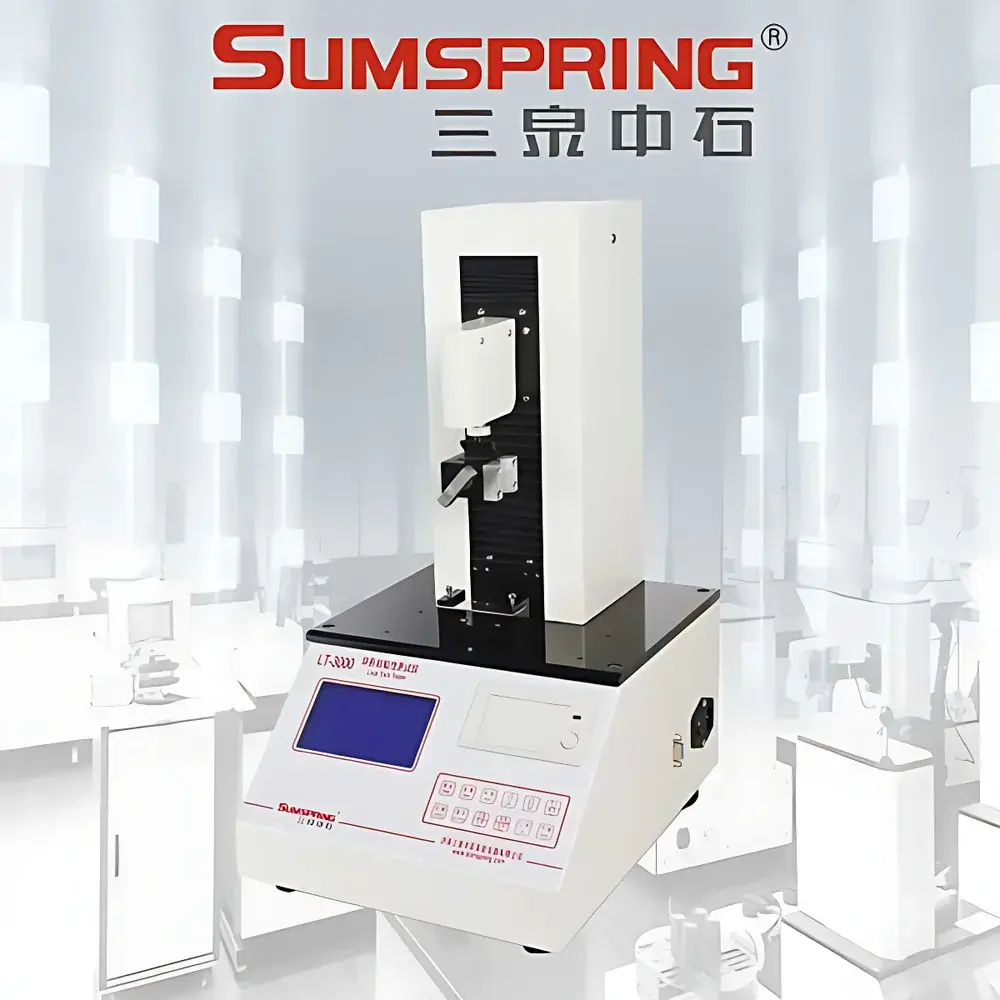
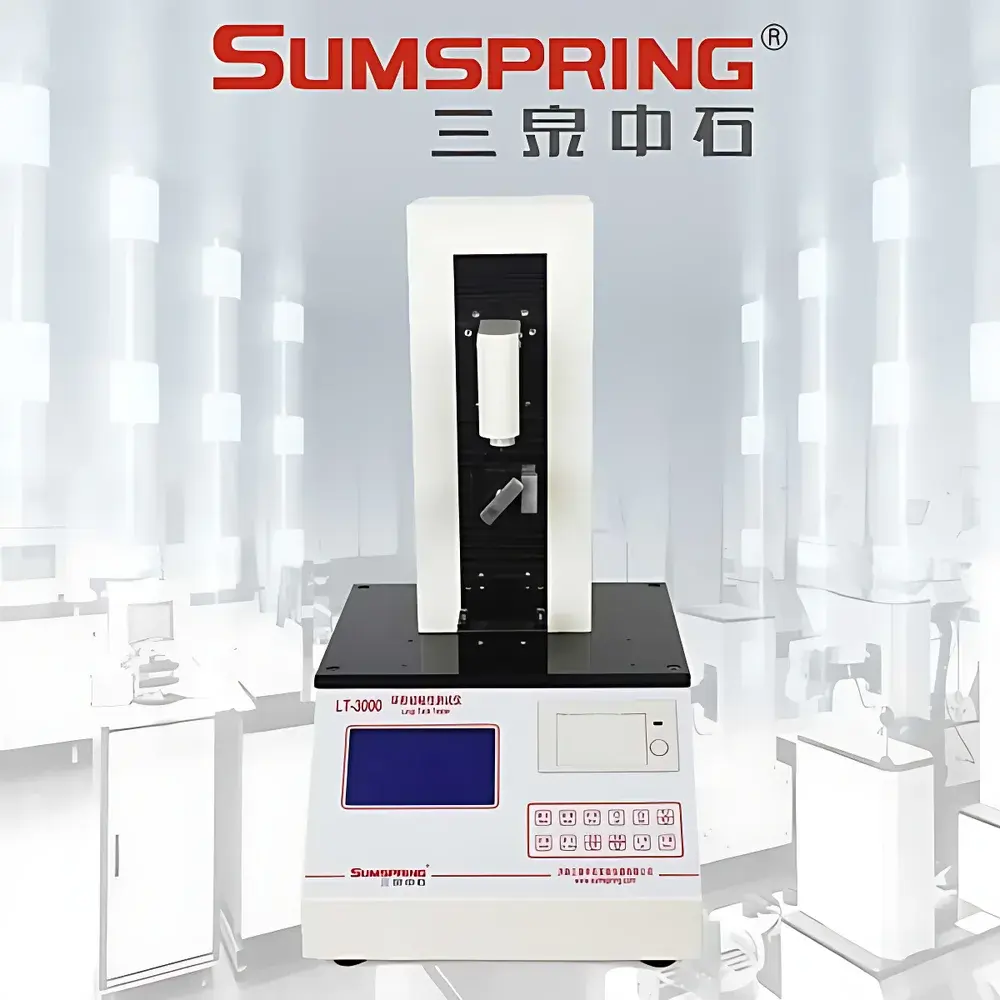
SumSpring LT-3000 Ring Tack Adhesion Tester
| Brand | SumSpring |
|---|---|
| Model | LT-3000 |
| Measurement Range | 20 N or 300 N (selectable) |
| Accuracy Class | Class 1 |
| Test Speed | 1–500 mm/min (standard setting: 300 mm/min) |
| Speed Accuracy | ±2% |
| Specimen Size | 180 mm (L) × 25 mm (W) |
| Test Plate Dimensions | 25 mm × 72 mm × 3 mm |
| Overall Dimensions | 310 mm × 400 mm × 560 mm (L×W×H) |
| Weight | 26 kg |
| Operating Environment | 23 ± 2 °C, RH ≤ 80% (non-condensing) |
| Power Supply | 220 V, 50 Hz |
| Compliant Standards | FINAT Test Method No. 9, GB/T 31125–2014 |
Overview
The SumSpring LT-3000 Ring Tack Adhesion Tester is a precision mechanical testing instrument engineered for quantitative evaluation of initial tack—the instantaneous adhesive bond strength formed upon brief contact under defined load and dwell time. It operates on the principle of ring tack measurement per FINAT Test Method No. 9, wherein a circular specimen (formed by folding a strip into a ring configuration) is brought into controlled contact with a standardized stainless steel test plate, then peeled radially at a constant rate while force and displacement are recorded in real time. This method replicates the dynamic interfacial interaction typical of pressure-sensitive adhesives (PSAs) during application—such as label affixing, tape dispensing, or medical patch placement—and delivers reproducible, traceable data essential for QC/QA, formulation development, and regulatory documentation. The LT-3000 is not a general-purpose tensile tester; its mechanical architecture, fixture geometry, and motion control are specifically calibrated to meet the geometric and kinematic constraints specified in ISO 29862 (adhesives — determination of tack by the ring tack method) and GB/T 31125–2014 (Chinese national standard for initial tack testing of pressure-sensitive tapes).
Key Features
- Two selectable load cell options: 20 N (for low-tack films, release liners, and pharmaceutical transdermal patches) or 300 N (for high-performance industrial tapes, double-coated foams, and structural adhesives), both certified to Class 1 accuracy per ISO 7500-1.
- Programmable crosshead speed from 1 to 500 mm/min, with closed-loop servo control ensuring speed stability within ±2% across the full range—critical for comparative testing under ASTM D3121 and FINAT-compliant protocols.
- Dedicated ring tack fixture set including precision-machined stainless steel test plates (25 × 72 × 3 mm), conforming to dimensional tolerances specified in GB/T 31125–2014 and FINAT TM9.
- Integrated thermal-stabilized test chamber environment control: maintains ambient temperature at 23 ± 2 °C during operation, minimizing viscoelastic drift in PSA response—a requirement for GLP-compliant adhesion labs.
- Onboard micro-printer outputs raw force–displacement curves and calculated parameters (peak tack force, average tack force, energy-to-peel) with timestamp, operator ID, and test condition metadata.
- Rigid cast-aluminum frame and linear guideway system ensure minimal deflection (<0.02 mm) under maximum load, preserving measurement integrity during high-force testing cycles.
Sample Compatibility & Compliance
The LT-3000 accommodates standard specimens measuring 180 mm × 25 mm, which are folded into a consistent 25-mm-diameter ring prior to testing. Compatible substrates include polypropylene, PET, paper, aluminum foil, and skin-simulating membranes (e.g., Strat-M®). All test plates are passivated stainless steel meeting ASTM F86 surface finish requirements. The instrument satisfies mandatory clauses in FINAT TM9 (2021 edition), GB/T 31125–2014, and supports audit-ready compliance with ISO/IEC 17025:2017 for accredited laboratories. While not FDA 21 CFR Part 11–certified out-of-the-box, its data export functionality (CSV/Excel) enables integration into validated LIMS environments supporting electronic records and signature workflows.
Software & Data Management
The LT-3000 operates via embedded firmware with no external PC dependency. All test parameters—including dwell time (0–60 s adjustable), peel angle (radially constrained), and trigger threshold—are configured via intuitive membrane keypad interface. Real-time force–time and force–displacement plots appear on the 4.3-inch TFT display. Test results are stored internally (up to 1,000 records) with automatic date/time stamping, operator code input, and batch ID tagging. Data export occurs via USB port to standard CSV format, compatible with statistical process control (SPC) software such as Minitab, JMP, or internal QA dashboards. Audit trails record all parameter changes, test starts/stops, and calibration events—supporting GLP and GMP documentation requirements.
Applications
- Quality control of pressure-sensitive adhesives in converting operations: validation of coating uniformity, solvent residual effects, and aging behavior.
- Comparative assessment of acrylic vs. rubber-based PSAs in labeling applications under varying humidity conditions.
- Regulatory submission support for medical device adhesives (ISO 10993-5 cytotoxicity correlation studies).
- R&D screening of novel bioadhesive hydrogels for wearable sensor interfaces.
- Supplier qualification testing per IATF 16949 clause 8.4.2.2 for automotive interior trim tapes.
- Root-cause analysis of delamination failures in laminated packaging structures (e.g., pouch seals, blister lidding).
FAQ
What standards does the LT-3000 directly implement?
It is mechanically and algorithmically aligned with FINAT Test Method No. 9 and GB/T 31125–2014. Optional calibration certificates reference ISO/IEC 17025-accredited traceability to NIM (National Institute of Metrology, China).
Can the LT-3000 measure holding power (shear adhesion)?
No. Holding power requires static load application over extended durations (e.g., ASTM D3654); the LT-3000 is exclusively configured for dynamic ring tack measurement.
Is third-party verification of test plate surface roughness provided?
Yes—each test plate is supplied with a surface profilometry report (Ra ≤ 0.2 µm) conforming to ISO 4287 and included in the factory calibration dossier.
Does the instrument support multi-language UI?
The firmware interface is English-only, but exported CSV files contain field headers in English and comply with UTF-8 encoding for international character support in downstream analysis.
What maintenance intervals are recommended?
Load cell zero-point verification every 30 days; full recalibration annually or after 5,000 test cycles—per ISO 9001:2015 clause 7.1.5.1.



