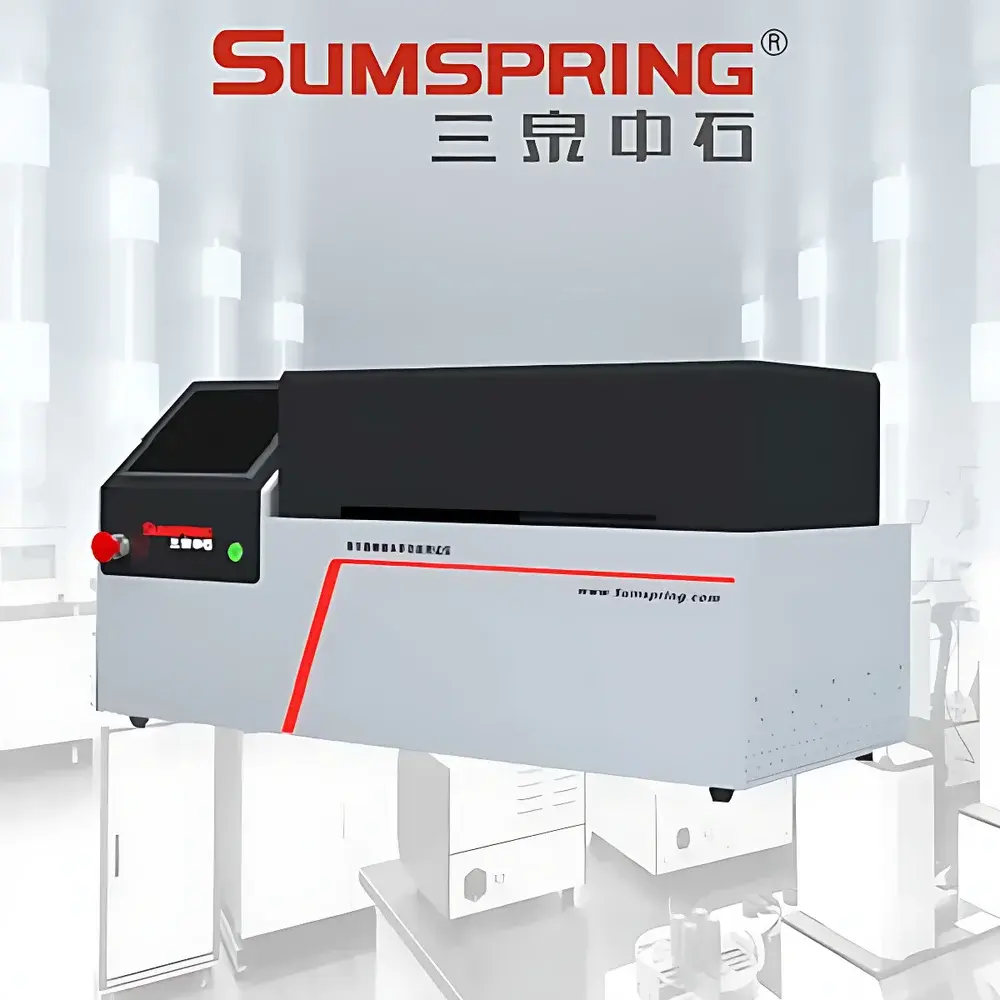

SumSpring RJT-03S Luer Cone Connector Leak Tester
| Brand | SumSpring |
|---|---|
| Origin | Shandong, China |
| Manufacturer Type | OEM/ODM Manufacturer |
| Country of Origin | China |
| Model | RJT-03S |
| Price | Upon Request |
| Axial Force Range | 0–50 N |
| Hydrostatic Test Pressure | 0–500 kPa (adjustable) |
| Torque Measurement Range | 0.01–0.50 N·m |
| Nominal Capacity Compatibility | 1–60 mL |
| Dimensions (W×D×H) | 660 × 380 × 400 mm |
| Weight | 35 kg |
| Operating Temperature | 5–40 °C |
| Relative Humidity | 45–80 % RH (non-condensing) |
| Power Supply | 220 V ± 10 %, 50 Hz ± 2 % |
| Compliant Standards | GB/T 1962.1–2015, GB/T 1962.2–2001 |
Overview
The SumSpring RJT-03S Luer Cone Connector Leak Tester is an electromechanical test system engineered for quantitative verification of mechanical integrity and fluid-tight performance of ISO 594-compliant Luer taper connectors—specifically 6 % (Luer) conical fittings used in medical infusion devices, syringes, IV sets, and diagnostic instrumentation. It operates on a dual-axis force-pressure principle: applying controlled axial load and regulated hydrostatic pressure to simulate clinical assembly, pressurization, and disengagement conditions. The instrument measures critical functional parameters—including seal integrity under pressure, resistance to unintended separation (disconnection force), torque stability during coupling, and real-time leakage rate (via pressure decay or flow-through detection)—all aligned with the mechanical and dimensional requirements defined in GB/T 1962.1–2015 and GB/T 1962.2–2001. Designed for quality control laboratories, regulatory validation teams, and R&D facilities in medical device manufacturing, the RJT-03S supports objective, repeatable, and auditable assessment of Luer interface reliability—directly impacting patient safety, regulatory compliance, and product lifecycle consistency.
Key Features
- Integrated dual-sensor architecture: simultaneous measurement of axial force (0–50 N, ±0.5 % FS accuracy), torque (0.01–0.50 N·m, ±1.0 % FS), and internal hydrostatic pressure (0–500 kPa, ±0.5 % FS)
- Programmable multi-stage test sequences: user-defined dwell time, ramp rate, hold duration, and pressure/force thresholds for assembly, leak-hold, and separation phases
- Real-time digital display of all primary metrics: applied axial load, sealing torque, internal pressure, elapsed time, and calculated leakage rate (kPa/s or mL/min)
- Onboard thermal printer with timestamped output: generates traceable hard-copy reports including test ID, operator code, date/time stamp, pass/fail status per parameter, and raw data tables
- Modular fixture design accommodating standard Luer lock and Luer slip configurations across nominal capacities from 1 mL to 60 mL
- Robust aluminum alloy frame with vibration-damped base; compliant with IEC 61000-6-2 (immunity) and IEC 61000-6-3 (emission) for laboratory electromagnetic environments
Sample Compatibility & Compliance
The RJT-03S is validated for testing all ISO 594-1:2015 and ISO 594-2:2015 compliant Luer conical connectors—including male/female Luer lock, Luer slip, and needleless access devices—integrated into infusion sets, syringes, catheter hubs, anesthesia manifolds, and point-of-care diagnostics. Fixture adaptability ensures secure clamping of both rigid (e.g., polycarbonate hubs) and semi-flexible (e.g., PVC tubing terminations) assemblies without slippage or deformation. All test protocols align with national and international standards: GB/T 1962.1–2015 (equivalent to ISO 594-1), GB/T 1962.2–2001 (equivalent to ISO 594-2), and referenced clauses in ISO 8536-4 (infusion sets) and ISO 7886-1 (syringes). Data acquisition meets GLP/GMP documentation requirements, supporting FDA 21 CFR Part 11 readiness when integrated with validated LIMS or electronic lab notebook systems.
Software & Data Management
While the RJT-03S operates as a standalone benchtop unit with embedded firmware, its RS-232 and USB-B interfaces enable bidirectional communication with external PCs running SumSpring’s optional QC-Connect software (v3.2+). This application provides extended functionality: automated test method libraries (pre-loaded with GB/T 1962.1–2015 Annex A/B/C test templates), statistical process control (SPC) charting (X̄-R, Cpk), batch-level trend analysis, PDF/CSV report export, and audit trail logging with operator authentication. All stored test records include metadata (test sequence ID, calibration certificate expiry, environmental sensor readings), satisfying traceability requirements for ISO 13485:2016 Clause 7.5.10 and MDR Annex XIII documentation protocols.
Applications
- Final release testing of sterile Luer-fitted IV administration sets prior to packaging
- Design verification of novel Luer-compatible drug delivery cartridges and wearable pump interfaces
- Root cause analysis of field-reported connector failures (e.g., spontaneous decoupling, microleakage during transport)
- Supplier qualification audits for Tier-1 component manufacturers producing molded Luer hubs
- Regulatory submission support: generating test evidence for FDA 510(k), CE Marking (Annex II), and NMPA registration dossiers
- In-process monitoring during high-volume assembly line validation (e.g., torque consistency checks at 3σ limits)
FAQ
Does the RJT-03S comply with ISO 8536-4 for infusion set testing?
Yes—the instrument’s axial force and pressure profiles are programmable to replicate the 300 kPa hydrostatic hold test and 30 N separation force verification specified in ISO 8536-4:2016 Clause 5.4.2.
Can it test both Luer lock and Luer slip connectors on the same platform?
Yes—interchangeable upper/lower fixtures accommodate both thread engagement (Luer lock) and friction-fit (Luer slip) geometries without recalibration.
Is calibration certification included with shipment?
Each unit ships with a factory-issued calibration certificate (traceable to CNAS-accredited standards), valid for 12 months under normal operating conditions.
What environmental conditions must be maintained during operation?
Ambient temperature: 5–40 °C; relative humidity: 45–80 % RH (non-condensing); no direct sunlight or airflow drafts exceeding 1 m/s near the test chamber.
How is leakage quantified—pressure decay or volumetric flow?
Leakage is calculated via pressure decay methodology (dP/dt) using high-stability piezoresistive transducers; optional mass flow sensor integration is available upon request for ISO 15883-4-compliant gas leak verification.
Related Products