
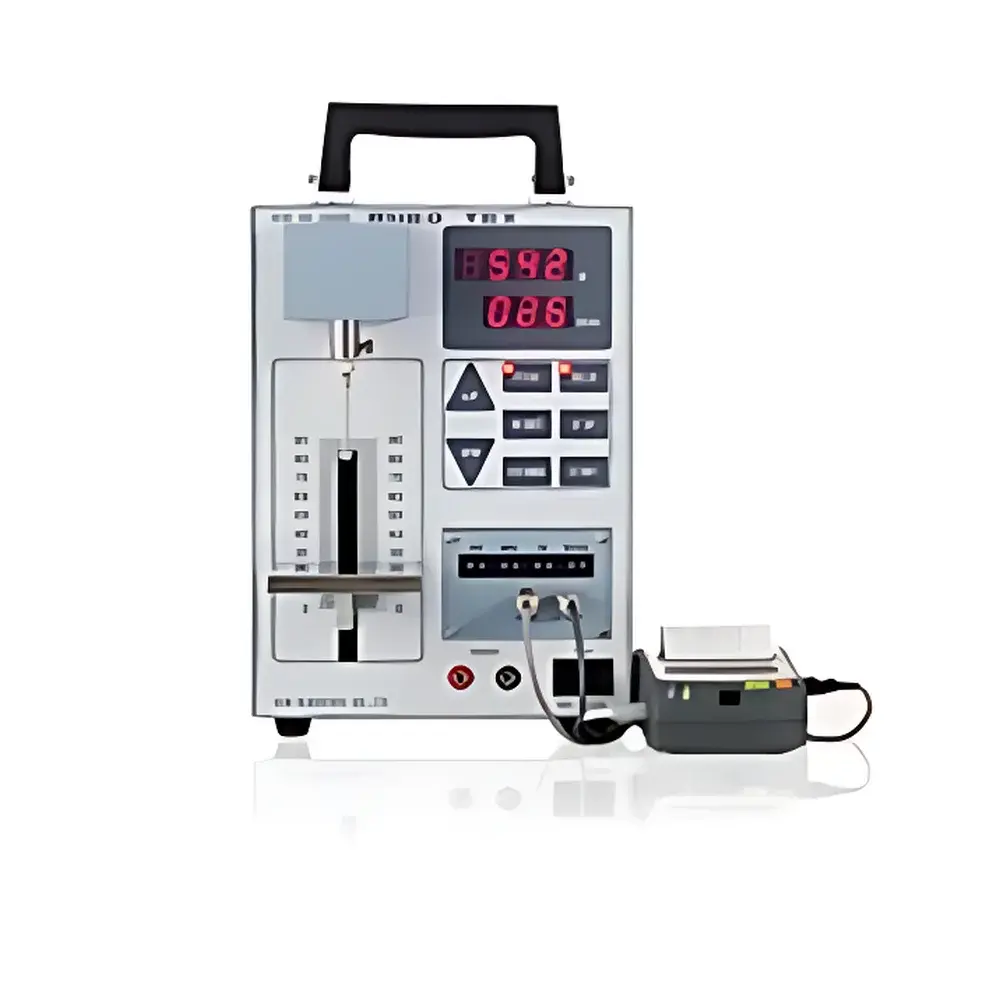
Sun Scientific Rheo TEX SD-700II Fish Surimi Elasticity Tester
| Brand | Sun Scientific |
|---|---|
| Origin | Japan |
| Model | SD-700II |
| Load Range | 0.01–19.99 N (1–1999 gf) |
| Travel Distance | 90 mm |
| Test Speeds | 30 mm/min, 60 mm/min |
| Display | 4-digit LED (simultaneous force & displacement) |
| Force Resolution | 0.01 N |
| Power Supply | 90–230 VAC, 50/60 Hz |
| Dimensions | W260 × H310 × D205 mm |
| Weight | ~10 kg |
| Output | 0–2 V analog signal, RS-232C interface |
| Compliance | Designed for ISO 11357-3, ASTM F3155, and USP <1141> compliant texture testing workflows |
Overview
The Sun Scientific Rheo TEX SD-700II Fish Surimi Elasticity Tester is a precision-controlled, microprocessor-driven texture analyzer engineered specifically for quantitative mechanical characterization of surimi-based seafood products and other soft-solid food matrices. Operating on the principle of controlled uniaxial compression and penetration, the instrument applies calibrated axial force to a sample at defined speed and displacement profiles, capturing real-time load-deformation response curves. Its design adheres to fundamental rheomechanical measurement standards used in food science laboratories—particularly those validating textural attributes critical to consumer acceptance, process consistency, and shelf-life stability in fish paste, kamaboko, chikuwa, and related gelatinous seafood products. Unlike general-purpose force testers, the SD-700II integrates domain-specific calibration protocols, adaptive zeroing routines, and surimi-optimized probe geometries to ensure metrological traceability across production batches and R&D iterations.
Key Features
- Microcomputer-based control system with intuitive Ten-Key numeric input and LCD-guided parameter setup—enabling rapid configuration of break-force, constant-distance, or constant-load test modes.
- High-precision ball-screw drive mechanism coupled with a brushless DC servo motor, delivering repeatable displacement accuracy ±0.02 mm and force linearity within ±0.5% of full scale.
- Auto-zero compensation function activated upon adaptor exchange, eliminating manual recalibration drift between probe types (e.g., spherical, cylindrical, blade, or conical).
- Mechanical overload protection integrated at the load cell base, safeguarding sensor integrity during unexpected sample resistance spikes.
- Dual-channel 4-digit LED display showing real-time force (N/gf) and displacement (mm) synchronously—critical for identifying yield point, fracture threshold, and recovery behavior.
- Analog 0–2 V output and standard RS-232C serial interface support seamless integration with external data loggers, LIMS platforms, or custom QA software.
- Compact footprint (260 × 310 × 205 mm) and lightweight construction (~10 kg) facilitate benchtop deployment in QC labs, pilot plants, or mobile inspection units.
Sample Compatibility & Compliance
The SD-700II accommodates a broad spectrum of viscoelastic food materials—including surimi gels, tofu, agar jellies, processed meats, baked goods, and dairy desserts—via interchangeable probes (flat plunger, puncture needle, Kramer shear cell, Warner-Bratzler blade, etc.). Each probe geometry conforms to standardized test configurations described in ISO 11357-3 (Plastics — Differential Scanning Calorimetry — Part 3: Determination of melt and crystallization temperatures), ASTM F3155-21 (Standard Test Method for Measuring Texture Profile of Surimi-Based Seafood Products), and USP <1141> (Mechanical Testing of Pharmaceutical Gels and Semisolids). The system supports GLP-compliant operation through audit-trail-capable data export, timestamped measurement records, and user-accessible calibration logs—making it suitable for facilities undergoing FDA 21 CFR Part 11 or BRCGS Food Safety certification.
Software & Data Management
While the SD-700II operates as a standalone instrument, its RS-232C port enables bidirectional communication with third-party analysis software (e.g., Texture Pro CT, Exponent Connect, or custom Python/MATLAB scripts) for automated curve fitting, statistical reporting, and multivariate correlation modeling. Raw force-displacement datasets are exported in CSV format, preserving peak force, deformation at rupture, slope-derived modulus values, and area-under-curve metrics. Optional digital printer integration (SD-700DP variant) provides hardcopy output of test ID, date/time stamp, max/min/mean values, pass/fail flags, and operator ID—fully traceable for internal QA audits or supplier documentation requirements.
Applications
- Quantifying gel strength and elasticity index of surimi pastes across varying salt content, setting temperature, and myofibrillar protein concentration.
- Evaluating thermal stability of fish protein gels during retort processing or chilled storage.
- Validating texture consistency in ready-to-eat kamaboko slices under accelerated aging conditions.
- Correlating instrumental hardness with sensory panel scores using ASTM E1958-20 guidelines.
- Assessing structural degradation in frozen-thawed surimi products via repeated compression cycling.
- Supporting formulation development for plant-based seafood analogues by benchmarking against traditional surimi reference standards.
FAQ
What standards does the SD-700II comply with for food texture testing?
It supports method execution aligned with ASTM F3155, ISO 11357-3, and USP <1141>, with hardware-level repeatability meeting ISO 5725-2 precision criteria.
Can the SD-700II be integrated into an existing LIMS or ERP system?
Yes—via its RS-232C interface and ASCII-based command protocol, enabling direct data ingestion into laboratory information management systems without middleware.
Is calibration traceable to national standards?
Load cell calibration is performed using NIST-traceable deadweight standards; certificate of calibration includes uncertainty budget per ISO/IEC 17025 requirements.
Does the instrument support multi-cycle fatigue testing?
Yes—the microcontroller allows programmable sequence execution, including dwell time, return speed, and inter-cycle relaxation intervals.
What probe types are available for surimi-specific testing?
Standard offerings include 5-mm spherical probe (for elasticity modulus), 2-mm needle probe (for penetration resistance), and 10-mm flat plunger (for compression yield), all manufactured from AISI 316 stainless steel.






