
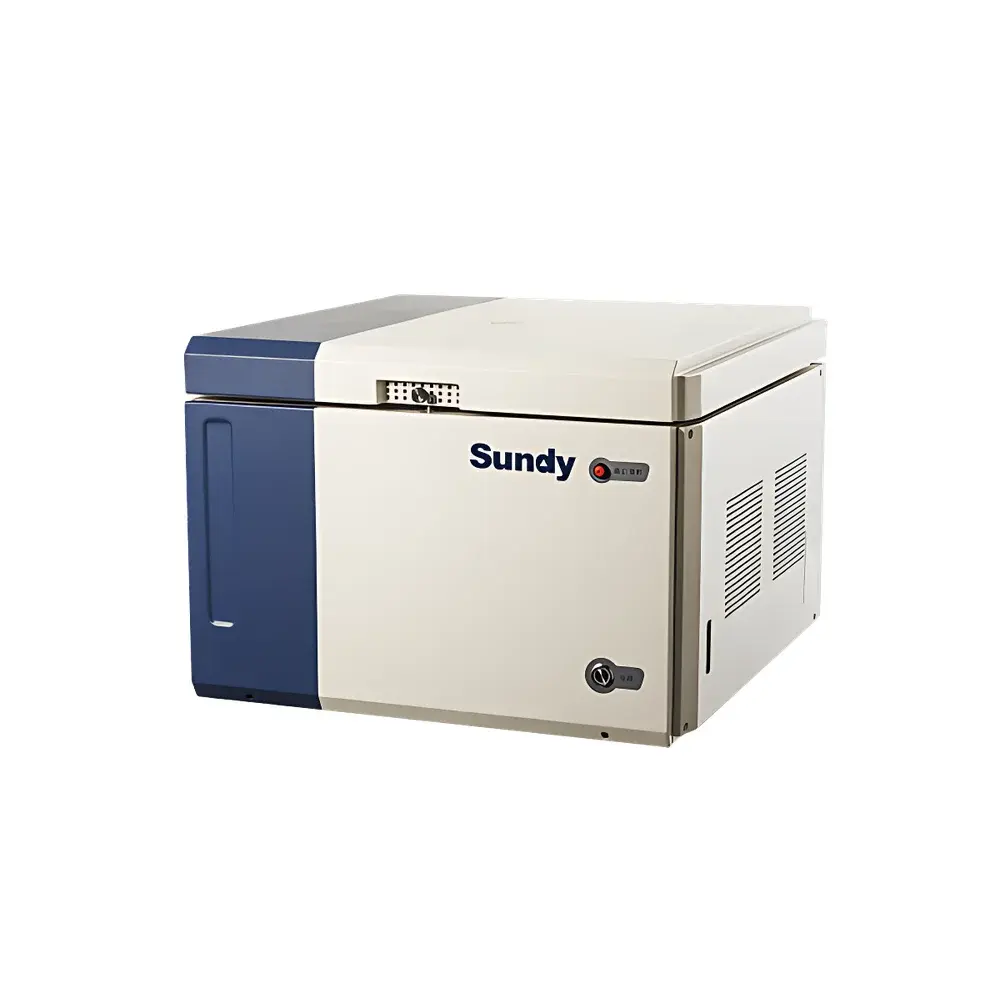
Sundly SDTGA520 Moisture Analyzer
| Brand | Sundly |
|---|---|
| Model | SDTGA520 |
| Origin | Hunan, China |
| Application | Coal, coke, ores, solid biomass fuels |
| Standards Compliance | GB/T 212–2008, GB/T 211–2017, DL/T 2029–2019 |
| Sample Capacity | 20 positions |
| Temperature Range | Ambient to 200 °C |
| Temperature Control Accuracy | ±2 °C |
| Max Power | 2 kW |
| Sample Mass (Analytical Moisture) | 0.9–1.1 g |
| Sample Mass (Total Moisture) | 10–12 g |
| Test Duration (Analytical Moisture) | 15–40 min |
| Test Duration (Total Moisture) | 25–60 min |
| Particle Size Compatibility | 0.2 mm, 3 mm, 6 mm |
| Power Supply | AC 220 V ±10 %, 50 Hz ±1 Hz |
| Dimensions (W×D×H) | 651 mm × 636 mm × 451 mm |
| Net Weight | ~67 kg |
| Heating Modes | Forced-air convection + infrared radiant heating |
| Optional Atmosphere | Nitrogen purge capability |
| Data Logging | Environmental temperature & humidity auto-captured and embedded in reports |
| Software Features | Batch configuration, custom test protocols, power-interruption recovery, GLP-compliant audit trail |
Overview
The Sundly SDTGA520 Moisture Analyzer is a fully automated, dual-mode thermal gravimetric instrument engineered for precise, high-throughput moisture determination in solid fuel materials—including coal, coke, mineral ores, and solid biomass fuels. It implements the standardized loss-on-drying (LOD) principle under controlled thermal conditions, conforming rigorously to Chinese national standards GB/T 211–2017 (Total Moisture), GB/T 212–2008 (Proximate Analysis), and DL/T 2029–2019 (Automated Instrument Method for Total Moisture). Unlike conventional ovens or manual thermogravimetric systems, the SDTGA520 integrates programmable convection heating with infrared radiant heating—enabling rapid, uniform thermal energy delivery across heterogeneous particulate samples while minimizing thermal lag and edge effects. Its 20-position carousel architecture supports unattended multi-batch operation, making it suitable for QC laboratories in power plants, coal trading enterprises, metallurgical testing centers, and third-party certification labs requiring daily throughput of ≥100 samples.
Key Features
- 20-sample capacity with top-and-bottom hinged dual-access chamber design—facilitates rapid loading/unloading and efficient heat dissipation between cycles.
- Dual heating system: independently controllable forced-air convection (for bulk drying uniformity) and infrared radiant heating (for surface moisture removal acceleration); nitrogen purging option available for inert-atmosphere testing per arbitration requirements.
- PID-based temperature regulation with ±2 °C stability across the full 20–200 °C operating range; furnace chamber constructed from high-reflection, heat-resistant stainless steel for consistent thermal field distribution.
- Integrated high-precision analytical balance with real-time mass monitoring; supports both single-sample weighing and pre-batch tare/weight entry modes.
- Intelligent power-loss recovery: all active test states—including elapsed time, current mass reading, and target temperature—are retained in non-volatile memory; resumed automatically upon power restoration without data corruption.
- Self-diagnostic firmware with hardware fault detection (e.g., door interlock, heater element continuity, fan RPM monitoring) and visual status indicators for proactive maintenance planning.
Sample Compatibility & Compliance
The SDTGA520 accommodates sample particle sizes of 0.2 mm (for air-dried moisture analysis), 3 mm, and 6 mm (for total moisture determination), aligning directly with sampling preparation specifications in GB/T 211–2017 and GB/T 212–2008. Sample mass ranges are configurable: 0.9–1.1 g for analytical moisture (Mad) and 10–12 g for total moisture (Mt), with user-defined override capability for method validation or atypical matrices. All test protocols—including duration, ramp rate, hold temperature, and atmosphere selection—are stored as editable templates. The system maintains full traceability for GLP and internal QA audits: each report embeds timestamped environmental temperature and relative humidity (measured via onboard sensors), operator ID, instrument serial number, calibration certificate expiry, and version-stamped firmware revision.
Software & Data Management
Controlled via Windows-based desktop software, the SDTGA520 platform provides role-based access control, customizable reporting (PDF/CSV/XLSX), and structured database archiving. Test methods comply with ISO/IEC 17025 documentation requirements, including electronic signatures, change logs, and audit trails compliant with FDA 21 CFR Part 11 principles (when configured with optional digital signature module). Data export supports LIMS integration via ODBC or HL7-compatible interfaces. Calibration routines include automatic zero-point verification, span adjustment using certified reference masses, and temperature uniformity mapping—each logged with metadata and subject to configurable retention policies (default: 5 years).
Applications
- Routine moisture quantification in coal procurement, blending, and combustion efficiency modeling.
- Quality assurance for coke oven feedstock and sinter plant raw materials.
- Compliance testing for international coal trade contracts referencing ASTM D3173 or ISO 589.
- Research-grade moisture profiling in biomass pelletization and pyrolysis feedstock characterization.
- Method transfer and validation studies requiring inter-laboratory reproducibility (RSD < 0.2% for Mad, < 0.35% for Mt under controlled conditions).
FAQ
Does the SDTGA520 support ASTM or ISO standard methods?
Yes—it is configurable to execute ASTM D3173 (moisture in coal and coke) and ISO 589 (determination of total moisture in coal), though primary validation remains aligned with GB/T series standards. Method parameters can be imported or manually defined.
Can test parameters be modified during an active run?
No—once initiated, temperature profile and duration are locked to ensure repeatability; however, users may pause and resume tests only after full stabilization, with all intermediate mass data preserved.
Is nitrogen gas supply integrated or external?
Nitrogen is supplied externally via standard 6 mm OD tubing with pressure regulator; the instrument includes solenoid-controlled inlet valve and flow sensor with alarm threshold.
What calibration certificates are provided with shipment?
Factory calibration certificate for balance (traceable to NIM, China), temperature uniformity map (9-point grid at 105 °C and 150 °C), and software validation report (IQ/OQ summary).
How often does the system require preventive maintenance?
Recommended every 6 months or after 2,000 test cycles—includes heater resistance check, fan cleaning, door seal inspection, and balance recalibration verification.





