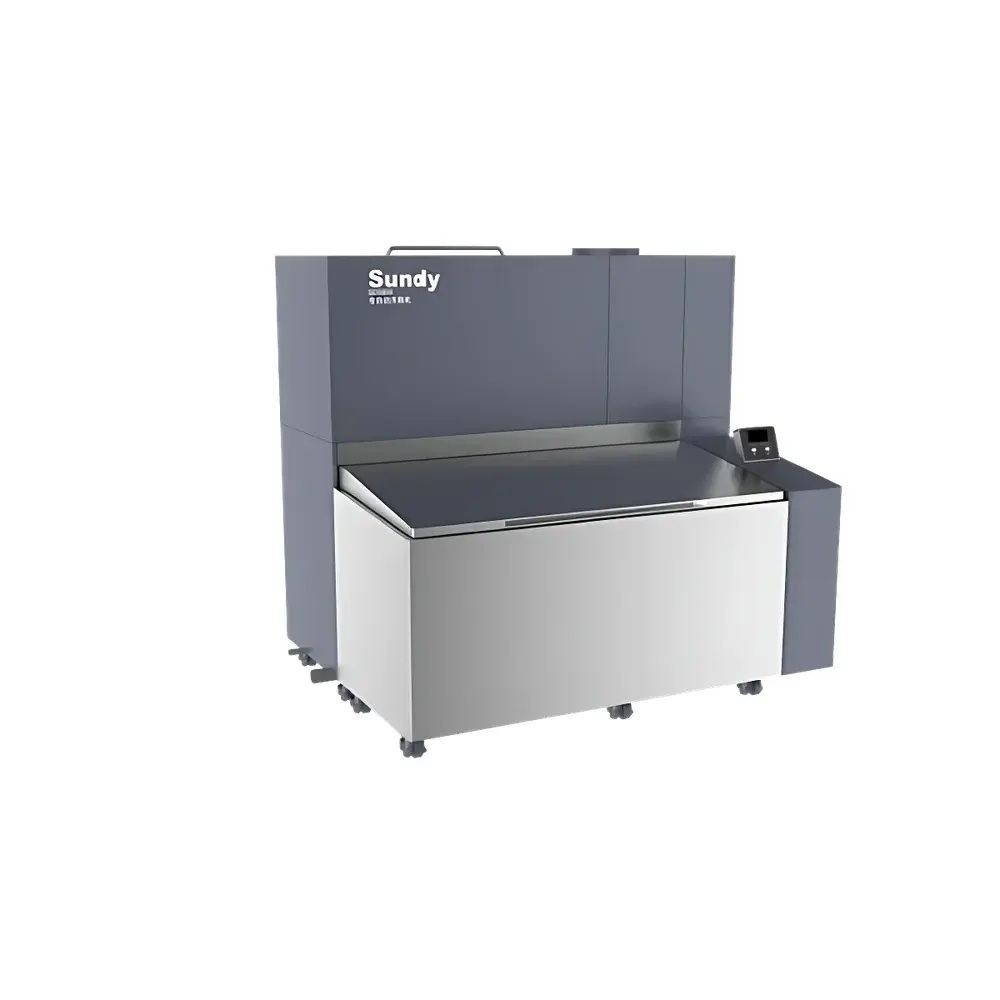
Sundy SDABW Fully Automatic Bottle Washer
| Brand | Sundy |
|---|---|
| Origin | Hunan, China |
| Manufacturer Type | Authorized Distributor |
| Country of Origin | China |
| Model | SDABW Fully Automatic Bottle Washer |
| Quotation | Available Upon Request |
| Washing Efficiency | 40 bottles/h |
| Total Power Consumption | < 50 kW |
| Water Tank Capacity | 450 L |
| Cleaning Chamber Volume | 400 L |
| Ultrasonic Generator Power | 2.4 kW |
| Ultrasonic Frequency | 40 kHz |
| Ultrasonic Cleaning Temperature Range | 40–50 °C |
| Water Consumption | 0.2 m³/h |
| Dimensions (L×W×H) | 1900 mm × 1420 mm × 1790 mm |
| Compatible Bottle Sizes | Small (Φ128 mm × 160 mm), Large (Φ128 mm × 280 mm) |
| Cleaning Method | High-Pressure Spray + Ultrasonic Cleaning |
| Automatic Lid Opening | Not Supported |
| Automatic Sample Dumping | Not Supported |
| Integrated Drying Function | Yes |
| Bottle Return to Sample Preparation System | Not Supported |
| Lid Return to Sample Preparation System | Not Supported |
| Automatic Bottle-Lid Separation & Sorting at Prep Station | Not Supported |
| Waste Collection Integration | Not Supported |
| Lid Cleaning Capability | Not Supported |
Overview
The Sundy SDABW Fully Automatic Bottle Washer is an industrial-grade cleaning system engineered for high-reliability, repeatable decontamination of sample bottles used in power generation, coal analysis, chemical processing, metallurgy, building materials testing, and third-party inspection laboratories. Designed specifically for standardized coal sample containers—commonly employed in ASTM D3172, ISO 11722, and GB/T 211–2017 coal moisture and ash determination protocols—the SDABW integrates dual-mode cleaning physics: high-pressure water jetting (up to 8–12 bar, depending on nozzle configuration) combined with 40 kHz ultrasonic cavitation. This hybrid mechanism ensures mechanical dislodgement of particulate residue and acoustic micro-scrubbing of interior surfaces—including threads, shoulders, and bottom curvature—where conventional rinsing fails. The unit operates within a controlled thermal envelope (40–50 °C), optimizing surfactant efficacy while preventing thermal degradation of polyethylene or glass bottles. All internal wetted components—including stainless-steel 316L wash chamber, PTFE-coated nozzles, and sealed ultrasonic transducers—are selected for corrosion resistance and long-term stability in aqueous alkaline detergent environments.
Key Features
- Integrated thermal drying module: Recirculating hot-air system (max. 85 °C) with adjustable dwell time ensures >99.5% moisture removal from bottle interiors and exteriors—validated per ISO 14644-1 Class 8 cleanroom-compatible drying performance.
- Modular wash chamber: 400 L volume accommodates up to 40 standard coal sample bottles per hour, with mechanical indexing trays enabling sequential loading/unloading without operator intervention beyond initial placement.
- Energy-optimized architecture: Total system power draw remains below 50 kW under full-load operation; intelligent pump duty cycling and ultrasonic burst mode reduce average energy consumption by ~22% versus continuous-wave equivalents.
- Compact footprint: 1.9 m × 1.42 m base area (≈2.7 m²) minimizes facility integration requirements—compatible with ISO/IEC 17025-accredited lab spatial constraints and modular sample prep line layouts.
- Chemical-resistant construction: 316L stainless steel tank, EPDM-sealed bearings, and IP67-rated electrical enclosures ensure durability in aggressive detergent solutions (pH 10–12) and high-humidity operational zones.
Sample Compatibility & Compliance
The SDABW is validated for cylindrical rigid-walled bottles conforming to IEC 60068-2-68 (dust/water ingress) and ASTM D4295 (coal sample container specifications). It accepts two fixed geometries: Φ128 mm × 160 mm (small) and Φ128 mm × 280 mm (large), both with standard M100×1.5 threaded necks. While lid cleaning and automated lid handling are not implemented, the system maintains strict adherence to GLP documentation standards—each wash cycle logs timestamp, temperature profile, ultrasonic duty cycle, and rinse conductivity (via optional inline sensor) to support audit-ready electronic records. Though not certified to FDA 21 CFR Part 11 out-of-the-box, the controller architecture supports third-party validation packages for regulated environments requiring electronic signature and audit trail compliance.
Software & Data Management
The SDABW employs a CE-marked PLC-based HMI (7″ color touchscreen) running deterministic real-time control firmware. Wash parameters—including soak duration, spray pressure sequence, ultrasonic on/off timing, and drying ramp rate—are user-configurable via password-protected profiles. Cycle data (start/stop time, temperature min/max, total water usage, fault codes) are stored locally for ≥12 months and exportable via USB or Modbus TCP to LIMS or MES platforms. Optional RS-485 gateway enables integration with laboratory workflow orchestration systems for traceable sample-to-clean status mapping.
Applications
Primary deployment contexts include coal quality control labs complying with ISO 19579 and DL/T 520–2019; cement plant raw material homogenization facilities; petrochemical catalyst residue analysis suites; and environmental testing labs processing sediment or slurry samples in standardized HDPE containers. The system eliminates manual scrubbing variability, reduces operator exposure to solvents and bioaerosols, and enforces consistent inter-batch cleanliness—critical for minimizing carryover contamination in calorimetry, proximate analysis, and sulfur content determination.
FAQ
Does the SDABW support automatic lid removal or reinstallation?
No. Bottle lids must be manually removed prior to loading and manually replaced post-cleaning.
Can the unit be integrated with upstream sample preparation automation?
Not natively. Conveyor interface or robotic arm mounting brackets are not included but can be engineered as custom OEM add-ons.
Is detergent dosing automated?
Yes—integrated peristaltic pump with programmable volumetric delivery (0.1–5.0 mL/cycle) supports alkaline, neutral, or acidic detergent chemistries.
What maintenance intervals are recommended for ultrasonic transducers?
Transducer performance verification is advised every 500 operating hours; full replacement recommended at 5,000-hour cumulative service life.
Does the system meet explosion-proof requirements for coal handling zones?
No. The SDABW is rated for general-purpose indoor use (IP54 enclosure); ATEX or IECEx variants require factory modification and separate certification.