
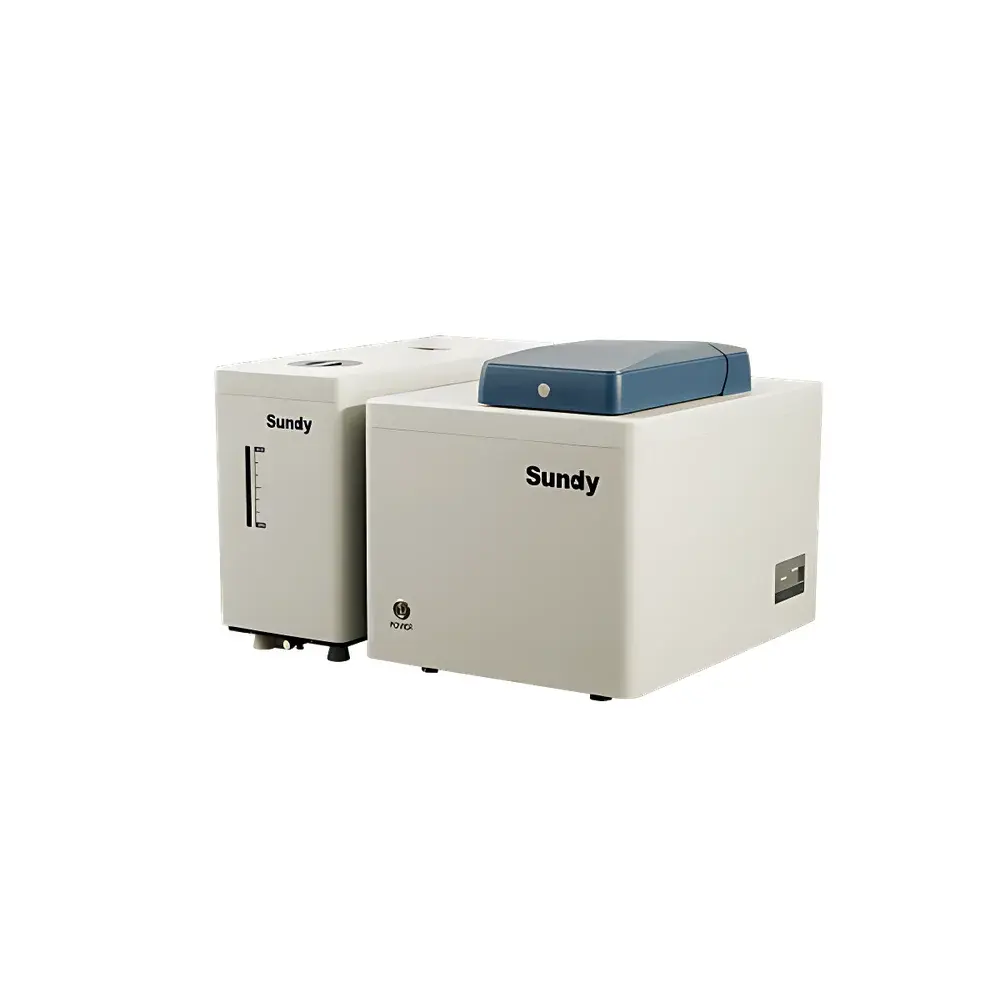
Sundy SDAC1000 Oxygen Bomb Calorimeter
| Brand | Sundy |
|---|---|
| Origin | Hunan, China |
| Manufacturer Type | Authorized Distributor |
| Origin Category | Domestic (China) |
| Model | SDAC1000 |
| Pricing | Upon Request |
| Intelligence Level | Fully Automated |
| Instrument Type | Isoperibol Oxygen Bomb Calorimeter |
| Temperature Measurement Range | 0–40 °C |
| Temperature Resolution | 0.0001 °C |
| Heat Capacity Precision | ≤0.10% RSD |
| Heat Capacity Stability | ≤0.20% drift over 12 months |
| Single Test Duration (Fast Mode) | <11 min |
| Single Test Duration (Classical Mode) | <13 min |
| Max Power Consumption | 0.65 kW |
| Supply Voltage | AC 220 V ±10%, 50 Hz ±1 Hz |
| Dimensions (Main Unit) | 428 mm × 565 mm × 450 mm |
| Weight (Main Unit) | ~45 kg |
| Water Jacket Dimensions | 220 mm × 565 mm × 410 mm |
| Water Jacket Weight | ~25 kg |
| Compliance | GB/T 213-2008, GB/T 384-1981, GB/T 30727-2014, ASTM D5865-2007, JC/T 1005-2006, ISO 1928-2020 |
Overview
The Sundy SDAC1000 Oxygen Bomb Calorimeter is a high-precision, isoperibol-type instrument engineered for the accurate determination of gross calorific value (GCV) of solid and liquid combustible materials. It operates on the fundamental principle of oxygen bomb combustion calorimetry: a precisely weighed sample is ignited under high-pressure oxygen (typically 3.0–3.5 MPa) inside a stainless-steel bomb immersed in a thermally stabilized water jacket. The heat released during complete combustion is transferred to the surrounding water bath, and the resulting temperature rise—measured with a platinum resistance thermometer (Pt100) at 0.0001 °C resolution—is used to calculate GCV using the instrument’s calibrated heat capacity. Designed for routine quality control and regulatory compliance testing in coal, petroleum, cement, biomass, and hazardous waste laboratories, the SDAC1000 meets all major international standards including ISO 1928-2020, ASTM D5865-2007, and GB/T 213-2008. Its architecture prioritizes thermal stability, measurement reproducibility, and operational robustness—not algorithmic compensation—ensuring that every reported value reflects physically measured data.
Key Features
- Isoperibol thermal design with dual-zone temperature control: an independently regulated outer jacket maintains ambient-stable conditions (±0.01 °C during test, ±0.05 °C over 24 h), eliminating external thermal interference.
- Semiconductor-based active cooling and heating system for the outer water jacket—no compressor, no condensation, lower noise (<45 dB), and superior long-term temperature uniformity compared to passive or chiller-based systems.
- Modular stainless-steel oxygen bomb with quick-release mechanism and optimized thermal mass; enables rapid heat transfer from bomb to inner bucket and reduces total test cycle time.
- Dedicated constant-temperature water reservoir with semiconductor temperature regulation, supporting both fast (<11 min) and classical (<13 min) test protocols without manual water replacement.
- True hardware-level precision: temperature sensing via calibrated Pt100 sensor, analog-to-digital conversion with 24-bit resolution, and real-time thermal drift compensation based on physical modeling—not post-hoc software correction.
- Integrated self-diagnostic firmware: monitors ignition circuit integrity, water level, oxygen pressure, stirrer operation, and thermal sensor response—generating actionable maintenance alerts.
- Flexible ignition options: compatible with both nickel-chromium ignition wires and cotton thread ignition, accommodating diverse sample matrices and ignition energy requirements.
Sample Compatibility & Compliance
The SDAC1000 is validated for use with heterogeneous, high-ash, high-moisture, and low-volatility samples—including bituminous coal, coke, petrochemical residues, cement raw meal (black feed), torrefied biomass, and classified solid/hazardous wastes. Its robust bomb geometry and pressure-rated construction (up to 4.0 MPa burst rating) ensure safe combustion of reactive or high-energy fuels. All measurement procedures adhere strictly to the thermodynamic definitions and procedural constraints outlined in ISO 1928-2020 (solid mineral fuels), ASTM D5865-2007 (coal and coke), and GB/T 30727-2014 (biomass). The instrument supports full audit trails and timestamped raw data logging, enabling compliance with GLP and internal QA/QC documentation requirements. While not pre-certified for FDA 21 CFR Part 11, its data export architecture (CSV, XML) and user-accessible audit logs facilitate integration into validated laboratory information management systems (LIMS).
Software & Data Management
The SDAC1000 is operated via dedicated Windows-based software that provides full control over test parameters, calibration routines, and report generation. Raw temperature vs. time datasets are stored unaltered in binary format and exported losslessly as CSV or Excel-compatible files. The software supports direct integration with analytical balances (RS-232/USB) and networked lab infrastructure (TCP/IP). Calibration records—including heat capacity determinations, benzoic acid verification runs, and periodic stability checks—are digitally signed and time-stamped. All user actions (login, method selection, calibration, result approval) are logged with operator ID and timestamp. Reports conform to standard templates per GB/T 213 and ASTM D5865, with optional inclusion of uncertainty estimates calculated per ISO/IEC 17025:2017 Annex A.3 guidelines.
Applications
- Quality assurance of commercial coal shipments per ISO 1928 and GB/T 213.
- Energy content certification of alternative fuels (e.g., RDF, SRF, torrefied wood pellets) for EU RED II reporting.
- Raw material characterization in cement production, specifically black feedstock calorific evaluation per JC/T 1005.
- Thermodynamic screening of waste-derived fuels prior to co-firing or pyrolysis process design.
- Regulatory submission testing for EPA Method 9040C (calorific value of solid waste) and ASTM D240 (petroleum products).
- Routine calibration verification using certified reference materials (e.g., NIST SRM 3261, benzoic acid).
FAQ
What standards does the SDAC1000 comply with?
It fully supports GB/T 213-2008, GB/T 384-1981, GB/T 30727-2014, ASTM D5865-2007, JC/T 1005-2006, and ISO 1928-2020.
Does the instrument require external cooling water or refrigerant?
No—it uses solid-state semiconductor modules for both heating and cooling of the outer jacket and water reservoir, eliminating dependence on tap water or compressor-based chillers.
Can test data be exported for LIMS integration?
Yes—raw temperature curves, final GCV values, calibration logs, and operator metadata are exportable in CSV, XML, and PDF formats with full traceability.
Is the oxygen bomb compatible with automated sample loading systems?
The SDAC1000 is designed for manual sample introduction; however, its mechanical interface and communication protocol (Modbus TCP) support third-party robotic integration upon request.
How is heat capacity stability verified over time?
The system performs automatic baseline drift analysis during idle periods and recommends recalibration when cumulative thermal drift exceeds 0.15%—aligned with ISO 1928-2020 annual verification requirements.



