
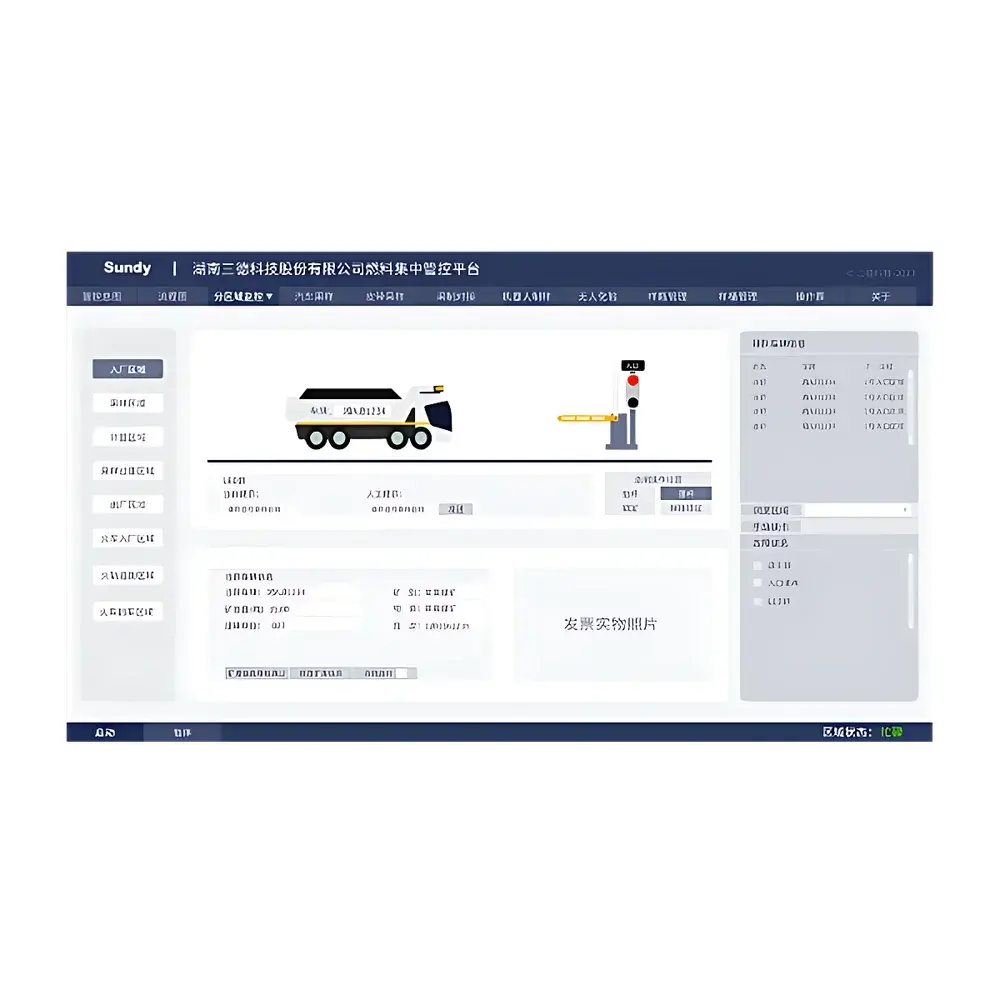
SundY SDFPCQ Intelligent Coal Acceptance & Supervision System for Truck-Based Fuel Delivery
| Brand | SundY |
|---|---|
| Origin | Hunan, China |
| Manufacturer Type | Authorized Distributor |
| Product Origin | Domestic (China) |
| Model | SDFPCQ Intelligent Coal Acceptance & Supervision System |
| Pricing | Available Upon Request |
Overview
The SundY SDFPCQ Intelligent Coal Acceptance & Supervision System is an integrated industrial automation platform engineered for end-to-end digital governance of coal delivery via road transport in thermal power plants, cement facilities, and large-scale industrial fuel receiving terminals. Built upon a deterministic control architecture, the system implements real-time orchestration of vehicle logistics, sampling, weighing, unloading supervision, and compliance documentation — all without manual intervention at critical process nodes. Its operational foundation lies in synchronized hardware-software integration: optical character recognition (OCR) and RFID-enabled vehicle identification; programmable logic controller (PLC)-driven signal light and barrier control; industrial-grade load cell data acquisition with dual-layer integrity verification; and ISO/IEC 17025-aligned sampling logic governed by GB/T 19494.1–2023 (Chinese national standard equivalent to ISO 13909 for mechanical coal sampling). The system does not perform chemical or physical analysis itself but ensures metrologically traceable, auditable, and tamper-resistant data capture across the acceptance chain — from gate entry to exit clearance.
Key Features
- End-to-End Unmanned Workflow Orchestration: Fully automated scheduling and route guidance for inbound coal trucks, including dynamic lane assignment, traffic signal coordination, and real-time status broadcasting via LED message boards and voice prompts.
- Dual-Layer Weighing Integrity Assurance: Simultaneous implementation of algorithmic weight stabilization (real-time filtering and true-value convergence) and hardware-level anti-remote interference monitoring via embedded anti-cheating instrumentation compliant with JJG 539–2016 (Chinese verification regulation for electronic vehicle scales).
- Statistically Validated Mechanical Sampling: Automated generation of stratified random sampling plans per vehicle profile (length, axle configuration, compartment geometry), aligned with GB/T 19494.1–2023 requirements for cross-sectional sampling frequency and spatial randomness — ensuring representativeness and legal defensibility of composite samples.
- Wireless Unloading Supervision: Localized Wi-Fi mesh network deployment across unloading zones, enabling handheld PDA-based violation logging with geotagged photo capture, timestamped annotation, and immediate synchronization to central audit logs.
- Regulatory Document Automation: On-demand generation, digital signing (SHA-256 hash + PKI-based electronic seal), and thermal printing of certified weighbridge tickets — each bearing unique QR-coded transaction IDs traceable to raw sensor timestamps, operator actions (if any), and calibration records.
Sample Compatibility & Compliance
The SDFPCQ system is designed exclusively for bulk solid fuel handling environments where coal is delivered in standard commercial freight vehicles (e.g., 3-axle, 4-axle, articulated trucks). It supports integration with common industrial weighing systems (OIML R76-compliant load cells), mechanical auger or rotary sampler units meeting GB/T 19494.2–2023 mechanical performance criteria, and third-party mine dispatch information systems via RESTful API or OPC UA protocol. From a regulatory standpoint, the system’s data acquisition and retention architecture satisfies core principles of GLP (Good Laboratory Practice) and GMP (Good Manufacturing Practice) for material receipt verification, and its audit trail functionality aligns with the evidentiary requirements of China’s DL/T 520–2019 (Coal Quality Supervision Technical Code) and State Grid Corporation’s Q/GDW 11718–2017 (Intelligent Fuel Management System Specification).
Software & Data Management
The system runs on a hardened Linux-based server platform with redundant storage (RAID 10) and TLS 1.2+ encrypted client communications. All process events — vehicle ID reads, scale value acquisitions, sampling actuation signals, PDA violation entries, and document issuance — are time-stamped using NTP-synchronized clocks and written immutably to a PostgreSQL database with write-ahead logging (WAL). Audit trails include user context (where applicable), source hardware ID, and cryptographic checksums for every record. Role-based access control (RBAC) enforces separation of duties between operators, supervisors, and auditors. Historical data export supports CSV, PDF/A-2, and XML formats with embedded digital signatures — suitable for internal QA review or external regulatory inspection under CNAS accreditation frameworks.
Applications
- Thermal power generation stations requiring full-chain accountability for calorific value and ash content verification prior to furnace feedstock acceptance.
- Cement manufacturing plants managing multi-source coal procurement with strict contractual quality clauses tied to sampling representativeness.
- Industrial park energy centers operating centralized fuel reception hubs serving multiple downstream consumers.
- State-owned coal trading enterprises needing demonstrable chain-of-custody documentation for inter-provincial transportation compliance reporting.
FAQ
Does the SDFPCQ system support integration with existing ERP or MES platforms?
Yes — via configurable middleware supporting industry-standard protocols including OPC UA, MQTT, and RESTful webhooks. Pre-built connectors are available for SAP S/4HANA, Oracle EBS, and Yonyou NC systems.
Can sampling parameters be adjusted to match non-GB standards such as ASTM D7504 or ISO 13909?
The core sampling logic engine is modular and configurable; mathematical models can be reparameterized under engineering supervision to reflect alternative statistical frameworks, provided validation testing confirms equivalence in sample variance reduction.
Is the electronic signature on weighbridge tickets legally admissible in Chinese courts?
Yes — when deployed with certified PKI infrastructure and timestamping services accredited under China’s Electronic Signature Law (2005) and MIIT Order No. 39, the digital seal meets evidentiary requirements for civil and administrative proceedings.
What cybersecurity certifications does the system hold?
The platform complies with GB/T 22239–2019 (China’s Multi-Level Protection Scheme Level 3) and has undergone penetration testing per ISO/IEC 27001:2022 Annex A controls; formal certification documentation is available under NDA.
How is system uptime ensured during peak throughput periods (e.g., >120 trucks/day)?
The architecture employs load-balanced application servers, real-time database sharding, and hardware watchdog timers on all field controllers — validated for sustained operation at 99.95% availability over 30-day stress tests simulating 200+ daily transactions.
Related Products






