
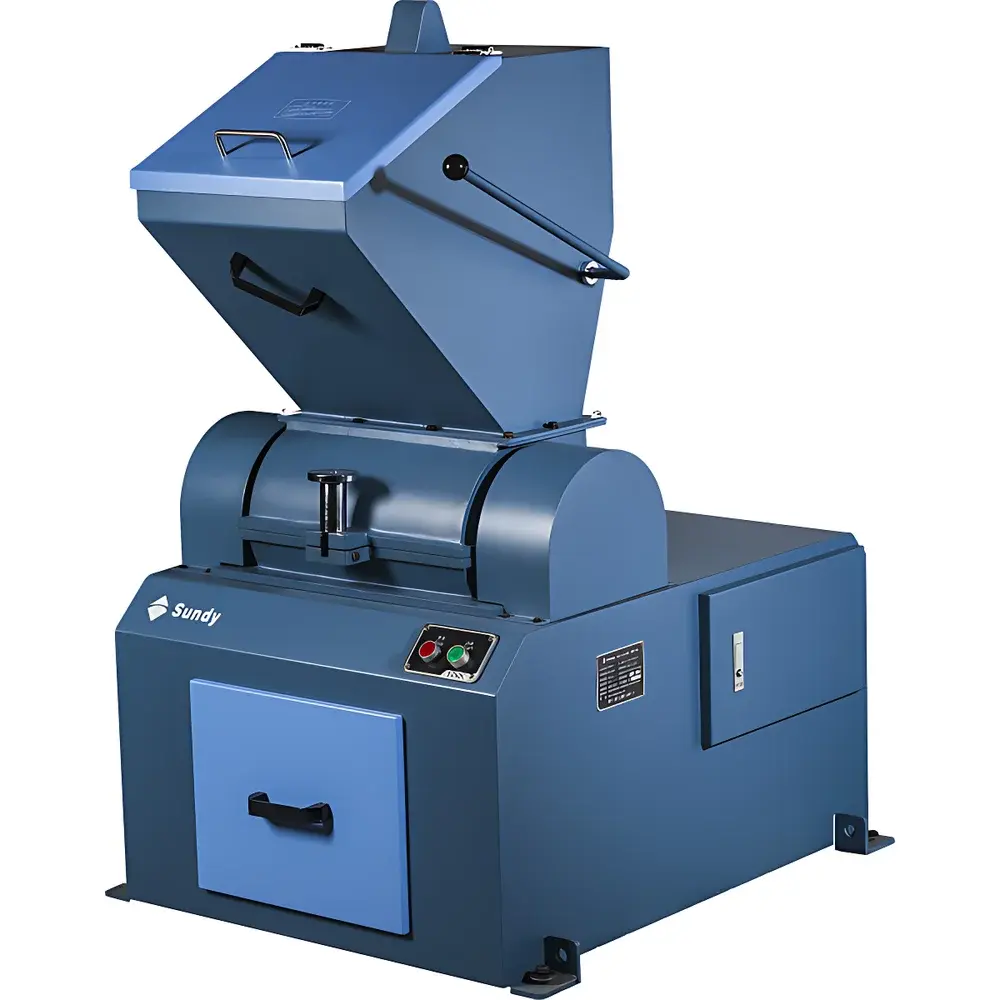
Sundy SDHC Hammer Crusher
| Brand | Sundy |
|---|---|
| Model | SDHC |
| Type | Laboratory Hammer Crusher for Coal and Mineral Sample Preparation |
| Compliance | GB/T 474–2008 |
| Input Size | ≤50 mm / ≤150 mm |
| Output Size | ≤3 mm / ≤6 mm / ≤13 mm |
| Moisture Tolerance | ≤15% (total moisture) |
| Throughput | 250–500 kg/h / 650–2000 kg/h |
| Dimensions (L×W×H) | 910×720×1100 mm / 970×840×1240 mm |
| Weight | 195 kg / 300 kg |
| Motor Power | 1.5 kW / 4 kW |
| Voltage | AC 380 V ±10%, 50 Hz ±1 Hz |
| Safety | Interlocked Chamber Access Cutoff |
| Dust Extraction Port | Standardized Flanged Interface |
Overview
The Sundy SDHC Hammer Crusher is an industrial-grade laboratory sample preparation instrument engineered for consistent, contamination-free size reduction of coal, ores, and other brittle mineralogical materials. It operates on the principle of high-speed impact comminution—where rotating hammers strike feed material against a fixed breaker plate and screen, achieving controlled particle size distribution through mechanical attrition and shearing. Designed specifically to meet the stringent reproducibility and representativeness requirements of routine analytical laboratories in power generation, coal mining, metallurgy, cement production, and geological survey institutions, the SDHC series adheres fully to GB/T 474–2008 “Methods for the Preparation of Coal Samples”, ensuring compliance with national standard protocols for homogenization, division, and grinding prior to proximate/ultimate analysis, calorimetry, or ash fusion testing.
Key Features
- Patented Anti-Clogging Feed Mechanism: Integrates a rotating arc-shaped scraper synchronized with hammer rotation to continuously remove adhered or moist material from the inner chamber walls and feed chute—eliminating bridging, preventing cross-contamination between batches, and maintaining consistent throughput without manual intervention.
- Interlocked Safety System: Equipped with a dual-point mechanical and electrical interlock that immediately de-energizes the motor upon lid opening, satisfying basic functional safety requirements for Class I laboratory equipment under IEC 61000-6-2 and GB/T 19001–2016 (ISO 9001) operational risk control frameworks.
- Dust Mitigation Ready: Features a standardized 120 mm diameter flanged dust extraction port compliant with ISO 16000-7 sampling interface geometry, enabling direct integration with centralized lab ventilation or portable HEPA-filtered vacuum systems to maintain particulate exposure below OSHA PEL (Permissible Exposure Limit) thresholds for respirable coal dust (≤2.0 mg/m³).
- Modular Rotor Assembly: Hammers are mounted on replaceable rotor arms using hardened steel pins and lock washers, allowing rapid field replacement without specialized tools—minimizing downtime during scheduled maintenance or abrasive wear cycles.
- Vibration-Damped Structural Frame: Heavy-gauge welded carbon steel chassis with elastomeric mounting isolators reduces transmitted vibration by ≥65% at operating frequencies (1500–3000 rpm), enhancing long-term bearing life and minimizing adjacent instrumentation interference.
Sample Compatibility & Compliance
The SDHC series accepts feed materials with total moisture content up to 15%, accommodating moderately wet coal samples common in field-sourced bituminous and lignite batches. Its robust hammer geometry and optimized screen aperture configuration ensure uniform output grading across three nominal size classes (≤3 mm, ≤6 mm, ≤13 mm), directly supporting downstream procedures including ASTM D3174 (ash determination), ASTM D3175 (volatile matter), and ISO 1171 (determination of ash). All units are CE-marked for machinery directive compliance (2006/42/EC) and include traceable factory calibration documentation aligned with ISO/IEC 17025:2017 clause 6.5.2 for measurement equipment verification.
Software & Data Management
While the SDHC is a stand-alone electromechanical system without embedded digital controls, it supports full GLP/GMP traceability when operated within validated workflows. Optional external data loggers (e.g., Omega OM-DAQPRO-5300) can be connected via analog 4–20 mA output (available on SDHC-Plus variants) to record runtime, motor current draw, and thermal sensor feedback—enabling audit-ready records per FDA 21 CFR Part 11 requirements when paired with electronic lab notebook (ELN) platforms such as LabArchives or Benchling. Maintenance logs, calibration certificates, and batch-specific crushing parameters (feed mass, duration, ambient RH) are recommended to be archived per ISO/IEC 17025 section 7.11.
Applications
- Routine coal sample reduction prior to proximate analysis (moisture, volatile matter, fixed carbon, ash), ultimate analysis (C/H/N/S/O), and gross calorific value (GCV) determination.
- Preparation of geochemical reference materials (CRMs) and certified coal standards (e.g., NIST SRM 1632E, SARM 20) for method validation and instrument calibration.
- Size reduction of limestone, bauxite, phosphate rock, and slag samples in cement and metallurgical QA/QC labs.
- Primary crushing stage in multi-step sample preparation lines integrating vibratory feeders, rotary dividers, and automated weighing stations.
FAQ
Does the SDHC require periodic recalibration?
No—mechanical crushers do not require metrological recalibration; however, hammer wear, screen deformation, and bearing clearance must be verified every 500 operational hours per manufacturer’s preventive maintenance schedule.
Can the SDHC process materials other than coal?
Yes—provided they exhibit compressive strength 40 (per ASTM D5744), including shale, gypsum, soft limestone, and certain clays. Avoid highly fibrous, ductile, or metallic feedstocks.
Is explosion-proof certification available?
Standard SDHC units are not ATEX-certified; however, custom configurations with intrinsically safe motor enclosures (IECEx Zone 21) and static-dissipative housings can be commissioned upon request.
What maintenance intervals are recommended?
Hammer replacement every 800–1200 hours depending on abrasivity; screen inspection every 200 hours; lubrication of main bearings every 100 hours using ISO VG 220 gear oil.
How is sample representativeness ensured?
Through patented scraper-assisted feed dynamics and symmetrical hammer trajectory design, which minimize segregation and promote uniform residence time distribution—validated via ASTM E1989 round-robin testing across 12 independent coal labs.
Related Products



