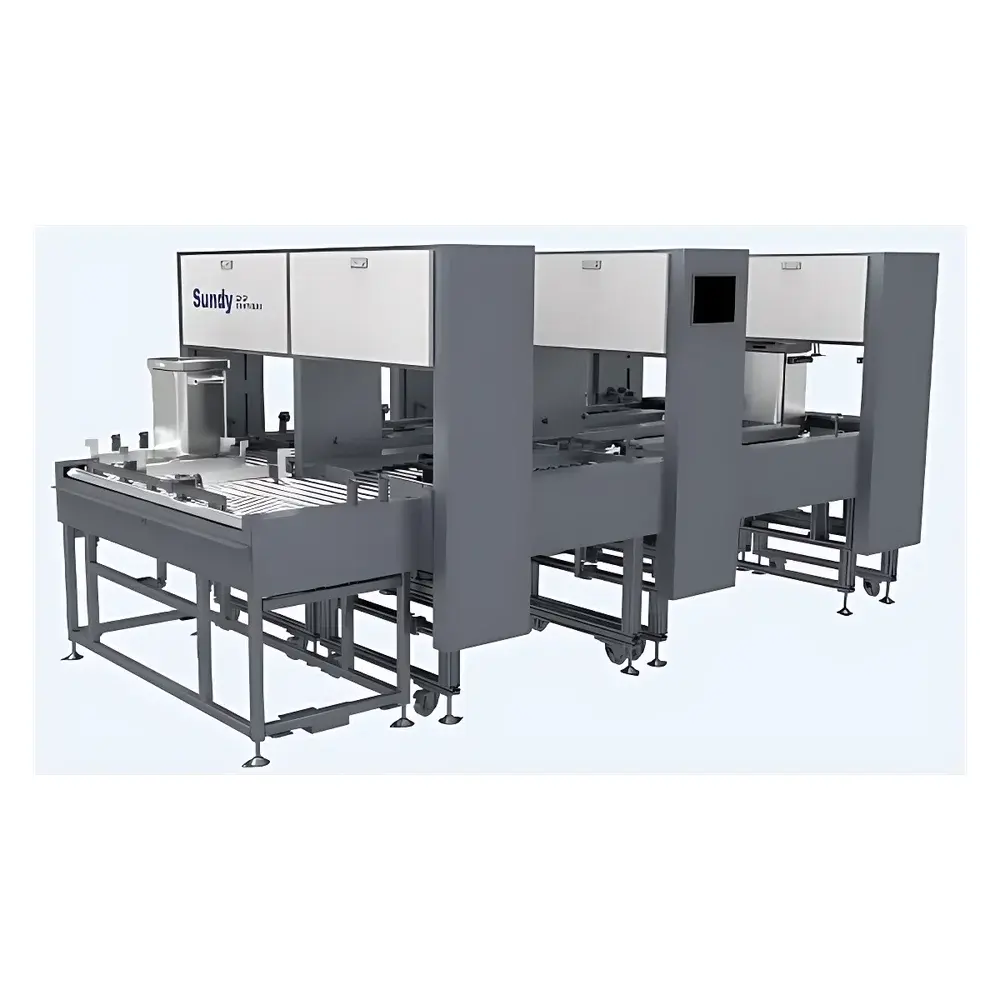
Sundy SDIGP Intelligent Coal Sample Segregation and Sealing System
| Brand | Sundy |
|---|---|
| Origin | Hunan, China |
| Manufacturer Type | Authorized Distributor |
| Country of Origin | China |
| Model | SDIGP Intelligent Coal Sample Segregation and Sealing System |
| Pricing | Upon Request |
| Stations | 8 |
| Sample Bucket Capacity | 25 L |
| Bucket Material | Stainless Steel or Polypropylene |
| Bucket Exchange Time | < 90 s |
| Station Switching Time | < 5 s |
| Power Supply | 380 V AC, 3 kW |
| Sealing Method | Electromechanical Locking Lid |
| Coding Method | RFID Embedded in Lid |
| Bucket Entry/Exit Mode | Automatic or Manual |
| Moisture Loss (48 h) | < 0.1% |
| Compliance | Designed for ISO 13909, ASTM D2234, and GB/T 19494 series coal sampling standards |
Overview
The Sundy SDIGP Intelligent Coal Sample Segregation and Sealing System is an engineered solution for automated, traceable, and moisture-preserving coal sample handling between primary sampling and laboratory preparation stages. Built on a modular architecture, it operates on the principle of sequential, station-based segregation—where each of the eight independent stations receives, identifies, weighs, seals, and encodes discrete coal sub-samples according to predefined batch logic. The system eliminates manual intervention by integrating electromechanical lid locking, RFID-based digital sample identity management, and closed-loop pneumatic/hydraulic actuation for bucket handling. It is specifically designed for applications where physical distance between sampling points and preparation facilities precludes direct mechanical coupling—enabling secure, auditable, and environmentally controlled sample transit via standardized 25-L sealed containers. Its operational envelope aligns with international coal sampling protocols requiring strict chain-of-custody integrity, moisture retention, and tamper-evident packaging.
Key Features
- Fully automated sample bucket lifecycle management: automatic bucket ingress, RFID authentication, lid unlocking, sample reception & gravimetric weighing (±0.1% repeatability), sealing via electromagnetic lock, RFID encoding, and egress—all without operator interaction.
- Hermetic sample containment: all transfer, storage, and sealing phases occur within sealed stainless steel or food-grade polypropylene buckets; validated moisture loss ≤0.1% over 48 hours under ambient conditions per ISO 13909 Annex D test methodology.
- Two-tier security architecture: physical security via motorized locking lids (requiring authenticated access at designated stations) and data security via encrypted RFID tags embedded in bucket lids—storing batch ID, timestamp, mass, and location history; no human-readable labels are used.
- Dual-mode bucket interface: supports both fully automated bucket exchange (via integrated conveyor and robotic gripper) and manual loading/unloading at dedicated stations—ensuring operational continuity during maintenance or integration with legacy infrastructure.
- Scalable modularity: optional add-on modules—including the Bucket Buffer Module (for up to 24 additional bucket slots) and the Trolley Interface Module (with optical alignment and adaptive docking)—enable seamless synchronization with autonomous sample transport trolleys and upstream/downstream units such as homogenization or auto-emptying stations.
Sample Compatibility & Compliance
The SDIGP system accommodates standard 25-L cylindrical coal sample containers conforming to ISO 13909-2:2018 dimensional tolerances and material specifications. It supports bituminous, sub-bituminous, lignite, and anthracite coals with top sizes up to 50 mm and moisture content ranging from 2% to 35% (as-received basis). All control logic and audit trails comply with GLP principles; system logs—including weight records, lid actuation timestamps, RFID read/write events, and error codes—are stored locally with configurable export to CSV or SQL formats. The architecture supports future validation against FDA 21 CFR Part 11 requirements through optional electronic signature and role-based access modules.
Software & Data Management
The system runs on a real-time industrial PLC (Siemens S7-1500 series) paired with a Windows-based HMI interface featuring dual-language support (English/Chinese) and remote diagnostics via OPC UA. Sample metadata—including batch number, source point ID, collection time, gross/net mass, and environmental humidity—is written directly to the RFID tag during sealing and remains immutable throughout transit. The software includes configurable alarm thresholds (e.g., weight deviation >±0.5%, lid unlock timeout >3 s), automated daily backup to network-attached storage, and exportable audit reports compliant with ISO/IEC 17025 documentation requirements.
Applications
- Power plant coal quality monitoring: continuous segregation of incoming railcar or barge deliveries into representative batches prior to lab analysis.
- Mine site quality assurance: integration with cross-belt samplers to route samples by seam, seam depth, or geological stratum while preserving moisture and preventing cross-contamination.
- Third-party inspection laboratories: receipt verification of sealed, encoded buckets with cryptographic hash matching between field RFID data and lab database entries.
- Contractual arbitration: tamper-proof sample provenance tracking for disputes related to calorific value, ash content, or sulfur specification compliance.
FAQ
What standards does the SDIGP system reference for coal sample integrity?
It is engineered to meet the procedural and equipment requirements of ISO 13909-2:2018, ASTM D2234/D7430, and GB/T 19494.1–19494.3, particularly regarding sample representativeness, moisture preservation, and chain-of-custody documentation.
Can the system integrate with existing LIMS or ERP platforms?
Yes—via OPC UA server interface or configurable REST API endpoints; sample metadata and status events can be pushed to external systems using JSON or XML payloads.
Is the RFID encoding compatible with common industrial readers?
It uses ISO/IEC 18000-63 (EPC Gen2) protocol with 96-bit EPC memory banks, readable by fixed-mount and handheld readers from Zebra, Impinj, and Alien Technology.
What maintenance intervals are recommended for the electromechanical sealing mechanism?
Lubrication and functional verification every 6 months; full actuator calibration annually or after 10,000 lid cycles—documented in the provided maintenance logbook and accessible via HMI service menu.
Does the system support hazardous area classification (e.g., ATEX or IECEx)?
Standard configuration is rated for Zone 2 / Class I Div 2 environments; explosion-proof variants with certified motors and enclosures are available upon engineering review and site-specific ATEX/IECEx certification planning.