
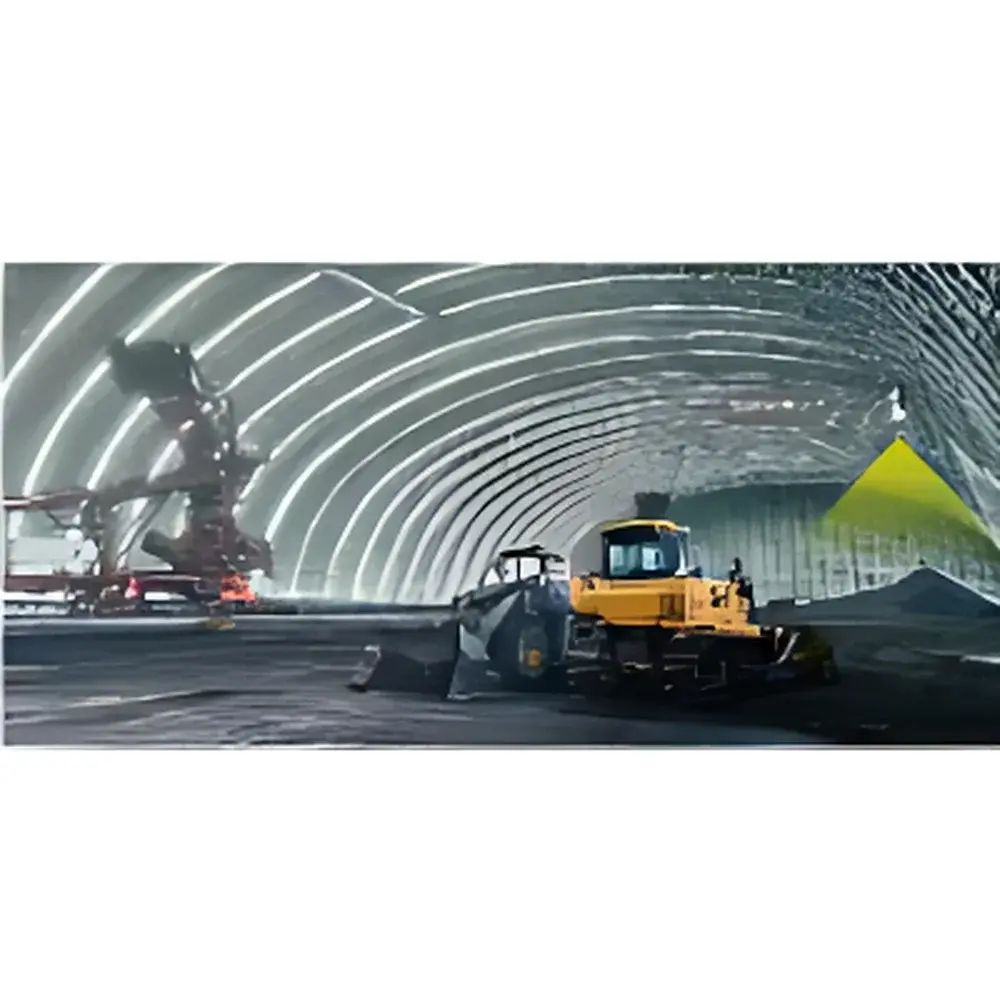
Sundy SDLM1250 Fixed-Mount Laser Coal Stockpile Analyzer
| Brand | Sundy |
|---|---|
| Model | SDLM1250 |
| Origin | Hunan, China |
| Type | Fixed-mount 3D LiDAR-based coal stockpile volume measurement system |
| Measurement Range | 250 m |
| Scan Angle | 360° horizontal, ±30° vertical (typical) |
| Accuracy | <0.3% relative error |
| Measurement Time per Stack | ≤20 min (for up to 100,000 m³ pile, coverage area 280 × 60 m) |
| Data Acquisition Interval | ≥10 ms |
| Response Time | ≤20 s |
| Operating Temperature | −40 °C to +70 °C |
| Power Supply | 24 V DC ±15% |
| Total Power Consumption | 36 W (scanner), 140 W (heating unit) |
| Ingress Protection | IP67 |
| Mounting | Integrated with stacker-reclaimer or bucket-wheel stacker via rigid mechanical interface |
| Travel Sensor Compatibility | Optional encoder-based linear displacement sensor for synchronized motion compensation |
Overview
The Sundy SDLM1250 Fixed-Mount Laser Coal Stockpile Analyzer is an industrial-grade, permanently installed 3D LiDAR volumetric measurement system engineered for continuous, high-reliability quantification of bulk material stockpiles in thermal power plants, coal terminals, steel mills, cement facilities, and mining operations. It operates on time-of-flight (ToF) laser scanning principles, emitting pulsed infrared laser beams (905 nm) across a full 360° horizontal field of view and ±30° vertical range to capture dense point clouds of coal piles, sand heaps, gravel mounds, or earthworks. Unlike handheld or mobile survey solutions, the SDLM1250 is mechanically integrated with existing stacker-reclaimers or bucket-wheel machines—leveraging their precise travel path as a known spatial reference—enabling georeferenced, motion-compensated scanning without external GNSS dependency. Its core function is to deliver traceable, auditable volume calculations compliant with ISO 9001 quality management requirements and aligned with ASTM D6172 (Standard Practice for Determining Volume of Stockpiled Materials by Survey Methods) and IEC 61508 functional safety guidelines for industrial instrumentation.
Key Features
- Fixed-mount architecture with rigid mechanical coupling to stacker-reclaimer booms or rail-mounted carriers—eliminates manual repositioning and ensures repeatable measurement geometry.
- Integrated encoder-based travel sensor support for real-time motion synchronization; maintains measurement fidelity during variable-speed traversals and enables automatic trajectory correction in post-processing.
- IP67-rated sealed optical housing with active heating (140 W) and anti-fog lens coating—guarantees uninterrupted operation under rain, snow, fog, dust, and extreme ambient temperatures from −40 °C to +70 °C.
- High-speed ToF LiDAR engine with ≥10 ms point acquisition interval and ≤20 s end-to-end data processing latency—supports rapid turnaround for daily inventory reconciliation.
- Modular, telescoping mounting bracket with quick-release lower swing mechanism—simplifies laser head installation, maintenance access, and field calibration verification.
- Multi-perspective visualization suite: real-time point cloud streaming, meshed surface rendering, cross-sectional slicing, elevation-contoured topographic maps, and orthographic projection views—all fully interactive (pan, zoom, rotate) with sub-centimeter point distribution uniformity.
Sample Compatibility & Compliance
The SDLM1250 is validated for heterogeneous, non-reflective, and irregularly shaped bulk solids including bituminous and lignite coal, crushed limestone, fly ash, slag, sand, gravel, and overburden soil. Surface moisture content up to 12% does not degrade point cloud density or registration accuracy. System compliance includes CE marking per EMC Directive 2014/30/EU and Low Voltage Directive 2014/35/EU; mechanical design adheres to ISO 12100 for machinery safety. Volume computation algorithms are internally validated against third-party terrestrial laser scanning (TLS) benchmarks per ISO/IEC 17025-accredited protocols. Audit trails, user access logs, and raw scan file timestamps satisfy GLP/GMP documentation requirements for inventory control systems in regulated energy and metallurgical sectors.
Software & Data Management
The analyzer interfaces with Sundy’s proprietary CoalStock Manager v4.x software platform via Ethernet (TCP/IP). The application supports automated daily volume reports in PDF/CSV formats, historical trend analysis with customizable KPI dashboards (e.g., depletion rate, stacking efficiency, shrinkage tracking), and integration with enterprise MES/ERP systems through OPC UA or RESTful API. All raw .LAS/.LAZ point cloud files are stored with embedded geotags, sensor metadata, and environmental condition stamps (temperature, humidity, timestamp). Software enforces role-based access control (RBAC), electronic signatures, and 21 CFR Part 11-compliant audit trails—including immutable records of parameter changes, report generation, and user login/logout events.
Applications
- Real-time coal inventory monitoring in fossil-fueled power stations to optimize procurement cycles and reduce stockout risk.
- Automated volume reconciliation between ship loading/unloading operations and yard stockpile records at port coal terminals.
- Stacking and reclaiming efficiency analysis for bucket-wheel stacker-reclaimers—quantifying material loss, segregation, and wind erosion effects.
- Regulatory compliance reporting for environmental agencies requiring annual stockpile mass estimation (e.g., EPA GHG Reporting Rule Subpart D).
- Geotechnical volume verification of overburden removal and backfill operations in open-pit mining and civil infrastructure projects.
FAQ
Can the SDLM1250 operate without GNSS or total station referencing?
Yes. It relies exclusively on its integrated motion encoder and internal inertial measurement unit (IMU) for trajectory reconstruction—no external positioning infrastructure is required.
Is raw point cloud data export supported?
Yes. Full-resolution .LAS Level 1.4 and compressed .LAZ files are exportable with coordinate system metadata (local Cartesian or optional UTM projection).
How is calibration maintained under thermal cycling?
The system performs autonomous thermal drift compensation using onboard reference targets and factory-characterized temperature-response coefficients—no field recalibration needed between −40 °C and +70 °C.
Does it support integration with DCS or SCADA systems?
Yes. Native Modbus TCP and OPC UA server modules enable seamless read/write access to volume totals, status flags, and diagnostic alarms.
What is the typical service life of the laser scanner module?
Rated for ≥30,000 operating hours under continuous duty; optical window cleaning intervals recommended every 6 months in high-dust environments.





