
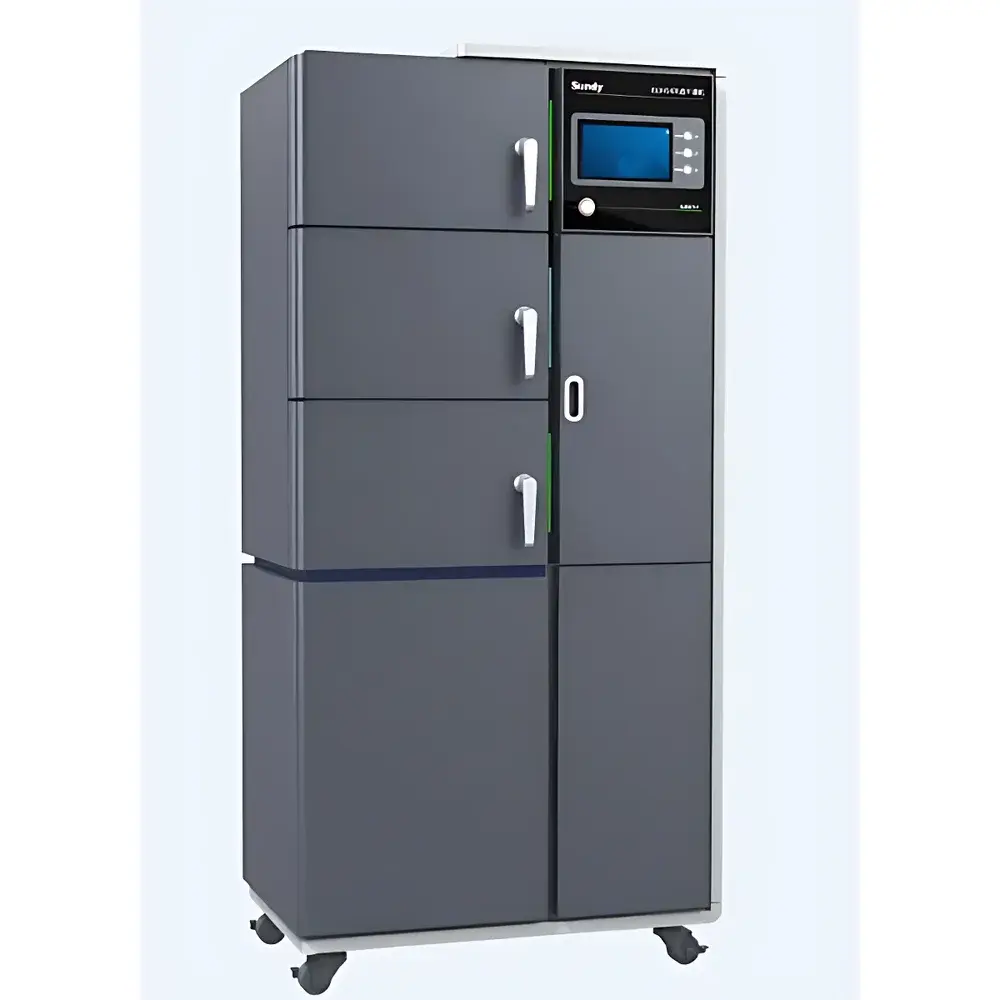
Sundy SDVD1000 Forced-Air Through-Flow Drying Oven
| Brand | Sundy |
|---|---|
| Model | SDVD1000 |
| Temperature Range | Ambient to 60 °C (default setpoint: 40 °C) |
| Temperature Resolution | 1 °C |
| Temperature Accuracy | ±2.5 °C |
| Max. Heating Rise | 0–35 °C |
| Drying Units | 3 independently controlled |
| Sample Capacity per Unit | 30–500 g |
| Overall Dimensions | 693 × 410 × 1523 mm |
| Weight | ~118 kg |
| Power Rating | 3 kW |
| Voltage | AC 220 V ±10%, 50 Hz ±1 Hz |
| Compliance | GB/T 474 – “Methods for Preparation of Coal Samples” |
Overview
The Sundy SDVD1000 Forced-Air Through-Flow Drying Oven is an engineered solution for rapid, standardized moisture removal from particulate solid samples in laboratory and quality control environments. Unlike conventional convection ovens that rely on static or top-down heat transfer, the SDVD1000 employs a patented through-flow drying principle—where conditioned hot air is actively directed *vertically through* the sample bed. This ensures uniform thermal energy distribution across the entire sample volume, minimizing thermal gradients and eliminating surface crusting or case-hardening effects common in traditional drying methods. Designed specifically for compliance with GB/T 474 (“Methods for Preparation of Coal Samples”), the instrument maintains sample integrity and representativeness by adhering to strict layer-thickness and surface-loading constraints (≤1 g/cm² or ≤1.5× nominal top size). Its operational envelope—ambient to 60 °C with ±2.5 °C accuracy and 1 °C resolution—supports method-defined drying protocols without risking thermal degradation of sensitive organic matrices such as coal, biomass, fly ash, or industrial sludge.
Key Features
- Tri-channel independent control architecture: Three drying units operate simultaneously with fully decoupled temperature setpoints, timing schedules, and status monitoring—enabling parallel processing of heterogeneous sample batches.
- Through-flow airflow design: High-efficiency axial fans generate laminar vertical airflow at calibrated velocity, ensuring consistent heat and mass transfer across variable particle sizes (from <1 mm to 13 mm top size).
- Integrated digital supervision interface: Real-time logging of temperature, elapsed time, door-open events, and process interruptions—exportable via USB or Ethernet to external PCs for audit-ready records.
- Instrument interoperability: Compatible with barcode scanners and analytical balances for automated sample ID capture and pre-/post-drying mass differential calculation—supporting traceable, operator-independent workflows.
- Built-in ultrasonic sieve cleaner: A dedicated 40 kHz ultrasonic module prevents mesh clogging during repeated use with fine or sticky materials, preserving airflow consistency and reducing maintenance downtime.
- Scalable system integration: One host PC can manage up to two SDVD1000 units concurrently, facilitating centralized lab-scale deployment without additional software licensing.
Sample Compatibility & Compliance
The SDVD1000 accommodates granular and powdered solids with bulk densities ranging from 0.4 to 1.2 g/cm³ and maximum particle sizes up to 13 mm. It is routinely deployed in coal preparation laboratories (per GB/T 474), power plant QA/QC departments, metallurgical assay labs, hazardous waste characterization facilities, and petrochemical R&D centers. All drying protocols align with ISO 589:2022 (“Solid mineral fuels — Determination of total moisture”) and ASTM D3173-22 (“Standard Test Method for Moisture in the Analysis Sample of Coal and Coke”), where gravimetric moisture determination requires controlled, non-pyrolytic drying conditions. The unit’s temperature stability and airflow repeatability support GLP-compliant documentation when paired with validated software and electronic signature-capable data acquisition systems.
Software & Data Management
The SDVD1000 communicates via RS-485 or TCP/IP to optional Windows-based LabManager™ software (v3.2+), which provides full lifecycle data handling: parameter configuration, real-time dashboard visualization, event-triggered alerts (e.g., door open >5 s, temperature deviation >±3 °C), and CSV/PDF report generation. Audit trails include user login timestamps, parameter change logs, and abnormal termination codes—all compliant with FDA 21 CFR Part 11 requirements when deployed with role-based access control and electronic signature modules. Raw sensor data (1 Hz sampling) is stored locally on embedded flash memory (≥16 GB) and synchronized automatically upon network reconnection.
Applications
- Rapid moisture conditioning of coal samples prior to crushing, sieving, and proximate analysis (ASTM D3172, ISO 1171)
- Drying of cement kiln dust, slag, and fly ash for leaching test preparation (TCLP, SPLP)
- Pre-treatment of contaminated soil or incinerator bottom ash prior to heavy metal extraction (EPA Method 3050B)
- Stabilization of biomass feedstocks (wood chips, agricultural residues) for calorific value testing (ISO 18125)
- Controlled dehydration of polymer pellets or pharmaceutical excipients where residual solvent quantification is critical
FAQ
Does the SDVD1000 meet international calibration traceability requirements?
Yes—temperature sensors are NIST-traceable RTDs (Class B, IEC 60751), and factory calibration certificates include uncertainty budgets per ISO/IEC 17025 guidelines.
Can drying parameters be locked to prevent unauthorized modification?
Yes—administrator-level password protection enables parameter locking, firmware update restrictions, and read-only mode for routine operators.
Is the unit suitable for Class 1 Div 2 hazardous locations?
No—the SDVD1000 is rated for general laboratory use (IP20 enclosure); explosion-proof variants require custom engineering and third-party certification.
What maintenance intervals are recommended for sustained performance?
Air filter replacement every 250 operating hours; ultrasonic transducer inspection annually; full thermal calibration verification every 12 months or after 2000 drying cycles.
How does the SDVD1000 ensure compliance with GB/T 474’s sample thickness constraint?
Each drying pan includes engraved depth markers and calibrated volume fill lines corresponding to 1 g/cm² loading density for common coal top sizes (e.g., 6 mm, 13 mm), enabling visual verification without additional measurement tools.



