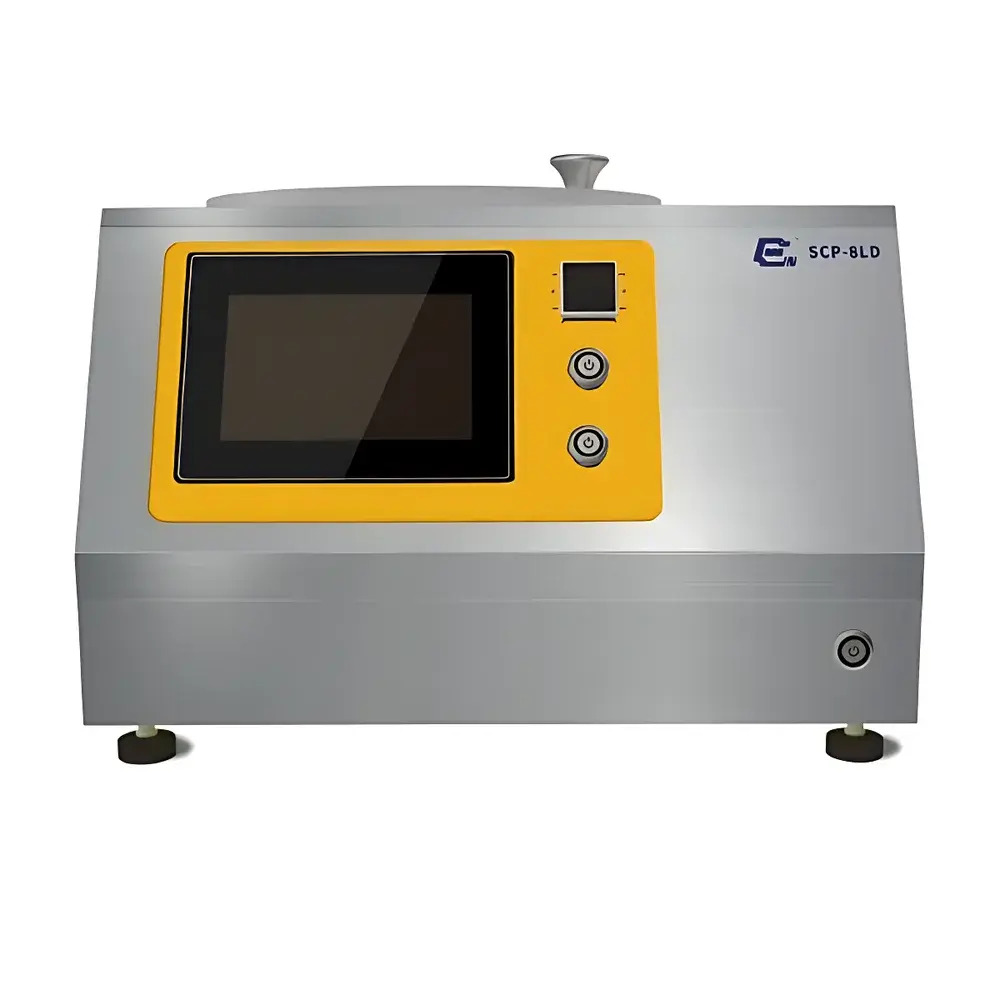
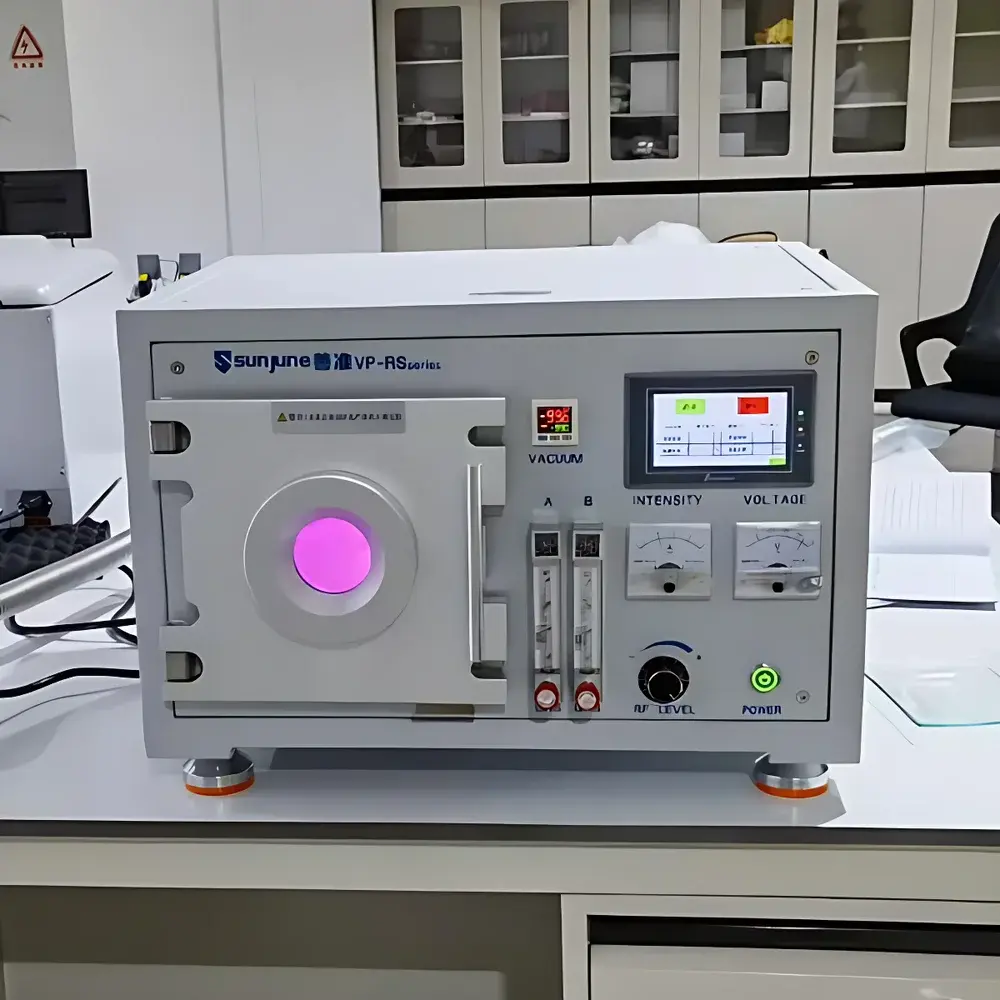
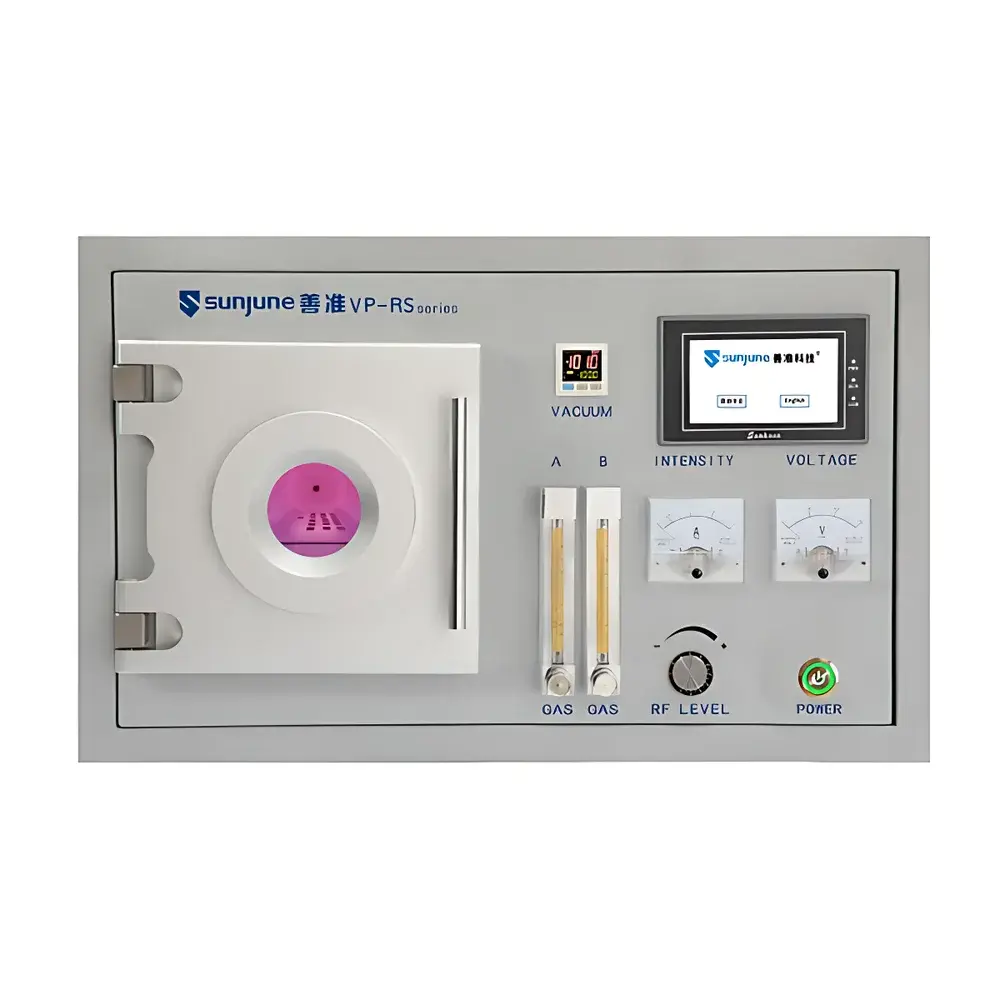
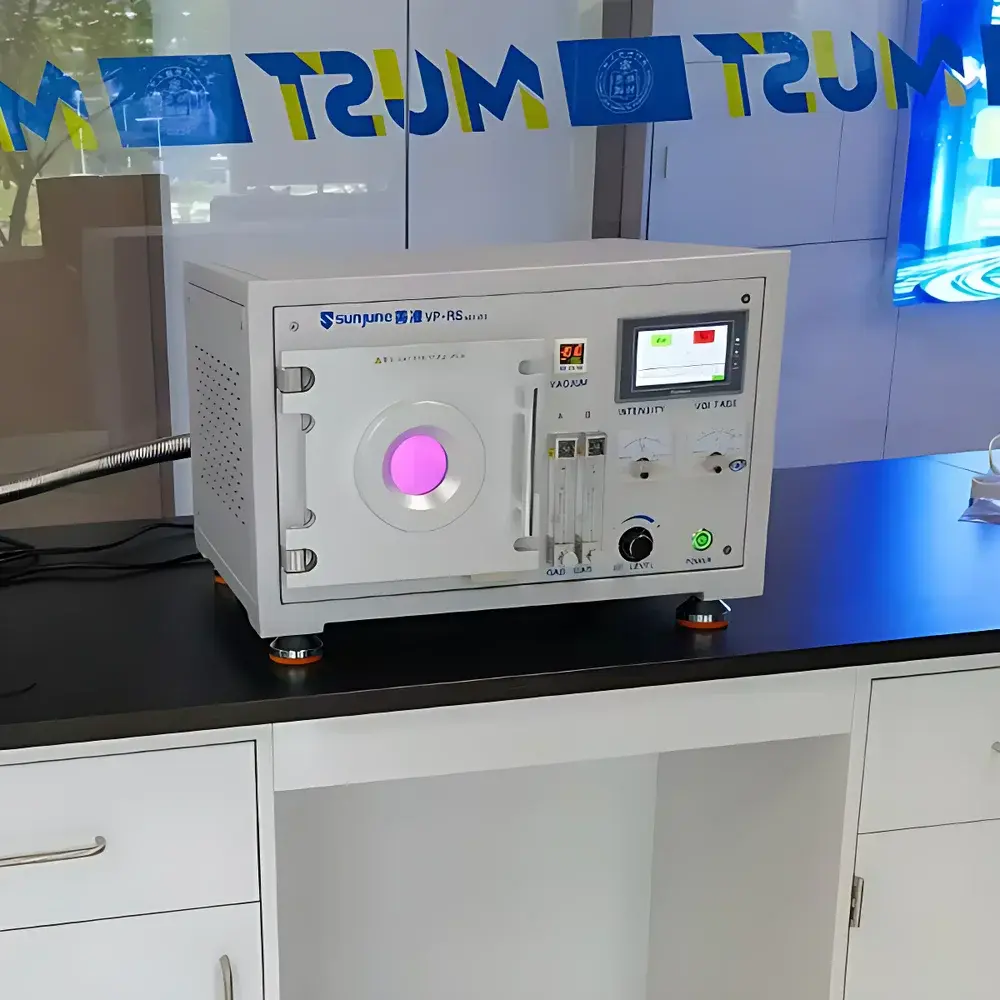
SUNJUNE VP-RS15 Plasma Etching System
| Brand | SUNJUNE |
|---|---|
| Origin | Guangdong, China |
| Manufacturer | SUNJUNE Technology Co., Ltd. |
| Model | VP-RS15 |
| Etching Principle | Capacitively Coupled Plasma (CCP) |
| RF Power | 500 W |
| RF Frequency | 13.56 MHz |
| Etch Rate | High |
| Selectivity | PR/GaAs ≥ 4:1 |
| SiO₂/InP > 10 | 1 |
| Etch Profile | Isotropic |
| Residue Byproduct | CO₂ |
| Uniformity | <5% (across 4-inch wafer) |
| Aspect Ratio | ≥5:1 |
| Chamber Material | 304 Stainless Steel |
| Max. Operating Temperature | ≤45°C after 3 min full-power operation |
| Gas Inlets | 2 independent mass-flow-controlled ports |
| Vacuum Display | Digital real-time readout |
| Control Interface | 7-inch capacitive touchscreen with embedded control software (Software Copyright No.: 2021SR1026389) |
| Safety Features | Automatic door interlock, pressure-sensing lid detection, post-process venting sequence |
| Warranty | 24 months parts and labor |
Overview
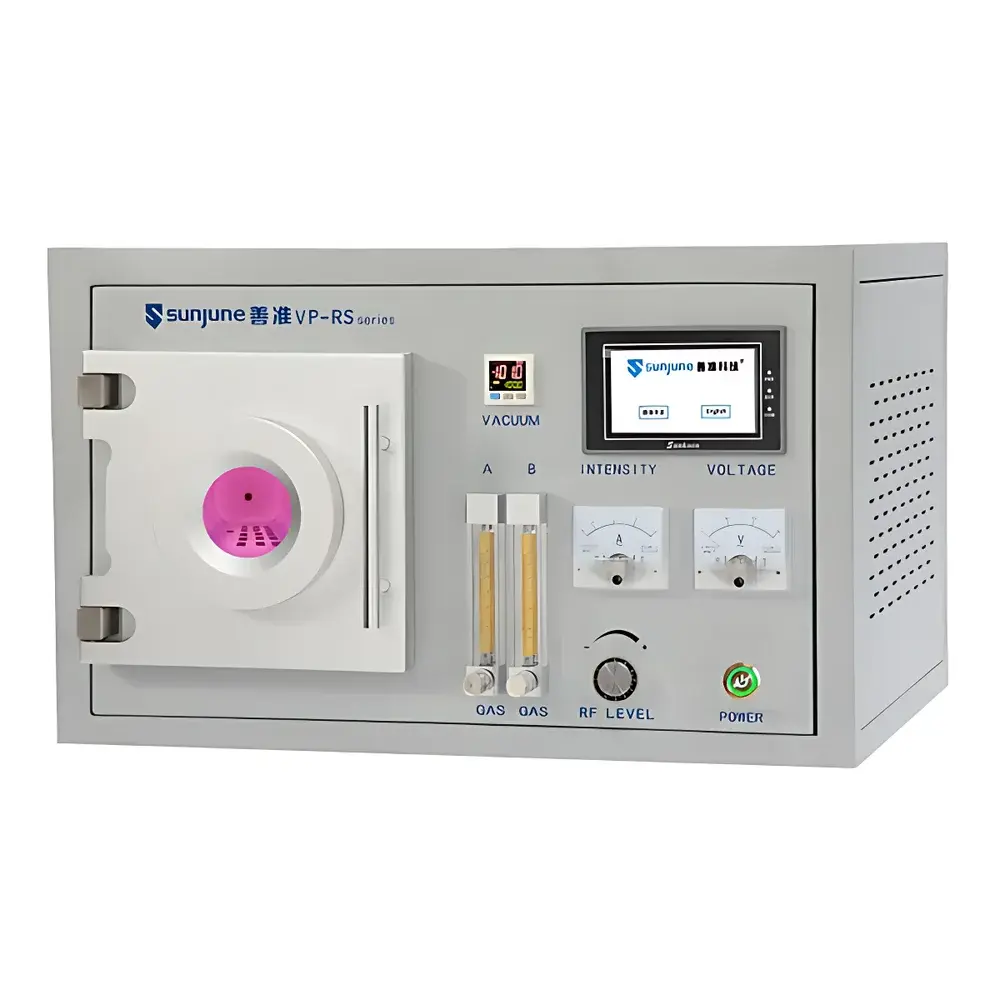
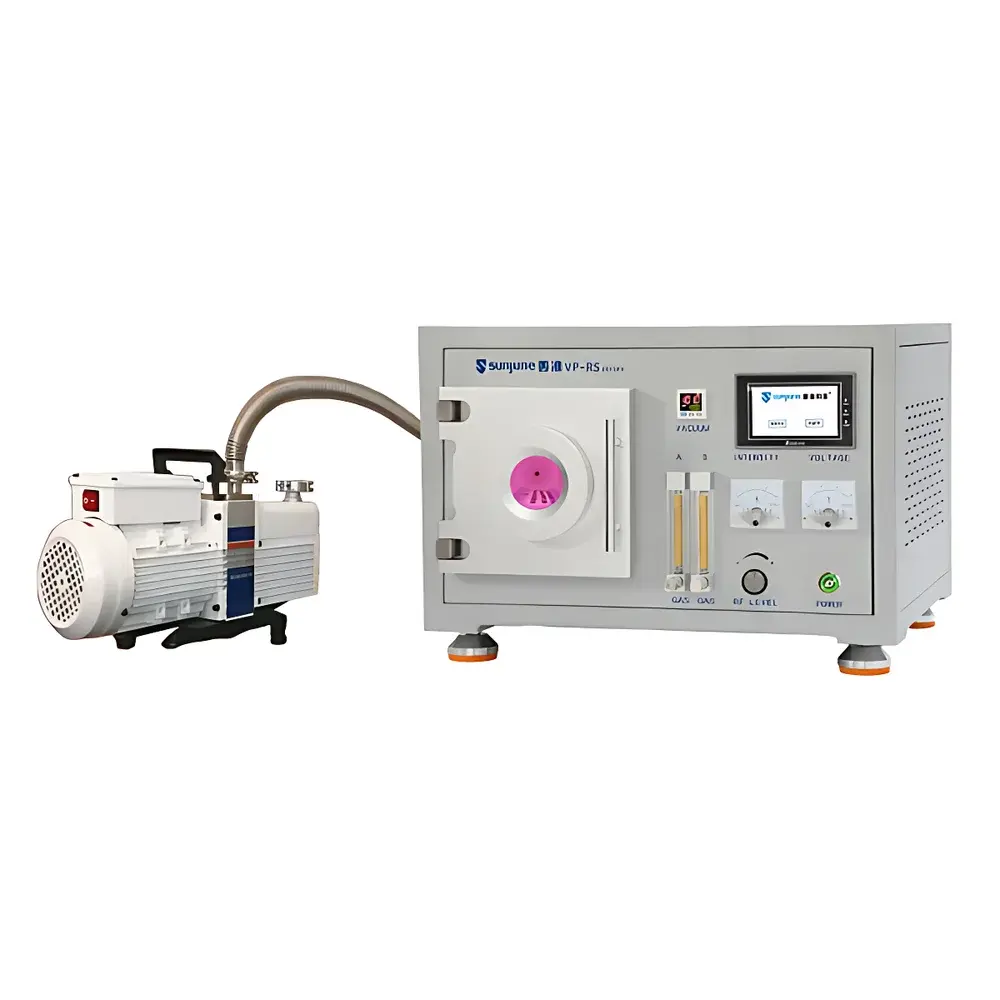
The SUNJUNE VP-RS15 Plasma Etching System is a benchtop-capable, capacitively coupled plasma (CCP) etcher engineered for precision isotropic etching, surface activation, ashing, and functionalization in R&D and pilot-scale semiconductor and advanced materials laboratories. Operating at a fixed 13.56 MHz radio frequency with a maximum output of 500 W, the system generates stable, low-temperature plasma in a vacuum environment—enabling non-damaging processing of thermally sensitive substrates such as PDMS, PET, graphene, and ITO-coated glass. Its stainless steel (304) vacuum chamber ensures long-term corrosion resistance and ultra-high vacuum compatibility (<5 × 10⁻³ mbar base pressure), while thermal management maintains chamber wall temperature ≤45°C even during sustained full-power operation—critical for preserving substrate integrity during extended exposure cycles.
Key Features
- Robust 304 stainless steel vacuum chamber with integrated RF electrode and optimized electrode gap geometry for uniform plasma density distribution
- Dual independent gas inlets with standard fittings for O₂, Ar, CF₄, SF₆, or custom gas mixtures—compatible with external mass flow controllers (MFCs) for advanced process tuning
- Real-time digital vacuum monitoring via integrated Pirani gauge, enabling precise pressure control between 10–500 mTorr
- 7-inch industrial-grade capacitive touchscreen HMI with intuitive workflow navigation, one-touch plasma ignition, and automatic safety sequencing (door interlock verification → pump start → pressure ramp → plasma initiation → timed treatment → controlled venting)
- Firmware-embedded control software (registered copyright: 2021SR1026389) supporting parameter logging, recipe storage (up to 99 profiles), and timestamped operational history for GLP-compliant documentation
- Passive cooling architecture—no external chiller required—ensuring quiet, maintenance-free operation in shared lab environments
Sample Compatibility & Compliance
The VP-RS15 supports isotropic etching and surface modification across a broad spectrum of materials without requiring photomask alignment or high-energy ion bombardment. Verified compatibility includes silicon wafers (Si, SiO₂, SiNₓ), compound semiconductors (GaAs, InP), transparent conductive oxides (ITO), polymer substrates (PDMS, PET, PI), 2D materials (graphene, MoS₂), carbon-based films (carbon nanotube networks, graphene oxide), and biomedical surfaces (tissue scaffolds, microfluidic channel walls). The system complies with IEC 61000-6-3 (EMC emissions) and IEC 61000-6-2 (immunity) standards. While not certified for Class 100 cleanroom integration, its sealed chamber design and particle-free operation meet ISO 14644-1 Class 5 requirements when operated inside laminar flow hoods or gloveboxes (VP-G series variant available for direct glovebox mounting).
Software & Data Management
The embedded control firmware provides full audit-trail capability: all process parameters—including RF power, pressure setpoint, gas flow rates (when MFC-equipped), treatment duration, and chamber temperature—are logged with UTC timestamps and user ID tagging. Exportable CSV logs support traceability under FDA 21 CFR Part 11 (when deployed with networked authentication and electronic signature modules). Remote monitoring via Ethernet is supported through optional Modbus TCP integration, enabling centralized fleet management in multi-instrument facilities. Software updates are delivered via secure USB firmware patching—no internet connectivity required during operation.
Applications
- Photoresist stripping and organic residue removal (ashing) on GaAs and InP wafers, with selectivity exceeding 10:1 versus underlying dielectrics
- Surface hydrophilization of PDMS for irreversible bonding in microfluidic device fabrication
- Controlled etching of SiO₂ layers on silicon substrates for MEMS release and cavity formation
- Functionalization of graphene and transition metal dichalcogenide (TMD) monolayers to tune work function and carrier concentration
- Pre-treatment of PET and PI flexible substrates prior to sputter deposition of transparent electrodes
- Removal of carbonaceous contamination from TEM grids and AFM tips
- Routine cleaning and activation of optical components, fiber end-faces, and sensor packaging surfaces
FAQ
What vacuum level can the VP-RS15 achieve?
The system reaches a base pressure of ≤5 × 10⁻³ mbar using the included two-stage rotary vane pump. With optional turbomolecular pumping, ultimate vacuum improves to <1 × 10⁻⁵ mbar.
Is the VP-RS15 compatible with reactive gas chemistries such as SF₆ or Cl₂?
Yes—provided appropriate gas handling infrastructure (stainless steel lines, corrosion-resistant seals, and exhaust scrubbing) is implemented externally. The chamber and RF feedthrough are rated for O₂, Ar, N₂, CF₄, and SF₆; Cl₂ requires upgraded nickel-plated internal components (available as OEM option).
Can process recipes be exported and shared between multiple VP-RS15 units?
Yes—recipe files (.prf) are stored in plain-text JSON format and can be transferred via USB drive or network share for cross-platform consistency and method transfer validation.
Does the system support automated sequential gas switching during a single run?
Not natively; gas selection is static per recipe. However, third-party MFC controllers with RS485/Modbus interfaces can be synchronized via the VP-RS15’s dry-contact I/O port for multi-step gas sequences.
What maintenance intervals are recommended?
RF matching network calibration every 12 months; O-ring replacement every 18 months under continuous use; vacuum pump oil change every 500 operating hours. Full preventive maintenance checklist is provided in the English-language service manual (Rev. 3.2, 2024).