
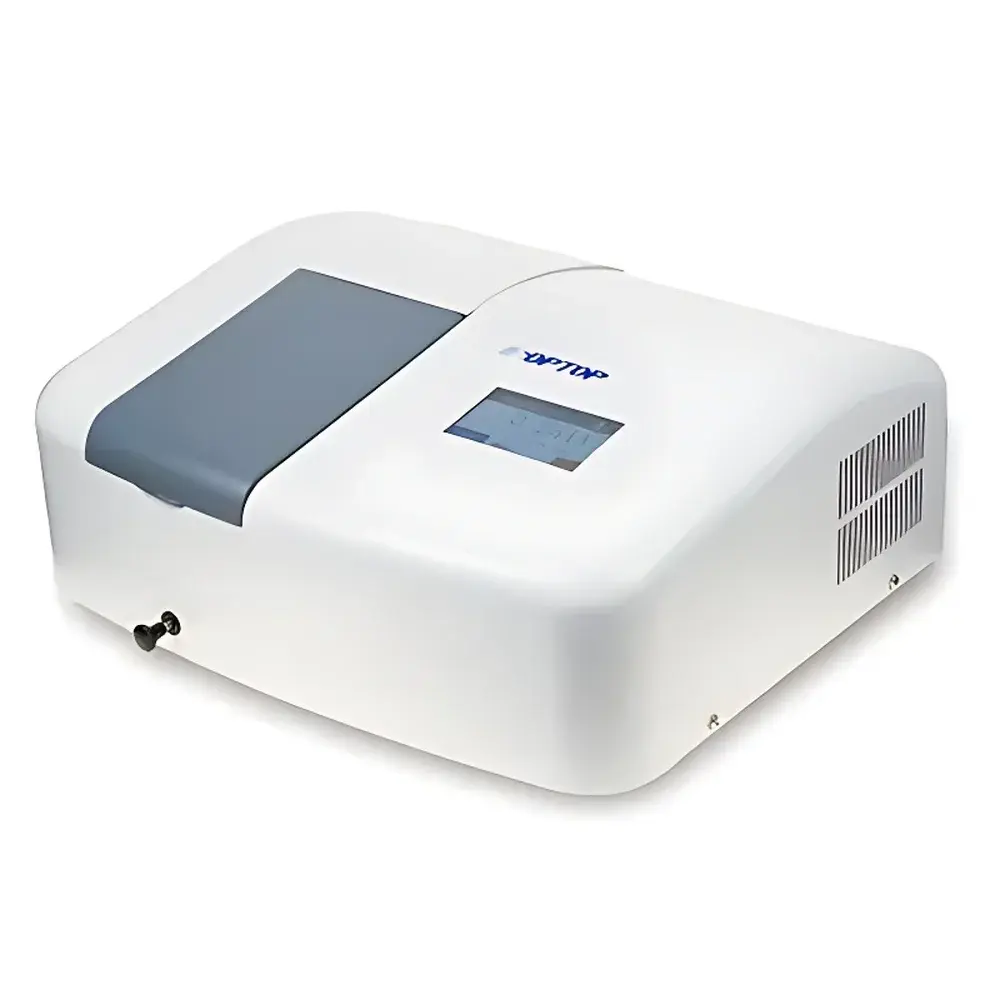
Sunny Hengping 7230G / 723PC UV-Vis Spectrophotometer
| Brand | Sunny Hengping Instrument |
|---|---|
| Origin | Shanghai, China |
| Manufacturer Type | Direct Manufacturer |
| Regional Classification | Domestic (China) |
| Model | 7230G / 723PC |
| Optical Design | Single-Beam |
| Detector Type | Photocell |
| Wavelength Range | 325–1100 nm |
| Wavelength Accuracy | ±0.5 nm |
| Wavelength Repeatability | ±0.2 nm |
| Spectral Bandwidth | 4 nm (7230G) / 2 nm (723PC) |
| Display | 4.3-inch Color Touchscreen (480 × 272 resolution) |
| Data Interface | USB |
| Power Supply | 220 V ±10%, 50 Hz / 110 V ±10%, 60 Hz, 75 W |
| Net Weight | 10.0 kg |
| Dimensions (W × D × H) | 470 × 380 × 225 mm |
Overview
The Sunny Hengping 7230G and 723PC are single-beam ultraviolet-visible (UV-Vis) spectrophotometers engineered for routine quantitative and qualitative analysis in academic teaching labs, quality control environments, and industrial R&D settings. Based on Czerny-Turner (C-T) monochromator architecture with a 1200-line/mm holographic grating, these instruments deliver stable spectral dispersion across a broad wavelength range of 325–1100 nm with 0.1 nm step resolution. The 723PC variant features a narrower 2 nm spectral bandwidth—enhancing resolution for sharper peak discrimination—while the 7230G maintains a 4 nm bandwidth optimized for higher photometric throughput and robustness in high-volume sample screening. Both models employ a silicon photocell detector, offering excellent linearity (typically >99.9% over 0–3.0 A), low noise, and long-term stability without requiring active cooling or frequent recalibration.
Key Features
- 4.3-inch high-resolution color touchscreen (480 × 272 pixels) with intuitive icon-driven interface for direct wavelength selection, method recall, and real-time spectrum visualization
- Automated wavelength positioning with ±0.5 nm accuracy and ±0.2 nm repeatability—enabling precise alignment for multi-point calibration and regulatory compliance workflows
- Direct concentration readout with customizable concentration factors, supporting both fixed-factor and user-defined linear/nonlinear calibration models
- Integrated linear regression engine for standard curve generation (including 1st–3rd order polynomial and piecewise linear fitting), with residual error reporting and goodness-of-fit (R²) calculation
- Dedicated DNA/protein analysis mode preconfigured for A260/A280 ratio calculation, nucleic acid quantification (50 µg/mL per A260 unit), and protein concentration estimation (1 mg/mL per A280 unit), fully editable for custom extinction coefficients
- Multi-wavelength measurement capability across up to 10 user-defined wavelengths in a single run, with simultaneous T (%) and A output and Excel-exportable tabular results
Sample Compatibility & Compliance
The 7230G/723PC accommodates standard 10 mm pathlength cuvettes (glass, quartz, or plastic) and supports optional accessories including 5 mm and 20 mm cells, micro-volume adapters, and thermostatted holders (external Peltier units). Its optical design meets core performance criteria outlined in ISO 9001-aligned laboratory practices and is routinely validated against ASTM E275 and ISO 6059 reference methods for photometric accuracy and stray light assessment. While not inherently 21 CFR Part 11 compliant out-of-the-box, the optional UV-Solution software package (723PC only) includes configurable audit trail logging—including operator ID, timestamp, parameter changes, and data export events—supporting GLP/GMP documentation requirements when deployed with controlled access protocols and electronic signature validation.
Software & Data Management
The UV-Solution workstation software (standard on 723PC, optional for 7230G) provides full PC-based instrument control and advanced data processing. It supports four primary operational modes: (1) Photometric mode for fixed-wavelength transmittance (T) and absorbance (A) measurement; (2) Spectrum scanning with adjustable scan speed, interval (0.1–5.0 nm), and post-acquisition processing (smoothing, derivative spectra up to 3rd order, peak/valley detection, overlay, and baseline correction); (3) Kinetic (time-scan) mode with programmable sampling intervals from 0.1 s to 600 s; and (4) Quantitative analysis with multi-wavelength, multi-curve, and multi-sample batch processing. All data—including raw spectra, kinetic traces, calibration curves, and reports—export natively to .xlsx, .csv, and .bmp formats. No proprietary binary formats are used, ensuring long-term data portability and third-party integration readiness.
Applications
- Pharmaceutical QC: Assay of active pharmaceutical ingredients (APIs) per USP and EP 2.2.25 guidelines using validated wavelength-specific methods
- Environmental testing: Nitrate, phosphate, and COD determination via colorimetric reaction protocols (e.g., APHA Standard Methods 4500-NO3−, 4500-P)
- Food & beverage analysis: Carotenoid quantification in oils, anthocyanin profiling in fruit extracts, and preservative (e.g., sulfite) titration by indirect spectrophotometry
- Biochemistry education: Enzyme kinetics (e.g., NADH oxidation at 340 nm), Bradford/Lowry protein assays, and oligonucleotide purity assessment
- Materials science: Bandgap estimation of semiconductor nanoparticles via Tauc plot construction from diffuse reflectance-derived absorbance data
FAQ
What is the difference between the 7230G and 723PC models?
The 723PC includes the UV-Solution software suite and a 2 nm spectral bandwidth for improved resolution; the 7230G uses a 4 nm bandwidth and operates via standalone touchscreen interface without bundled PC software.
Is quartz cuvette compatibility supported across the full 325–1100 nm range?
Yes—quartz cells are required below 350 nm for UV transparency; standard optical glass cells are suitable from 350–1100 nm.
Can the instrument be integrated into a LIMS environment?
Via USB-connected PC running UV-Solution, data exports (.xlsx, .csv) are LIMS-ready; direct ODBC or HL7 connectivity is not supported.
Does the system support GLP-compliant electronic signatures?
UV-Solution’s audit trail records user actions but requires external identity management (e.g., Windows domain authentication) and procedural controls to satisfy full 21 CFR Part 11 electronic signature requirements.
What maintenance is recommended for long-term wavelength accuracy?
Annual verification using NIST-traceable holmium oxide or didymium filters is recommended; no internal lamp or grating alignment is user-serviceable.
Related Products





