
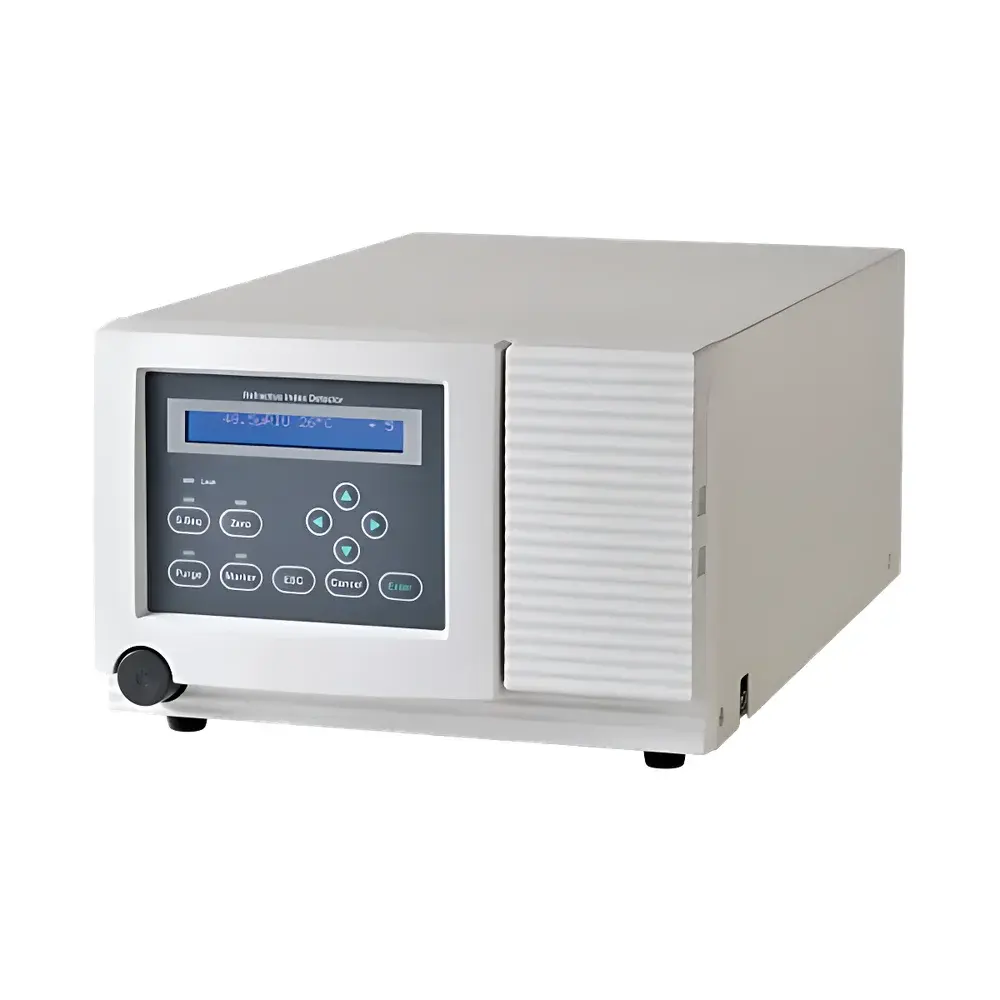
SUNNY HENGPING RI-500 Series Refractive Index Detector
| Brand | SUNNY HENGPING INSTRUMENT |
|---|---|
| Origin | Japan |
| Manufacturer Type | Original Equipment Manufacturer (OEM) |
| Product Category | Imported Instrument |
| Model | RI-500 Series |
| Detector Type | Refractive Index Detector (RID) |
| Compatible Systems | HPLC |
| Flow Cell Volume | 2.5–8 µL |
| Linear Range | 600–6000 µRIU |
| Noise | 2.5–5 nRIU (H₂O, 1.5 s response) |
| Drift | 0.2–2 µRIU/h |
| Response Time | 0.1–6 s (adjustable) |
| Temperature Control | 30–55 °C (dual-zone) |
| Max Backpressure | 50 kPa |
| Interface | LAN |
| Power | AC 100–240 V ±10%, 50/60 Hz, 150 VA |
| Dimensions | 260 W × 420 D × 165 H mm |
| Weight | 12.5 kg |
Overview
The SUNNY HENGPING RI-500 Series Refractive Index Detector is a high-stability, universal concentration-sensitive detector engineered for integration with analytical and preparative high-performance liquid chromatography (HPLC) systems. Operating on the principle of differential refractometry, the RI-500 measures minute changes in the refractive index of the mobile phase as analytes elute—enabling detection of compounds lacking chromophores or electrochemical activity, such as carbohydrates, polymers, lipids, and small organic molecules. Unlike UV-Vis or fluorescence detectors, refractive index detection requires no derivatization and delivers consistent response factors across chemically diverse solutes, making it indispensable for quantitative analysis in quality control, polymer characterization, and natural product isolation workflows. The detector’s dual-zone temperature control system actively regulates both the flow cell and optical block independently, minimizing thermal gradients and reducing thermal equilibration time by up to 40% compared to single-zone designs—critical for baseline stability during long-gradient or low-flow separations.
Key Features
- Dual-zone thermostatic control (30–55 °C) with independent PID regulation for flow cell and optics housing, ensuring <0.01 °C thermal stability and mitigating baseline drift during extended runs.
- Electromagnetic valve protection circuitry safeguards the optical path from pressure surges and solvent shock, extending optical alignment longevity and reducing recalibration frequency.
- Integrated leak sensor with real-time monitoring triggers automatic pump shutdown upon fluid detection—preventing solvent ingress into electronics and supporting GLP-compliant operational safety protocols.
- Modular flow cell architecture: three interchangeable configurations (RI-501 analytical, RI-502 semi-preparative, RI-504 microbore) with flow cell volumes of 8 µL, 8 µL, and 2.5 µL respectively—optimized for sensitivity, peak capacity, and system dead volume constraints.
- Full-range auto-zero functionality with programmable zero intervals; supports external zero/purge signal input and READY/LEAK/ERROR status outputs for seamless integration into automated HPLC platforms.
- Laboratory-grade analog outputs (0–10 mV recorder, 0–1 V integrator) and digital LAN interface compliant with IEEE 802.3 for remote configuration, firmware updates, and audit-trail-enabled data logging.
Sample Compatibility & Compliance
The RI-500 Series is compatible with all common HPLC mobile phases—including aqueous buffers, acetonitrile, methanol, THF, and chlorinated solvents—provided refractive index differentials exceed instrument sensitivity thresholds (≥2.5 nRIU). It meets ISO 9001 manufacturing standards and conforms to IEC 61010-1 for electrical safety in laboratory environments. Its analog output architecture supports compliance with FDA 21 CFR Part 11 when paired with validated chromatography data systems (CDS) that implement electronic signatures, audit trails, and user access controls. The detector’s passive optical design eliminates need for lamp replacement or wavelength calibration—reducing maintenance overhead and enhancing method transfer reproducibility across laboratories.
Software & Data Management
While the RI-500 operates as a standalone analog detector, its LAN interface enables bidirectional communication with modern CDS platforms (e.g., Waters Empower, Thermo Chromeleon, Agilent OpenLab). Firmware supports configurable sampling rates (up to 20 Hz), time-stamped event logging (zero, purge, leak alerts), and non-volatile storage of calibration parameters and operational history. All status signals (READY, LEAK, ERROR) are timestamped and exportable as CSV metadata—facilitating root-cause analysis during deviation investigations. Audit trail records include operator ID, parameter changes, and system state transitions—fully traceable for GMP/GLP audits.
Applications
- Quantitative analysis of sucrose, lactose, and oligosaccharides in food and beverage QC per AOAC 982.27 and ISO 16654.
- Molecular weight distribution profiling of polyethylene glycol (PEG), polylactic acid (PLA), and other synthetic polymers via SEC/GPC.
- Stability-indicating assays for non-UV-absorbing excipients in pharmaceutical formulations (ICH Q5C).
- Process monitoring of fermentation broths and biopolymer synthesis where UV transparency limits alternative detection.
- Method development support for gradient HILIC and normal-phase LC where universal detection is required.
FAQ
What is the minimum detectable refractive index change (RIU) under standard operating conditions?
The noise level is specified as 2.5 nRIU (RI-501/RI-502) and 5 nRIU (RI-504) in pure water at 1.5 s response time, corresponding to a theoretical detection limit of ~10 ng on-column for typical solutes under optimized flow conditions.
Can the RI-500 be used with UHPLC systems operating above 600 bar?
No—the maximum backpressure rating is 50 kPa (0.5 bar); it is designed exclusively for conventional HPLC and low-pressure preparative systems. Use with UHPLC requires an intermediate pressure-reduction interface.
Is temperature calibration traceable to NIST standards?
Yes—factory calibration includes traceable verification against NIST-traceable liquid-in-glass thermometers; users may perform field verification using certified reference fluids (e.g., sucrose solutions of known RI at defined temperatures).
Does the detector support real-time baseline correction algorithms?
No—baseline correction is performed externally in the data system; the RI-500 delivers raw, unprocessed analog voltage proportional to ΔnD, preserving full dynamic range and avoiding algorithm-induced artifacts.
How often is recalibration recommended?
Annual calibration is recommended for GLP environments; however, routine verification using a stable reference solvent (e.g., 5% ethanol in water) before each analytical sequence satisfies most ISO/IEC 17025 QA requirements.
Related Products





