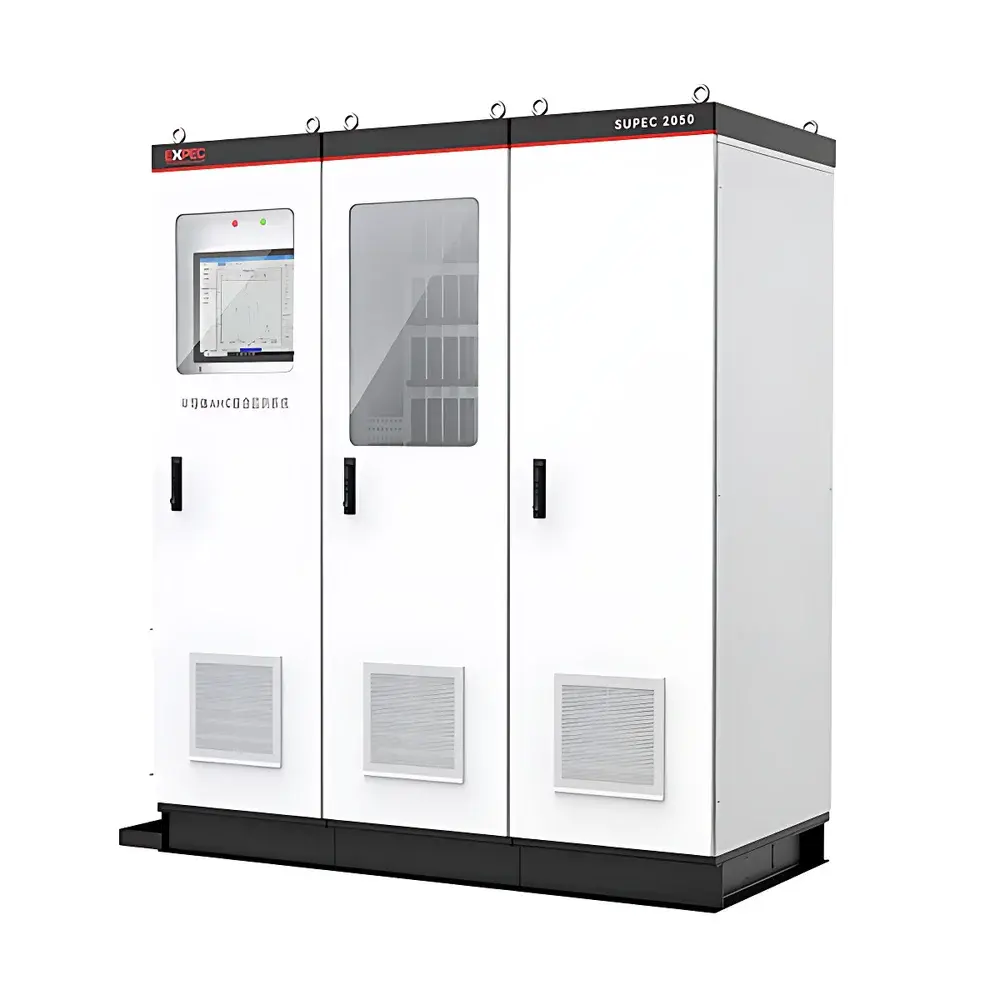
SUPEC 2050 AMC Integrated Monitoring System
| Brand | EXPEC |
|---|---|
| Origin | Zhejiang, China |
| Manufacturer Type | Original Equipment Manufacturer (OEM) |
| Country of Origin | China |
| Model | SUPEC 2050 |
| Price | Contact for Quotation |
Overview
The SUPEC 2050 AMC Integrated Monitoring System is an engineered solution for real-time, multi-point airborne molecular contamination (AMC) surveillance in semiconductor fabrication environments. Designed in accordance with ISO 14644-8 and SEMI F21 guidelines, the system employs a distributed sampling architecture coupled with modular analytical instrumentation to quantify trace-level gaseous contaminants—including acids (e.g., HCl, HF), bases (e.g., NH₃, amines), condensables (e.g., siloxanes, phthalates), and dopants (e.g., BCl₃, PH₃)—at sub-part-per-trillion (pptv) detection thresholds. Its core measurement methodology integrates timed sequential sampling via pressure-controlled pneumatic valving, inertial flow management, and analyte-specific detection modules (e.g., ion mobility spectrometry, tunable diode laser absorption spectroscopy, or GC-MS interfaces), ensuring metrological traceability and minimal cross-contamination across sampling channels.
Key Features
- Distributed multi-channel sampling architecture supporting up to 200 spatially discrete monitoring points within a single system configuration.
- Integrated pre-pumping function reducing transport delay and dead volume effects—achieving <60-second cycle time per channel under standard 30-m tubing layout.
- Modular gas analysis subsystem: configurable with interchangeable analytical modules (e.g., IMS for reactive species, TDLAS for NH₃/HF, PID for VOCs) to match site-specific contaminant profiles.
- Automated in-line purge and reverse-blow functionality per sampling line, minimizing carryover and ensuring <0.5% residual contamination between sequential samples (validated per ASTM D7922-19).
- On-demand auto-sampling trigger: activates SUMMA canister-based retention upon real-time exceedance of user-defined AMC thresholds, preserving evidentiary integrity for root-cause analysis.
- Embedded calibration verification unit with NIST-traceable permeation sources and zero-air generator, enabling automated daily drift correction and compliance with ISO/IEC 17025 internal quality control requirements.
Sample Compatibility & Compliance
The SUPEC 2050 accommodates a broad range of sample matrices encountered in cleanroom air handling systems, including recirculated and make-up air streams, point-of-use tool exhausts, and critical zone ambient air. All wetted materials (e.g., PFA-lined tubing, electropolished stainless-steel manifolds, quartz-fused silica filters) conform to SEMI F57 specifications for low-outgassing performance. The system supports audit-ready data logging compliant with FDA 21 CFR Part 11 (electronic signatures, audit trails, role-based access control) and aligns with GLP/GMP documentation standards for qualification protocols (IQ/OQ/PQ). Calibration records, maintenance logs, and raw spectral chromatograms are stored with immutable timestamps and cryptographic hash verification.
Software & Data Management
The embedded EXPEC AMC Manager v4.x software provides centralized configuration, real-time visualization, and trend analytics through a web-accessible interface (HTTPS/TLS 1.2). It supports OPC UA integration for bidirectional communication with factory MES and SCADA platforms. All measurement data—including raw detector signals, calculated concentrations, system diagnostics, and calibration status—is timestamped, geotagged (per channel ID), and exported in ASTM E2917-compliant CSV or XML formats. Automated report generation includes daily summary dashboards, excursion alerts with contextual metadata, and long-term statistical process control (SPC) charts (X-bar/R, CUSUM) aligned with semiconductor industry SPC benchmarks.
Applications
- Continuous AMC surveillance in photolithography zones (e.g., track tools, steppers, EUV scanner environments) where base contaminants induce pattern collapse or acid-induced resist degradation.
- Monitoring of chemical delivery systems (CDS) and bulk gas cabinets for trace impurity ingress during high-purity nitrogen, argon, or specialty gas distribution.
- Qualification and routine verification of AMC filtration media (e.g., activated carbon, impregnated alumina, chemisorbent cartridges) via challenge testing and breakthrough curve analysis.
- Root-cause investigation of yield excursions linked to airborne contamination events, supported by time-synchronized SUMMA canister archival and off-line GC-MS confirmation.
- Supporting ISO 14644-8 Annex D compliance reporting for Class 1–5 cleanrooms in advanced packaging and 3D NAND/Fab-lite facilities.
FAQ
What analytical techniques are supported by the gas monitoring subsystem?
The system accepts plug-in modules based on ion mobility spectrometry (IMS), tunable diode laser absorption spectroscopy (TDLAS), photoionization detection (PID), and interfaced gas chromatography–mass spectrometry (GC-MS); module selection is determined during system specification.
Does the SUPEC 2050 support remote diagnostics and firmware updates?
Yes—via secure TLS-encrypted SSH and HTTPS interfaces; remote access requires two-factor authentication and adheres to IEC 62443-3-3 SL2 cybersecurity controls.
Can the system integrate with existing facility BAS or MES platforms?
It supports native OPC UA, Modbus TCP, and MQTT 3.1.1 protocols; custom API wrappers (REST/JSON) are available for legacy SCADA systems.
Is validation documentation provided for GMP-regulated environments?
Full IQ/OQ documentation packages—including test scripts, acceptance criteria, and executed reports—are delivered with each installation; PQ support is available upon request.
What is the recommended calibration frequency for long-term stability?
Daily automated zero/span verification using internal standards; full multi-point calibration every 30 days or after maintenance, per ISO/IEC 17025 Clause 7.7 requirements.