
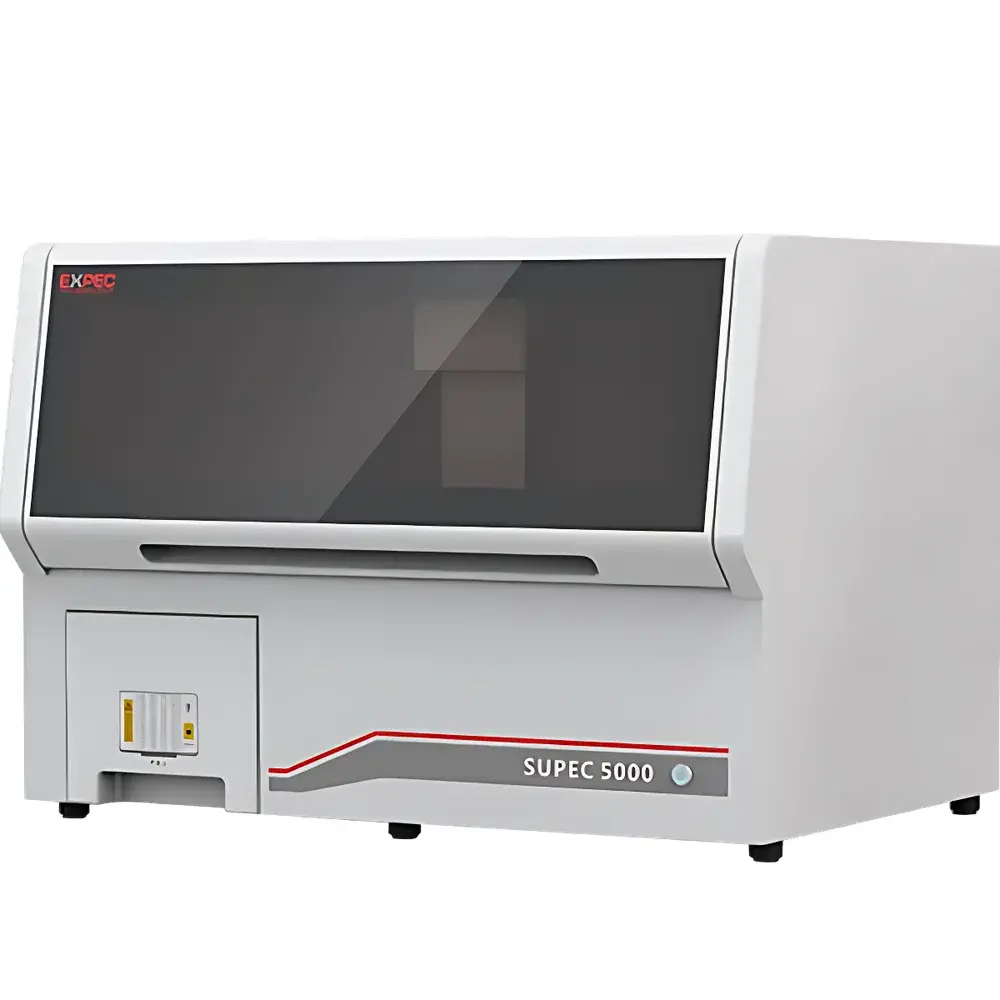
SUPEC 5000A Automated Permanganate Index Analyzer
| Brand | 1124123/13213112 |
|---|---|
| Origin | Jiangsu, China |
| Manufacturer Type | General Distributor |
| Product Category | Domestic |
| Model | SUPEC 5000A |
| Pricing | Upon Request |
| Measurement Principle | Potassium Permanganate Oxidation with ORP Endpoint Detection |
| Instrument Type | Laboratory Benchtop Analyzer |
Overview
The SUPEC 5000A Automated Permanganate Index Analyzer is a fully integrated laboratory instrument engineered for precise, reproducible determination of the permanganate index (CODMn) in water samples according to standardized oxidative titration methodology. It implements the classical hot-water bath digestion–potassium permanganate titration principle, where organic matter in acidic or neutral aqueous matrices is oxidized by KMnO4 under controlled thermal conditions (boiling water bath at ~100 °C), followed by back-titration with standardized sodium oxalate solution. Endpoint detection is achieved via potentiometric monitoring of oxidation-reduction potential (ORP), ensuring objective, operator-independent termination of titration. Designed exclusively for laboratory use, the SUPEC 5000A eliminates manual handling of boiling reagents and high-temperature glassware while maintaining strict compliance with Chinese national standards including GB 11892–1989 (Determination of Permanganate Index in Water), GB/T 5750.7–2023 (Standard Methods for Examination of Drinking Water – Organic Comprehensive Indicators), and the Operational Guidelines for the National Surface Water Environmental Quality Monitoring Network.
Key Features
- Automated boiling water bath digestion system with programmable fill/drain cycles, real-time water level sensing, and dry-run protection—ensuring consistent oxidation efficiency per GB 11892 requirements.
- Multi-position independent digestion blocks enabling parallel processing of up to 12 samples per batch without cross-contamination or thermal interference.
- High-temperature-rated robotic arm with precision positioning (<±0.2 mm repeatability) for safe transfer of sample cups between digestion, cooling, and titration stations—even at temperatures exceeding 95 °C.
- Intelligent thermostatic titration module maintaining reaction temperature within 70–80 °C during titration, critical for kinetic stability and endpoint sharpness in acidic KMnO4 titrations.
- Micro-syringe pump-based reagent delivery with volumetric accuracy ≤±0.2% RSD and resolution of 0.01 mL, supporting both forward and back-titration protocols.
- Computer-vision endpoint recognition system calibrated against reference ORP profiles; records full HD video of each titration sequence for auditability and troubleshooting.
- Modular multi-channel reagent injection architecture with physically isolated fluid paths—eliminating carryover and ensuring reagent integrity across sequential analyses.
- Drawer-style removable sample tray with ergonomic handle and locking mechanism, allowing rapid batch loading/unloading while minimizing exposure to ambient particulates.
- Sealed cabin enclosure with interlocked access door, preventing dust ingress and maintaining environmental stability during analysis—critical for low-conductivity or low-ionic-strength samples.
Sample Compatibility & Compliance
The SUPEC 5000A accommodates standard 100 mL borosilicate glass sample cups and accepts liquid samples with turbidity ≤10 NTU and suspended solids <50 mg/L (pre-filtration recommended per GB 11892). It supports both acidic (H2SO4-mediated) and neutral digestion modes. All operational parameters—including digestion time (30 min ± 0.5 min), titration temperature control, reagent concentration validation, and endpoint threshold (ΔE/ΔV ≥ 15 mV/mL) —are configurable and logged with timestamped metadata. The system supports GLP-compliant operation through electronic audit trails, user-access controls, and data immutability features aligned with ISO/IEC 17025:2017 clause 7.5 and CNAS-CL01-A002:2023 requirements for automated analytical instruments.
Software & Data Management
Controlled via a dedicated Windows-based application with dual-mode interface (guided workflow and expert mode), the software enables method creation, calibration curve management, QC sample scheduling, and automatic report generation in PDF/CSV formats. All raw sensor data (ORP mV vs. volume, temperature logs, pump actuation events) are stored in encrypted SQLite databases with SHA-256 hash verification. Audit trail functionality records every user action—including login/logout, parameter modification, and result approval—with IP address, workstation ID, and digital signature. Data export complies with LIMS integration protocols (ASTM E1467, HL7 v2.x) and satisfies basic FDA 21 CFR Part 11 readiness when deployed with validated Windows domain authentication and time-server synchronization.
Applications
The SUPEC 5000A is routinely deployed in municipal drinking water quality laboratories, provincial environmental monitoring centers, and third-party testing facilities accredited to CNAS. Primary applications include routine surveillance of surface water (rivers, lakes, reservoirs), groundwater abstraction points, and finished drinking water distribution systems. It is also applied in source water vulnerability assessments, wastewater treatment plant influent/effluent monitoring, and regulatory reporting under China’s “Blue Sky and Clear Water Protection Campaign” framework. Its robust design supports long-term unattended operation in high-throughput labs performing >50 CODMn determinations per day.
FAQ
Does the SUPEC 5000A support both acidic and neutral permanganate index methods?
Yes—it provides selectable digestion modes aligned with Sections 4.1 (acidic) and 4.2 (neutral) of GB 11892–1989, with independent reagent dispensing and thermal profiles for each.
Can the system be validated for ISO/IEC 17025 accreditation?
Yes—its hardware traceability (NIST-traceable temperature and volume calibrations), software audit trail, and documented IQ/OQ protocols meet minimum requirements for method validation under Clause 7.7 of ISO/IEC 17025:2017.
What maintenance intervals are recommended for long-term reliability?
Daily: rinse lines and check water bath level; Quarterly: replace digestion block gaskets and recalibrate ORP electrode; Annually: full syringe pump service and vision system alignment verification.
Is remote monitoring or troubleshooting supported?
Yes—the embedded industrial controller supports secure TLS 1.2 VPN access for diagnostics and firmware updates, subject to on-site network policy configuration.
How does the system handle samples with high chloride interference?
Per GB 11892, chloride correction is performed manually post-analysis using the recorded titrant consumption and measured Cl− concentration; the instrument does not perform automatic chloride compensation but flags potential interference based on blank deviation thresholds.
Related Products







