
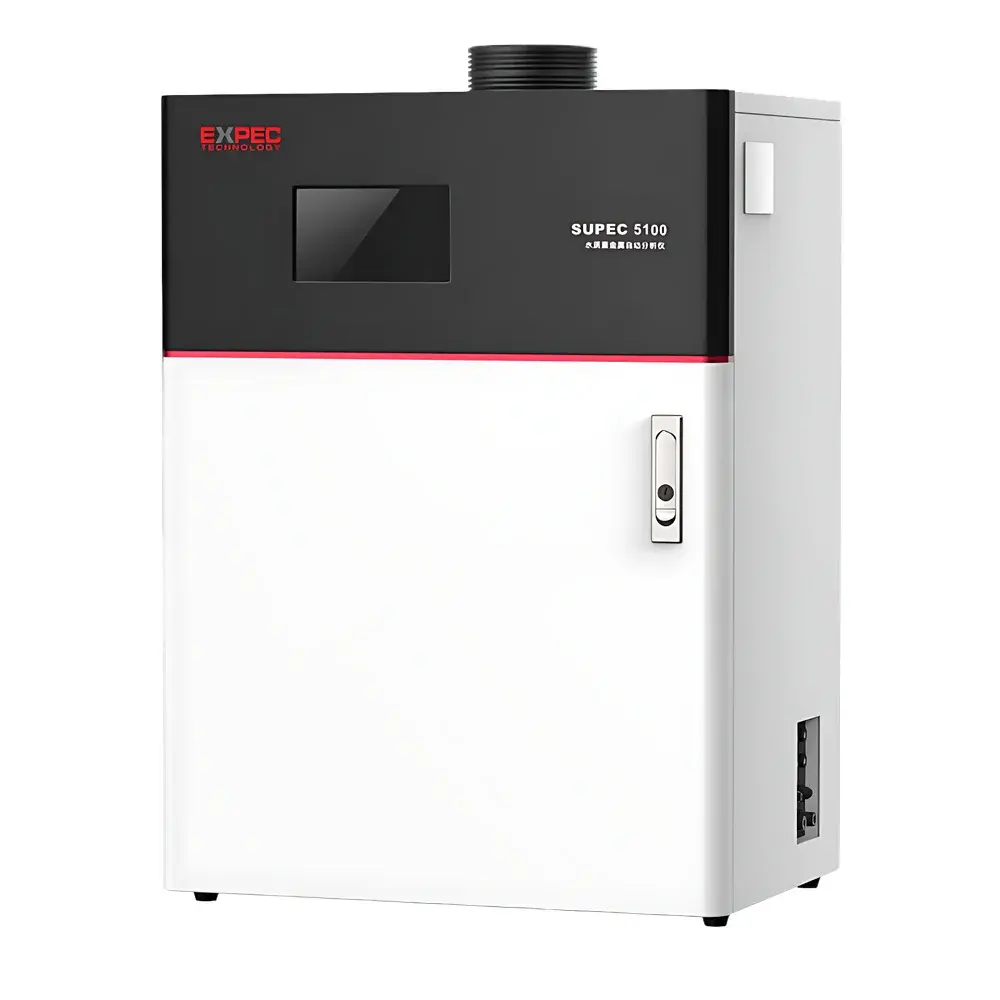
SUPEC 5100 ICP-OES Heavy Metals Online Water Analyzer
| Brand | EXPEC |
|---|---|
| Origin | Zhejiang, China |
| Model | SUPEC 5100 ICP-OES |
| Detection Principle | Inductively Coupled Plasma Optical Emission Spectrometry (ICP-OES) |
| Instrument Type | Online Analyzer |
| Target Elements | Thallium (Tl), Antimony (Sb), and other regulated heavy metals in water |
| Compliance Basis | Aligns with laboratory-standard methods per ISO 17294-2, EPA Method 200.7, and GB/T 3049–2022 |
| Automation Level | Fully automated sample introduction, digestion (if integrated), nebulization, plasma excitation, spectral acquisition, background correction, QC calibration, data validation, and remote telemetry |
Overview
The SUPEC 5100 ICP-OES Heavy Metals Online Water Analyzer is an industrial-grade, fully automated elemental analyzer engineered for continuous, unattended monitoring of regulated heavy metals—including thallium (Tl), antimony (Sb), arsenic (As), cadmium (Cd), chromium (Cr), copper (Cu), lead (Pb), nickel (Ni), and zinc (Zn)—in surface water, groundwater, wastewater effluents, and drinking water distribution systems. Unlike conventional atomic absorption or colorimetric online sensors, the SUPEC 5100 implements true laboratory-grade Inductively Coupled Plasma Optical Emission Spectrometry (ICP-OES) in a field-deployable architecture. It integrates a stabilized RF generator, robust axial-viewing polychromator with solid-state CCD detector, high-efficiency concentric nebulizer, and cyclonic spray chamber—all optimized for low-volume aqueous sample introduction without pre-concentration. The system operates on the fundamental principle of plasma-induced atomic excitation followed by wavelength-resolved emission detection, enabling simultaneous multi-element quantification with matrix-tolerant spectral resolution and inherent internal standard capability.
Key Features
- Fully autonomous operation: Integrated peristaltic sampling pump, precision syringe-driven sample metering (±0.5% volumetric accuracy), reagent auto-dosing, real-time spectral background correction (using adjacent pixel interpolation), and external QC standard verification at user-defined intervals (e.g., every 6 or 12 analyses)
- Low detection capability: Achieves sub-μg/L (pptr) detection limits for Tl and Sb—well below WHO and EU Drinking Water Directive thresholds—through optimized plasma viewing geometry, reduced spectral interferences, and signal averaging over multiple RF cycles
- Field-hardened mechanical design: Compact monolithic optical bench with shock-absorbing elastomeric mounts; thermal insulation jacket maintains ±2 °C internal temperature stability across −10 °C to +45 °C ambient range—validated for fixed water-quality stations and mobile laboratory vehicles
- Intelligent diagnostics engine: Continuous monitoring of carrier gas pressure (Ar), nebulizer gas flow (0.7–1.2 L/min), coolant water temperature, reagent reservoir levels, and plasma ignition status; triggers SNMP/Modbus alerts upon deviation beyond configurable thresholds
- Power resilience architecture: Optional battery-backed DC-AC inverter module supplies transient peak power (>5 kW) during graphite furnace-assisted sample introduction (when configured for hybrid ICP-OES/GF-AAS mode), eliminating dependency on dedicated 3-phase utility supply
Sample Compatibility & Compliance
The SUPEC 5100 accepts raw or filtered (≤0.45 µm) water samples with total dissolved solids (TDS) ≤2000 mg/L and suspended solids <5 mg/L. Acid preservation (HNO₃ to pH <2) is recommended prior to analysis. It complies with method validation requirements under ISO/IEC 17025:2017 for routine environmental testing laboratories and supports audit-ready data integrity features including electronic signatures, time-stamped audit trails, and 21 CFR Part 11–compliant user access controls when deployed with EXPEC’s certified firmware version 3.2+. All calibration curves are traceable to NIST SRM 3182 (Multi-Element Aqueous Standard) and verified against certified reference materials (CRMs) such as BCR-614 (River Water) and NIST SRM 1643f (Trace Elements in Natural Water).
Software & Data Management
Control and data handling are managed via EXPEC AquaLink™ v4.1—a Windows-based SCADA platform supporting OPC UA, MQTT, and FTP(S) protocols for seamless integration into central EMS or LIMS environments. Raw spectral data (intensity vs. wavelength), processed concentration tables, QC flag logs, instrument health metrics, and alarm histories are stored locally on encrypted SSD with automatic cloud backup (AWS S3 or private NAS). Software enforces ALCOA+ principles: Attributable, Legible, Contemporaneous, Original, Accurate, Complete, Consistent, Enduring, and Available—ensuring full compliance with GLP and GMP-aligned environmental monitoring programs.
Applications
- Real-time regulatory compliance monitoring at municipal intake points and wastewater treatment plant outfalls
- Early-warning detection of industrial discharge events (e.g., mining leachate, electroplating runoff)
- Mobile emergency response: Rapid deployment aboard environmental surveillance vessels or mobile labs during spill incidents
- Long-term trend analysis in watershed management programs requiring high-temporal-resolution metal speciation data
- Support for ISO 5667-3 and ASTM D1688-compliant sampling campaigns through synchronized auto-sampling and lab-parallel reporting
FAQ
Does the SUPEC 5100 require daily manual intervention?
No—once commissioned, it operates continuously for ≥30 days without operator input, including automatic recalibration, drift correction, and waste fluid disposal.
Can it analyze seawater or high-salinity brines?
Not without optional desalination pretreatment; the standard configuration is validated for freshwater matrices per ISO 17294-2 Annex B.
Is method validation documentation provided?
Yes—each unit ships with a Factory Acceptance Test (FAT) report, Method Validation Summary per ISO 17025 Clause 7.2.2, and Certificate of Conformance to GB/T 3049–2022.
What maintenance intervals are recommended?
Nebulizer cleaning every 72 hours; torch inspection every 30 days; spectrometer wavelength calibration every 90 days—fully guided via onboard diagnostic interface.
How is data security ensured during remote transmission?
All telemetry uses TLS 1.3 encryption; local storage employs AES-256 full-disk encryption; role-based access control (RBAC) restricts configuration changes to authorized personnel only.







